China Proposes Expanding CPEC to Afghanistan
Source:The Hindu ↗
Why It Matters
The China-Pakistan-Taliban trilateral nexus and the proposed extension of CPEC into Afghanistan directly challenge India's strategic, economic, and security interests in the region. Understanding China's growing footprint via BRI/CPEC and its evolving relationship with the Taliban is critical for answers on regional geopolitics, border sovereignty (PoK), and India's neighborhood policy.
Summary
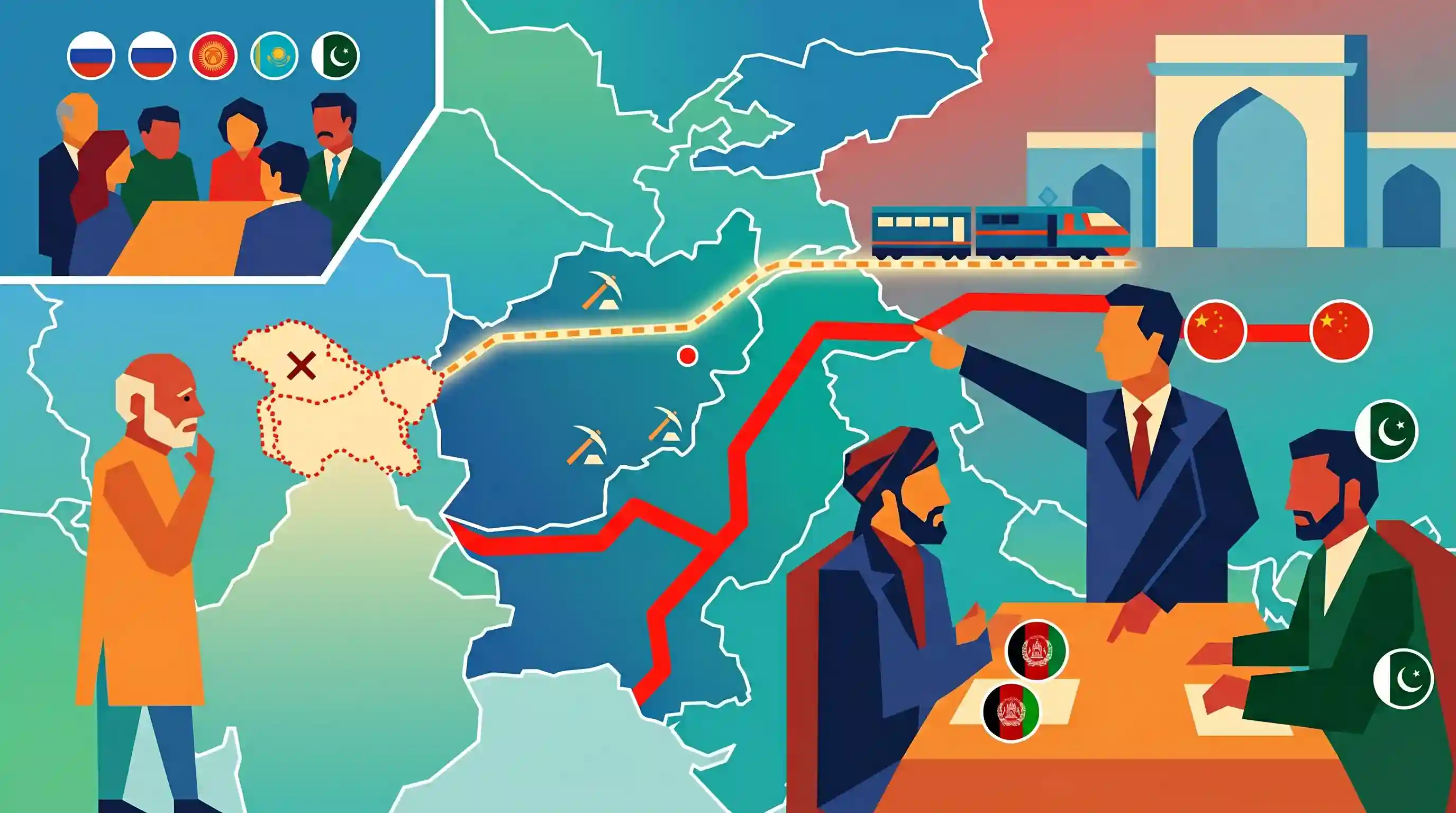
The fifth China-Afghanistan-Pakistan trilateral dialogue was held in Kabul, emphasizing regional connectivity and economic integration under the Belt and Road Initiative (BRI). China's Foreign Minister Wang Yi proposed formally incorporating Afghanistan into the China-Pakistan Economic Corridor (CPEC) and enhancing cross-border infrastructure, including a railway linking Central Asia and Pakistan via Afghanistan. This trilateral synergy poses significant geopolitical concerns for India, which staunchly opposes CPEC for violating its sovereignty in Pakistan-occupied Kashmir (PoK). Furthermore, China’s proactive engagement points toward solidifying a strategic footprint in Afghanistan to secure mining interests and deepen regional hegemony, particularly preceding key summits like the Shanghai Cooperation Organisation (SCO).
Key Points
- China held a trilateral dialogue with Pakistan and the Taliban in Kabul, marking the 5th such dialogue with a focus on regional economic integration.
- China formally invited Taliban-ruled Afghanistan to join the Belt and Road Initiative (BRI) as an extension of the China-Pakistan Economic Corridor (CPEC).
- Discussions explored infrastructure projects like a railway line linking Central Asia to Pakistan through Afghanistan, expanding China's strategic influence.
- India opposes CPEC and BRI as the corridor traverses Pakistan-occupied Kashmir (PoK), thus violating Indian territorial sovereignty.
- The meeting occurred in Kabul because UN sanctions barred Taliban acting Foreign Minister Muttaqi from traveling to Islamabad.
- China's engagement with the Taliban seeks to normalize relations, tap into Afghanistan's mining resources, and bolster regional connectivity via mechanisms like the SCO.
Important Terms
Belt and Road Initiative (BRI)

A multi-billion dollar global infrastructure project launched by China in 2013 to enhance regional connectivity across Asia, Africa, and Europe through land and sea routes.
UPSC context
GS Paper II: International Relations. Key for understanding India's sovereignty concerns and China's expanding regional influence.
China-Pakistan Economic Corridor (CPEC)
A flagship BRI project consisting of a ~3,000 km network of infrastructure linking China's Xinjiang region to Pakistan's Gwadar Port via Pakistan-occupied Kashmir.
UPSC context
GS Paper II: Bilateral Relations. Tests knowledge of India's territorial integrity and strategic encirclement concerns.
Taliban
An Islamist fundamentalist group that has functioned as the de-facto administration of Afghanistan since August 2021, currently seeking international recognition and economic aid.
UPSC context
GS Paper II: Neighborhood Relations. Important for India's 'engagement without recognition' policy and regional security.
Shanghai Cooperation Organisation (SCO)
A Eurasian political, economic, and security alliance founded in 2001, focusing on regional stability and counter-terrorism through its Regional Anti-Terrorist Structure (RATS).
UPSC context
GS Paper II: Regional Groupings. Significant for India's outreach to Central Asia and cooperation on regional security.
Haqqani Network
A semi-autonomous Islamist insurgent group that is a key component of the Taliban government, known for its strategic ties with Pakistan's security establishment.
UPSC context
GS Paper III: Security Challenges. Tests understanding of cross-border terrorism and threats to India’s assets in Afghanistan.
Pakistan-occupied Kashmir (PoK)
Territory of the former princely state of Jammu and Kashmir currently under Pakistan's administration, which India claims as an integral part of its sovereign territory.
UPSC context
GS Paper II: Governance and International Relations. Central to India's opposition to CPEC and historical border disputes.
Prelims Trap
"Afghanistan is a full member of the Shanghai Cooperation Organisation (SCO)."
Aspirants often confuse heavy Chinese and regional diplomatic engagement with formal institutional membership. Afghanistan holds only observer status in the SCO.
Static Concepts Connected
What is the China-Pakistan Economic Corridor (CPEC) and why does India oppose it?
- Route: A flagship BRI project connecting China's landlocked Xinjiang region to Pakistan's Gwadar Port on the Arabian Sea.
- Sovereignty Issue: India staunchly opposes the project because it passes through Gilgit-Baltistan in Pakistan-occupied Kashmir (PoK), violating Indian territorial sovereignty.
- Strategic Threat: It gives China direct access to the Indian Ocean, bypassing the congested Malacca Strait and amplifying India's maritime security threats.
What is the Shanghai Cooperation Organisation (SCO) and its security mandate?
- Formation & Expansion: An intergovernmental alliance created in 2001 by China, Russia, Kazakhstan, Kyrgyzstan, Tajikistan, and Uzbekistan. India and Pakistan joined in 2017.
- RATS Mandate: The Regional Anti-Terrorist Structure (RATS), headquartered in Tashkent, is the permanent organ of the SCO designed to combat terrorism, separatism, and extremism.
- Afghanistan's Status: Afghanistan is not a full member but holds observer status, though its participation has been effectively frozen since the 2021 Taliban takeover.
Cross-Topic Patterns
CPEC extension vs. Chabahar strategy
China's push to integrate Afghanistan into CPEC directly challenges India's investments in Iran's Chabahar port, which was specifically designed to bypass Pakistan for Central Asian trade access.
Afghanistan's untapped critical minerals
China’s diplomatic normalization with the Taliban is largely driven by a strategic imperative to secure exclusive extraction rights to Afghanistan's vast, untapped critical mineral reserves like lithium and copper.
UNSC sanctions vs. regional realpolitik
Holding talks in Kabul due to UN travel bans on the Taliban FM highlights the growing friction between global UNSC terror designations and Chinese-led regional realpolitik.

Expect a 2026 question linking Afghanistan's integration into CPEC with India's Central Asia connect (Chabahar) and SCO dynamics.
Linked PYQs · 5
Linked PYQs · 5
- 2021MainsGS2
Critically examine the aims and objectives of SCO. What importance does it hold for India?
- 2023MainsGS2
‘Virus of Conflict is affecting the functioning of the SCO’ In the light of the above statement point out the role of India in mitigating the problems.
- 2024MainsGS2
‘The West is fostering India as an alternative to reduce dependence on China's supply chain and as a strategic ally to counter China's political and economic dominance.’ Explain this statement with examples.
- 2022PrelimsGS1
Consider the following: 1. Asian Infrastructure Investment Bank 2. Missile Technology Control Regime 3. Shanghai Cooperation Organisation India is a member of which of the above?
- 2022PrelimsGS1
Consider the following countries: 1. Azerbaijan 2. Kyrgyzstan 3. Tajikistan 4. Turkmenistan 5. Uzbekistan Which of the above have borders with Afghanistan ?
