Bilateral Trade Negotiations and Tariff Protectionism Issues
Source:Indian Express ↗
Why It Matters
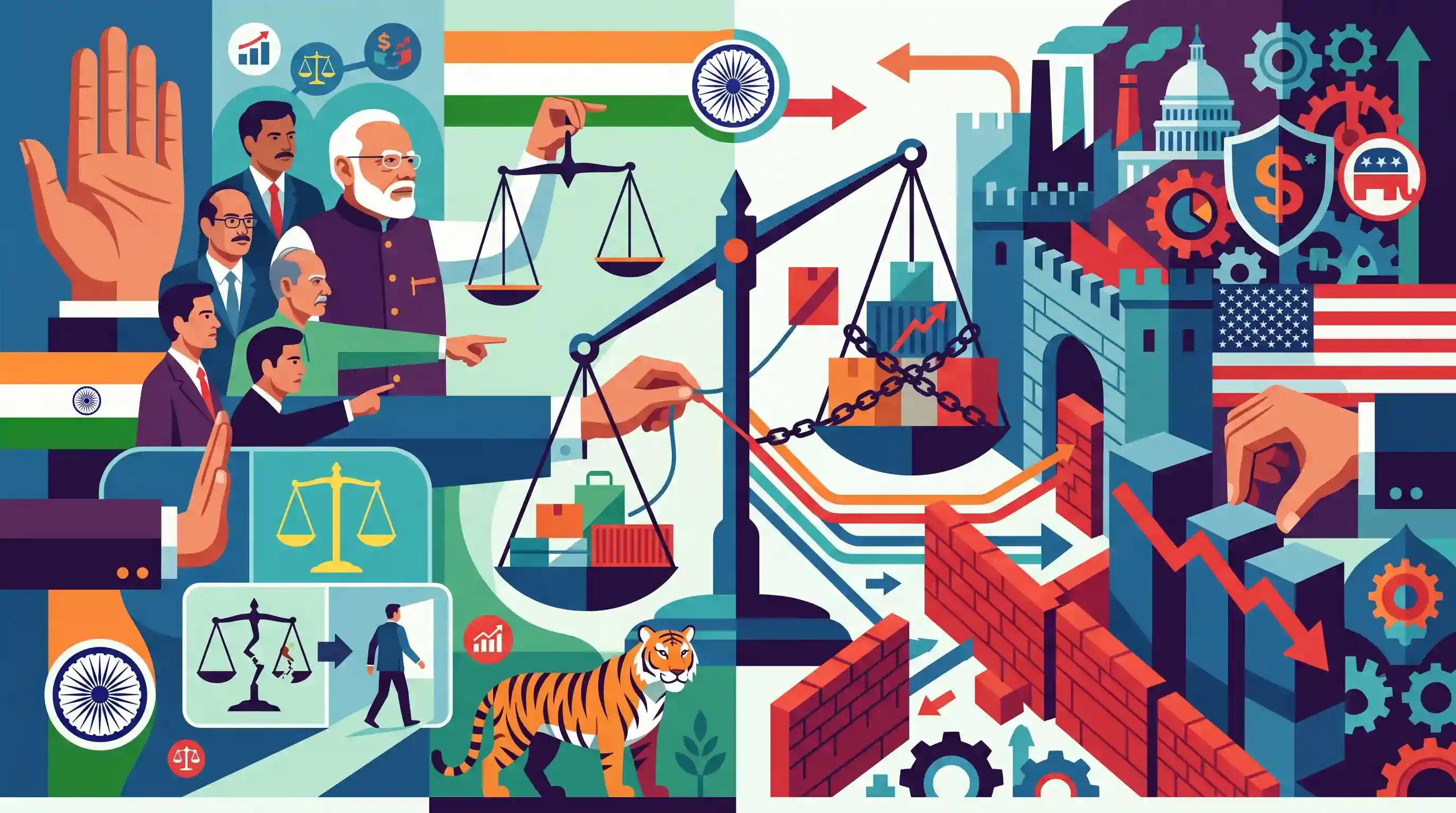
Demonstrates the strategic challenges India faces in negotiating Free Trade Agreements (FTAs) with developed nations, particularly when partner countries are constrained by domestic protectionist policies. It underscores the importance of reciprocal market access in international diplomacy and trade.
Summary
A group of former officials and trade experts have advised the Indian government to adopt a firm stance in ongoing trade negotiations with the United States. They warned that domestic constraints and an increasingly protectionist trade policy might prevent the US from offering reciprocal tariff reductions. Consequently, they urged the government to ensure any Free Trade Agreement provides equitable market access and to be prepared to walk away from the deal if it proves to be lopsided against India's economic interests.
Key Points
- Former trade officials and experts have cautioned the Indian government against accepting a disadvantageous trade agreement with the United States.
- They highlighted that the US may be unable to offer reciprocal tariff cuts due to its own domestic protectionist policies and political constraints.
- The experts advised that India must prioritize equitable market access and be willing to walk away from negotiations if the deal is lopsided and fails to benefit Indian interests.
Important Terms
Free Trade Agreement (FTA)

A pact between two or more countries to reduce or eliminate trade barriers like tariffs and quotas, facilitating the flow of goods and services.
UPSC context
GS Paper II/III; tests trade diplomacy, economic integration, and India's strategic bilateral engagements.
Protectionism
Economic policies, such as tariffs or quotas, designed to restrict imports to shield domestic industries and workers from foreign competition.
UPSC context
GS Paper III; relevant for analyzing global trade shifts and their impact on India's macroeconomic stability.
Tariff
A tax or duty imposed by a government on imported goods, used to protect domestic industry and generate revenue.
UPSC context
GS Paper III; fundamental concept in international trade, export competitiveness, and fiscal policy.
Reciprocal Tariffs
A trade policy where a country matches the specific tariff levels or barriers imposed by a trading partner on its own exports.
UPSC context
GS Paper II/III; tests understanding of bilateral trade disputes and the 'level playing field' concept.
Market Access
The conditions, determined by a country's trade policies, under which foreign goods and services can enter its domestic market.
UPSC context
GS Paper III; critical for evaluating export-led growth and the outcomes of trade negotiations.
Prelims Trap
India currently has a comprehensive Free Trade Agreement (FTA) with the United States, its largest trading partner.
Despite the US being India's largest trading partner, the two nations do not have a formal Free Trade Agreement (FTA) or CEPA.
Static Concepts Connected
What differentiates a standard FTA from a CECA or CEPA?
- FTA Focus: Focuses primarily on reducing or eliminating customs duties (tariffs) on the trade of goods between partner nations.
- CECA/CEPA Scope: More comprehensive than FTAs; they encompass trade in services, investments, competition policies, and intellectual property rights alongside goods.
What are Non-Tariff Barriers (NTBs) in international trade?
- Definition: Trade restrictions used to limit imports without involving a direct tax or tariff (e.g., quotas, licensing).
- SPS & TBT: Include Sanitary and Phytosanitary (SPS) measures and Technical Barriers to Trade (TBT), heavily utilized by developed countries.
- Modern equivalents: Strict intellectual property rules, complex labor/environmental standards, and data localization mandates act as modern NTBs.
Cross-Topic Patterns
RCEP Exit + Strategic Autonomy in Trade
Walking away from the US trade deal mirrors India's 2019 RCEP withdrawal, highlighting a consistent policy of prioritizing domestic industry (Atmanirbhar Bharat) over asymmetric market access.
WTO Frictions + Non-Tariff Barriers (NTBs)
While tariff negotiations stall, India and the US frequently clash over non-tariff barriers, linking bilateral trade issues directly to broader WTO disputes over agricultural subsidies and intellectual property.

Mains 2026 will likely test India's strategy of rejecting asymmetric FTAs amidst rising Western protectionism and friend-shoring trends.
Linked PYQs · 4
Linked PYQs · 4
- 2025MainsGS3
What are the challenges before the Indian economy when the world is moving away from free trade and multilateralism to protectionism and bilateralism? How can these challenges be met?
- 2019MainsGS2
‘What introduces friction into the ties between India and the United States is that Washington is still unable to find for India a position in its global strategy, which would satisfy India's national self-esteem and ambitions.’ Explain with suitable examples.
- 2018PrelimsGS1
Consider the following countries: 1. Australia 2. Canada 3. China 4. India 5. Japan 6. USA Which of the above are among the 'free-trade partners' of ASEAN?
- 2018MainsGS3
How would the recent phenomena of protectionism and currency manipulations in world trade affect macroeconomic stability of India?
