W-Beam Fencing and Railway Safety Improvements on Vande Bharat Route
Source:Indian Express ↗
Why It Matters
Demonstrates a practical infrastructural solution to enhance railway safety, improve the operational efficiency of flagship semi-high-speed trains like Vande Bharat, and reduce animal fatalities. This case study is highly relevant for GS3 answers on modernizing Indian Railways and resolving challenges faced by linear infrastructure projects.
Summary
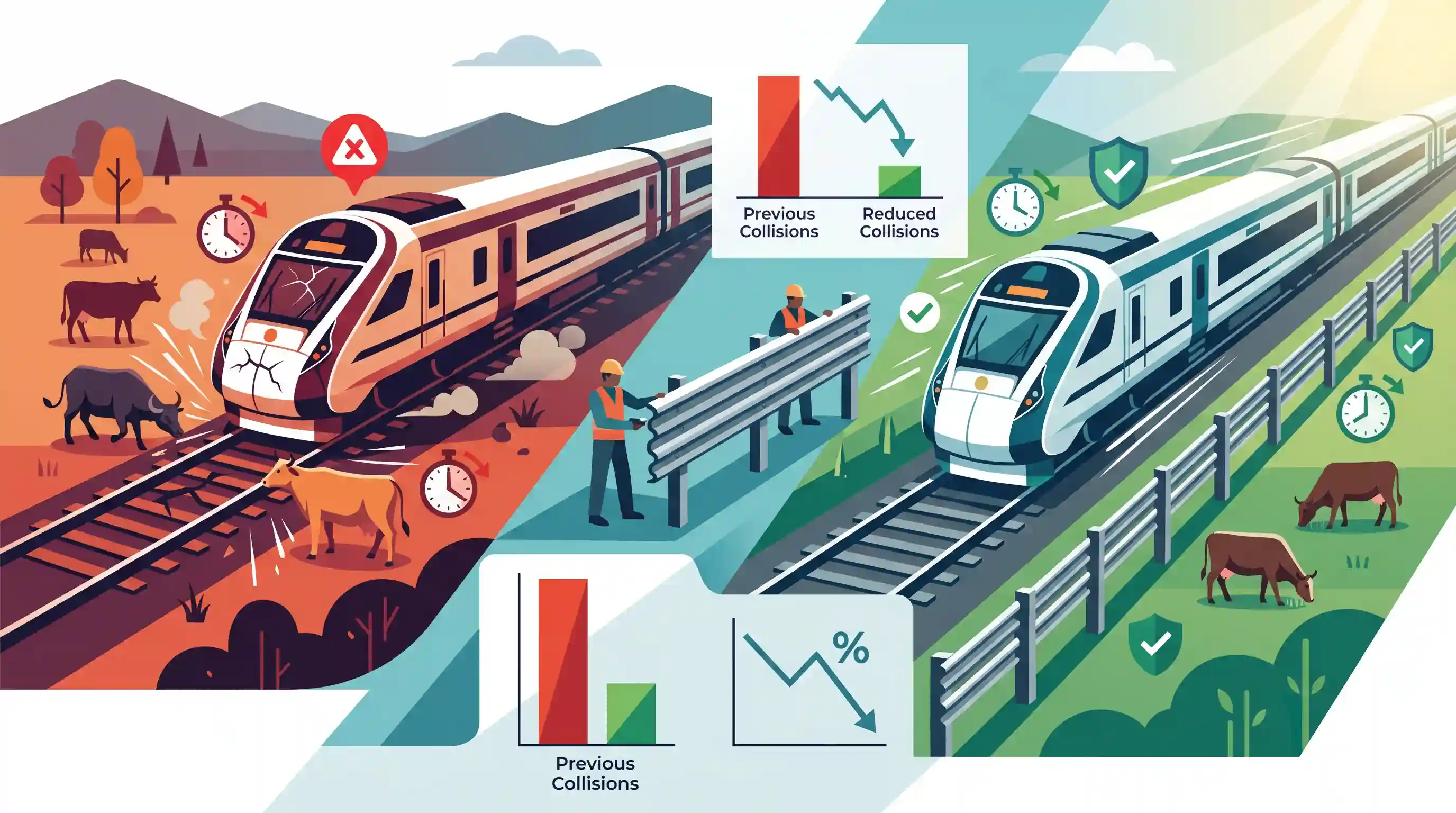
The article highlights a significant success in Indian Railways' safety measures on the Mumbai-Gandhinagar Vande Bharat route, where the installation of W-beam fencing has reduced cattle collisions by 81% over three years. Previously, frequent cattle run-overs caused costly damage to the train's aerodynamic nose and led to substantial operational delays. W-beam crash barriers, typically used on highways, provided a robust physical deterrent to prevent animals from straying onto tracks, ensuring smoother operations and enhanced safety for semi-high-speed rail networks.
Key Points
- The installation of W-beam fencing along the Mumbai-Gandhinagar railway route reduced cattle run-overs involving the Vande Bharat Express by 81% over three years.
- Cattle collisions previously caused extensive damage to the train's aerodynamic fiberglass nose and resulted in significant operational delays.
- W-beam fencing, commonly used as crash barriers on highways, serves as a strong physical deterrent to prevent livestock from straying onto high-speed rail tracks.
- The initiative highlights the necessity of upgrading track infrastructure to ensure the safety and punctuality of India's semi-high-speed rail network.
Important Terms
Vande Bharat Express

An indigenous semi-high-speed, self-propelled train set developed under 'Make in India.' It features aerodynamic design and integrated safety systems like Kavach.
UPSC context
GS Paper 3: Infrastructure; tests knowledge of indigenous manufacturing and railway modernization.
W-Beam Fencing
A semi-rigid metal crash barrier with a W-shaped profile, traditionally used on highways to absorb impact and redirect vehicles.
UPSC context
GS Paper 3: Infrastructure Safety; illustrates innovative engineering solutions for operational efficiency.
Cattle Run-Over (CRO)
Incidents where livestock stray onto tracks and are hit by trains, causing operational delays, financial loss, and safety risks like derailment.
UPSC context
GS Paper 3: Environment & Disaster Management; highlights challenges in human-animal-infrastructure conflict.
Kavach
An indigenous Automatic Train Protection (ATP) system designed to prevent collisions by automatically applying brakes if the pilot fails to react.
UPSC context
GS Paper 3: Science & Tech; tests awareness of home-grown safety technologies.
Railway Protection Force (RPF)
A statutory body under the Ministry of Railways tasked with protecting railway property, passengers, and track safety.
UPSC context
GS Paper 3: Internal Security; relevant for its role in infrastructure protection.
Mission Raftaar
An Indian Railways initiative aimed at increasing the average speed of freight and passenger trains to 50 kmph and 75 kmph respectively.
UPSC context
GS Paper 3: Infrastructure; focuses on throughput and logistics efficiency goals.
Prelims Trap
Vande Bharat trains rely on heavy front locomotives to withstand high-speed collisions with livestock.
Vande Bharat uses a 'distributed power' system without a central locomotive. Its lightweight, aerodynamic fiberglass nose makes leading coaches highly vulnerable to structural damage, making track fencing essential.
Static Concepts Connected
What are the core objectives of the National Rail Plan (NRP) for India?
- Capacity Creation: Create capacity ahead of demand by 2030, catering to future growth up to 2050.
- Freight Share: Increase the railway freight modal share from the current 27% to 45% to reduce logistics costs.
- Speed & Safety: Upgrade speeds to 160 kmph on Golden Quadrilateral corridors, necessitating elimination of level crossings and sturdy track fencing.
How does 'Distributed Power' technology in modern trainsets work?
- No Central Engine: Traction motors are distributed across multiple passenger coaches instead of relying on a single heavy hauling locomotive at the front.
- Rapid Acceleration: Enables faster acceleration and deceleration, significantly reducing overall travel time compared to locomotive-hauled trains.
- Energy Efficient: Lighter overall weight and regenerative braking save energy, but the lightweight front requires cleared tracks to prevent derailment upon impact.
Cross-Topic Patterns
Highway tech repurposed for Railways
Cross-pollination of infrastructure safety solutions—W-beam crash barriers, traditionally native to NHAI highways, are being effectively repurposed to secure semi-high-speed railway corridors.
Railways vs. Animal Corridors
While cattle are the primary collision hazard in Western India, similar fencing combined with AI-based optical fiber intrusion detection (Gajraj system) is vital for elephant corridors in Assam and Bengal.

Expect a GS-3 question linking National Rail Plan 2030 speed targets (160kmph) with safety upgrades (Kavach, fencing) needed for them.
Linked PYQs · 2
Linked PYQs · 2
- 2022MainsGS3
Why is Public Private Partnership (PPP) required in infrastructural projects ? Examine the role of PPP model in the redevelopment of Railway Stations in India.
- 2025PrelimsGS1
Consider the following statements : I. Indian Railways have prepared a National Rail Plan (NRP) to create a 'future ready' railway system by 2028. II. 'Kavach' is an Automatic Train Protection system developed in collaboration with Germany. III. 'Kavach' system consists of RFID tags fitted on track in station section. Which of the statements given above are not correct?
