Rajasthan Assembly Amrit Mahotsav Inaugurated By Dignitaries
Source:uniindia ↗
Why It Matters
The legislative history, prominent political personalities (such as Speakers, long-serving MLAs, and Protem Speakers), and milestone events of the Rajasthan Assembly are recurring themes in the RPSC RAS Prelims. Tracking current landmarks like the Diamond Jubilee celebrations helps candidates contextualize historical polity questions.
Summary
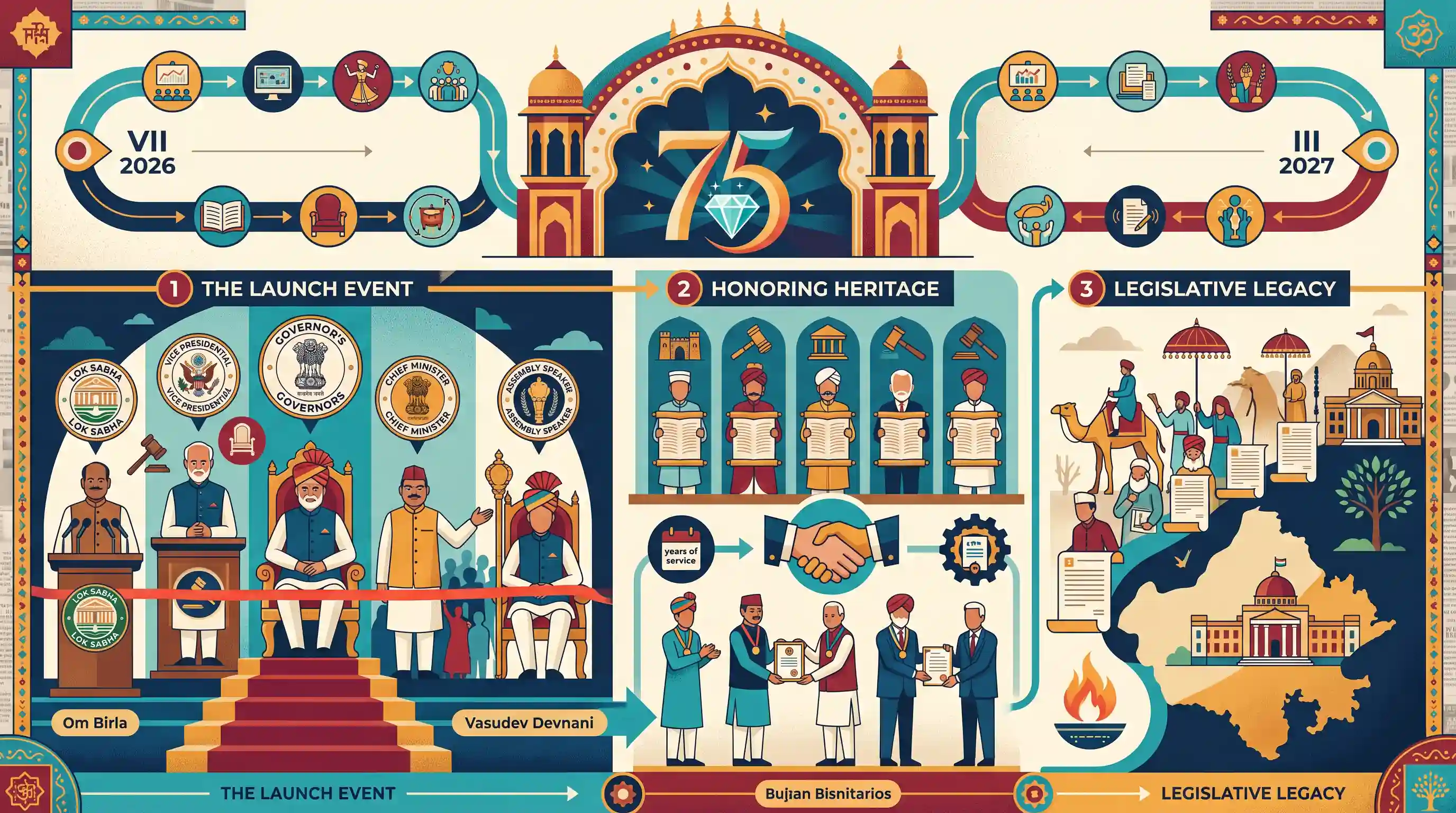
The Diamond Jubilee (Amrit Mahotsav) celebrations of the Rajasthan State Assembly will begin with high-profile events featuring Lok Sabha Speaker Om Birla, Vice President CP Radhakrishnan, Governor Haribhau Bagade, Chief Minister Bhajan Lal Sharma, and Assembly Speaker Vasudev Devnani. The celebrations will honor long-serving legislators and former Speakers, marking a year of events focusing on the legislative heritage of Rajasthan from July 2026 to March 2027.
Key Points
- The year-long Diamond Jubilee celebrations (Amrit Mahotsav) of the Rajasthan State Assembly are set to commence in Jaipur in July 2026, culminating in the Rajasthan Day Mahotsav in March 2027.
- The opening event is structured in two sessions, featuring inaugurations and concluding ceremonies by Lok Sabha Speaker Om Birla and Vice President CP Radhakrishnan.
- The events will also see the presence of key leaders including Governor Haribhau Bagade, Chief Minister Bhajan Lal Sharma, and Assembly Speaker Vasudev Devnani.
- All sitting and former MLAs who have served six or more terms will be felicitated by Om Birla, while former Speakers of the House will be honored by VP Radhakrishnan.
- Prominent attendees include centenarian former Minister Pundit Ramkishan and former Speaker of the 12th Assembly Sumitra Singh (2004-2009).
- Four national-level conventions will be organized as part of the celebrations to bridge the past, present, and future role of democratic institutions in Rajasthan.
Important Terms
Vice President of India

The second-highest constitutional officer in India, who acts as the ex-officio Chairperson of the Rajya Sabha and steps in to perform presidential duties in the event of a vacancy.
UPSC context
GS Paper II (Polity) — tests understanding of constitutional executive offices, executive-legislative relations, and election processes.
Speaker of Lok Sabha
The constitutional presiding officer of India's lower house of Parliament, responsible for maintaining house order, determining Money Bills, and protecting the collective privileges of members.
UPSC context
GS Paper II (Polity) — tests presiding officers, parliamentary dynamics, and the speaker's neutrality and powers.
Rajasthan State Assembly
The unicameral legislative body of Rajasthan, responsible for enacting state laws, debating policies, passing the state budget, and holding the state executive accountable.
UPSC context
GS Paper II (Polity) — covers state legislature structure, functioning, conduct of business, and federalism dynamics.
Ram Rajya Parishad
A traditionalist Hindu nationalist political party founded in 1948 by Swami Karpatri, which became the second-largest party in Rajasthan's first assembly election in 1952 before merging with Jana Sangh in 1971.
UPSC context
GS Paper I & II — tests post-independence political consolidation, party history, and regional electoral trends.
Lok Sabha
The lower house of India's bicameral Parliament, composed of directly elected representatives who vote on central legislation, initiate Money Bills, and hold the Union Cabinet accountable.
UPSC context
GS Paper II (Polity) — covers parliamentary structure, legislative procedures, and democratic accountability mechanisms.
Prelims Trap
The strength of the Rajasthan Legislative Assembly has remained fixed at 200 seats since its inception in 1952.
The first legislative assembly of Rajasthan actually started with 160 seats in 1952. It was gradually increased through subsequent reorganizations and delimitations, reaching 200 only in 1977.
Static Concepts Connected
What are the constitutional limits on the strength of State Legislative Assemblies under Article 170?
- Constitutional Limits: Article 170 prescribes a maximum of 500 members and a minimum of 60 members for a State Legislative Assembly.
- Exceptions: Smaller states like Sikkim (32), Goa (40), and Mizoram (40) have lower minimum strengths via specific constitutional amendments.
- Population Basis: Seats are allocated based on population, with representation ratios kept uniform across the state as far as practicable.
What are the constitutional roles and differences between a Protem Speaker and a permanent Speaker?
- Appointment: The Governor appoints the Protem Speaker (usually the senior-most member) to administer oaths to new members.
- Tenure: The office is temporary and automatically ceases to exist once the newly elected permanent Speaker assumes office.
- Powers: The Protem Speaker holds all powers of the Speaker while presiding, but does not handle long-term administrative actions like anti-defection cases.
Cross-Topic Patterns
Post-Independence Electoral History + Regional Parties
Early state elections saw localized conservative forces like the Ram Rajya Parishad challenge the Congress, showing India's multi-party character existed long before the coalition era of the late 1980s.
Delimitation Acts + State Assembly Seats
The expansion of state legislative seats tracks historical Delimitation Commissions, directly linking past representation changes to the upcoming post-2026 national delimitation exercise.

Evolution of state assembly seat counts and the constitutional limits under Article 170 may feature in comparative federalism questions.
Linked PYQs · 2
Linked PYQs · 2
- 2018RPSC_PRELIMSGS1
Who has been the Protem President, President and Vice President of the Rajasthan Legislative Assembly?
- 2013RPSC_PRELIMSGS1
In the first general elections for the Rajasthan Assembly, which political party, after the Congress, received the second highest number of seats?
