Voyager 1 milestone and deep space exploration significance
Source:The Hindu ↗
Why It Matters
Understanding deep-space milestones like Voyager 1's one light-day achievement is vital for aspirants studying space technology, interplanetary communications, long-term power sources (RTGs), and milestones in human space exploration.
Summary
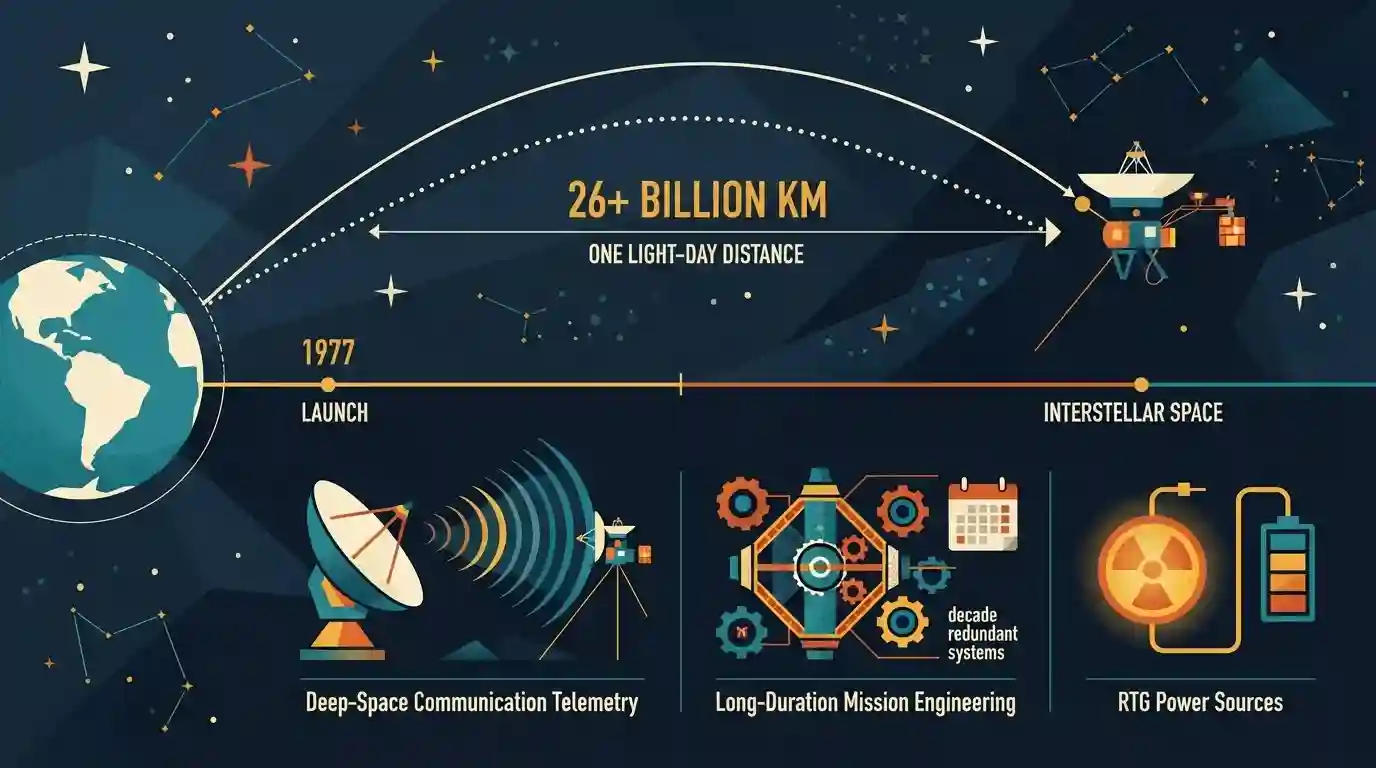
NASA's Voyager 1 spacecraft has reached a distance of one light-day from Earth, signifying its unprecedented journey into deep interstellar space. Launched in 1977, the spacecraft is now over 26 billion kilometres away, making it the most distant human-made object. This milestone underscores breakthroughs in deep-space communication telemetry, radioisotope thermoelectric power sources, and long-duration space mission engineering.
Key Points
- NASA's Voyager 1 spacecraft reached a milestone of one light-day distance from Earth, marking an unprecedented achievement in deep space exploration.
- At over 26 billion kilometres away, it is the farthest human-made object in history, continuing to send scientific data from interstellar space.
- Communication with Voyager 1 takes over 22 hours each way, highlighting the immense technological challenges of deep space tracking and telemetry.
- The mission demonstrates the longevity of radioisotope thermoelectric generators (RTGs) and space science engineering design from the 1970s.
Important Terms
NASA

An independent United States federal agency responsible for the civilian space program, aeronautics research, and space exploration missions like Voyager and Artemis.
UPSC context
GS Paper III (Science & Technology - Space). Important for questions on global space agencies, space exploration, and deep-space missions.
Voyager 1
A NASA robotic space probe launched in 1977 that has become the farthest human-made object in history, crossing into interstellar space.
UPSC context
GS Paper III (Science & Technology - Space). Relevant for deep-space exploration milestones, radioisotope power, and interstellar medium studies.
Interstellar Space
The region of space extending beyond the heliosphere, outside the influence of the Sun's magnetic field and solar wind.
UPSC context
GS Paper III (Science & Technology - Space). Tests understanding of cosmic boundaries, solar system limits, and astrophysics.
Radioisotope Thermoelectric Generator (RTG)
A nuclear power generator that produces electricity by converting heat released from the natural radioactive decay of an isotope like plutonium-238.
UPSC context
GS Paper III (Science & Technology - Space). Essential for questions on deep-space power sources where solar energy is insufficient.
Static Concepts Connected
What is the Heliopause and how do spacecraft detect interstellar space?
- Solar Wind Edge: Boundary layer where the sun's solar wind is stopped by the interstellar medium.
- Interstellar Crossing: Voyager 1 crossed it in August 2012, marking official entry into interstellar space.
- Data Signatures: Detected via abrupt changes in plasma density, magnetic field orientation, and cosmic ray fluxes.
Cross-Topic Patterns
Deep Space Missions + Nuclear Fuel Cycles
Voyager 1's deep-space communications rely on radioactive isotopes like Plutonium-238, linking space exploration directly to nuclear fuel supply chains and national security constraints.

Expect a statement-based prelims question on Voyager 1 crossing the heliopause vs entering interstellar space, or RTG power source mechanics.
Linked PYQs · 3
Linked PYQs · 3
- 2024PrelimsGS1
With reference to radioisotope thermoelectric generators (RTGs), consider the following statements: 1. RTGs are miniature fission reactors. 2. RTGs are used for powering the onboard systems of spacecrafts. 3. RTGs can use Plutonium-238, which is a by-product of weapons development. Which of the statements given above are correct?
- 2020PrelimsGS1
"The experiment will employ a trio of spacecraft flying in formation in the shape of an equilateral triangle that has sides one million kilometres long, with lasers shining between the craft." The experiment in question refers to
- 2022MainsGS3
Launched on 25th December, 2021, James Webb Space Telescope has been much in the news since then. What are its unique features which make it superior to its predecessor Space Telescopes ? What are the key goals of this mission ? What potential benefits does it hold for the human race?
