Fear of Disenfranchisement Drives High Turnout in Bengal Polls
Source:Indian Express ↗
Why It Matters
Understanding the dynamics of voter turnout is crucial for GS-2 (Electoral Reforms and Governance). The article illustrates how administrative exercises like the Special Intensive Revision of electoral rolls can create a 'fear psychosis' regarding disenfranchisement, significantly skewing electoral participation and highlighting systemic vulnerabilities in voter registration processes.
Summary
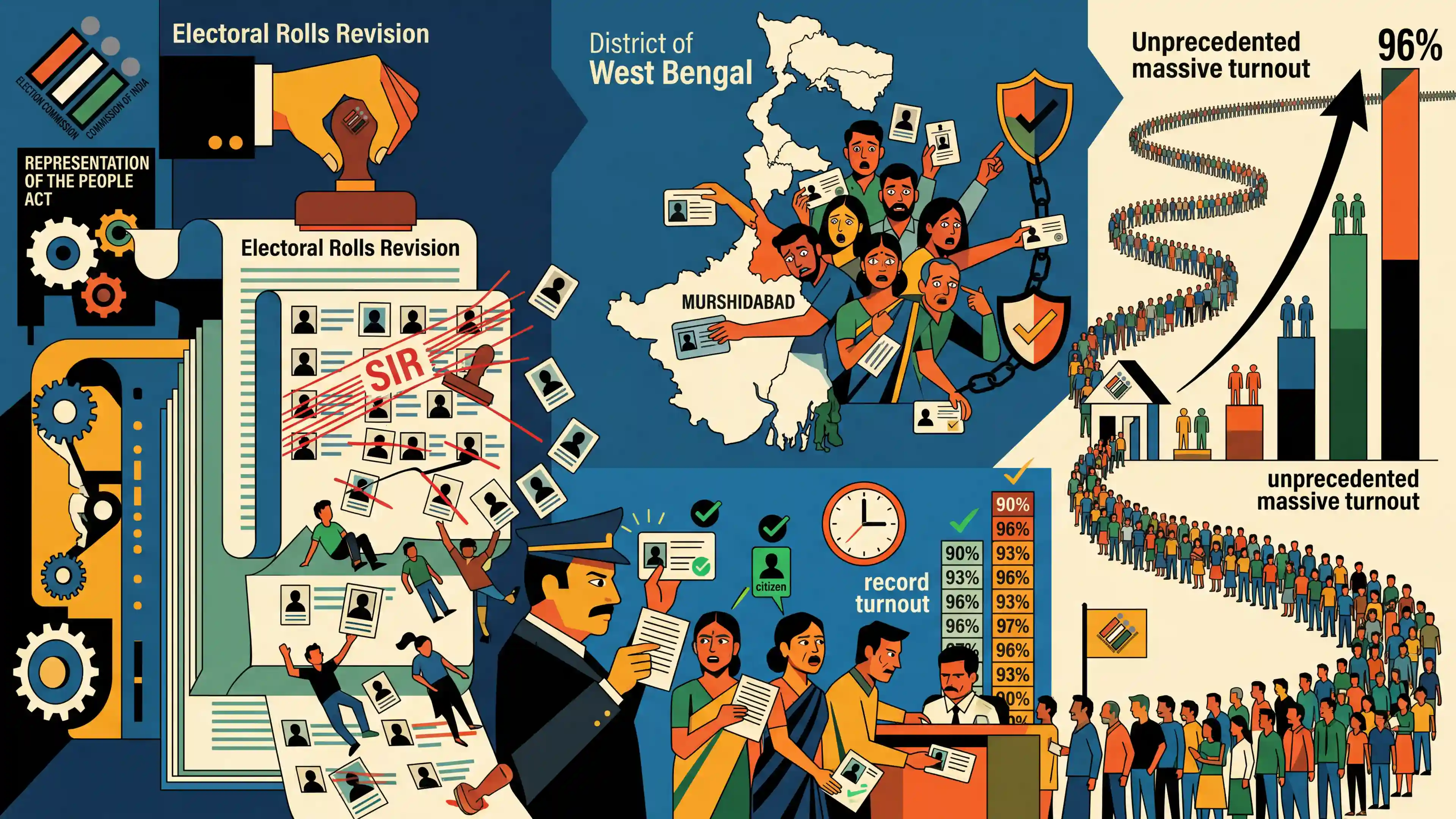
The article examines an unprecedented voter turnout in West Bengal's Murshidabad district, reaching up to 96% in certain assembly constituencies. This massive participation was driven not by standard political enthusiasm, but by widespread panic following large-scale voter deletions during the Election Commission's Special Intensive Revision (SIR) of electoral rolls. Fearing permanent disenfranchisement and a potential loss of citizenship rights, voters turned out in record numbers to prove their existence on the rolls. The situation highlights how administrative processes regarding voter registration can inadvertently shape voting behavior and spur regional political mobilization.
Key Points
- Unprecedented voter turnout (up to 96% in Samserganj) was recorded in parts of Murshidabad district during the West Bengal Assembly elections.
- The massive turnout was primarily driven by panic over large-scale deletions from the electoral rolls during the Special Intensive Revision (SIR) process.
- Voters feared that failing to cast their ballots would result in permanent disenfranchisement or loss of citizenship rights.
- Constituencies with the highest deletion rates (such as Lalgola and Bhagawangola) correspondingly witnessed some of the highest polling percentages.
- The crisis spurred political mobilization, with alternative outfits like the Aam Janata Unnayan Party (AJUP) assisting voters in getting their names re-included via ECINET, thereby challenging the local dominance of the TMC.
Important Terms
Special Intensive Revision (SIR)

A comprehensive house-to-house verification by the Election Commission to update electoral rolls, removing deceased or duplicate entries and adding new voters using fresh enumeration.
UPSC context
GS II (Electoral Reforms); tests understanding of ECI’s administrative measures for ensuring roll purity and democratic integrity.
Representation of the People Act, 1950
The 1950 legislation providing the legal framework for seat allocation, delimitation of constituencies, voter qualifications, and the preparation of electoral rolls in India.
UPSC context
GS II (Salient features of RPA); distinguishes between the preparatory framework (1950) and the conduct of elections (1951).
Election Commission of India (ECI)
An autonomous constitutional authority under Article 324 responsible for the superintendence, direction, and control of Union and State election processes.
UPSC context
GS II (Constitutional Bodies); critical for questions on the ECI's mandate to ensure free and fair elections.
Electoral Roll
The official list of registered citizens eligible to vote in a specific constituency, updated through periodic revisions to reflect migration, deaths, and new registrations.
UPSC context
GS II (Elections); relevant to issues of disenfranchisement, identity-based voting, and the legal right to participate in democracy.
Booth Level Officer (BLO)
A grassroots official appointed by the ECI to perform field-level duties, including door-to-door verification of voters and handling claims or objections for roll revisions.
UPSC context
GS II (Electoral Administration); tests knowledge of the decentralized machinery used for implementing election laws at the local level.
Voter Turnout
The percentage of eligible voters who cast a ballot, serving as a key indicator of civic participation and political mobilization in a democracy.
UPSC context
GS II (Political Dynamics); analyzes how administrative actions or citizenship concerns influence democratic participation and regional mobilization.
Prelims Trap
"The preparation and revision of electoral rolls is conducted under the Representation of the People Act, 1951."
RPA 1950 governs the preparation of electoral rolls and voter qualifications, while RPA 1951 deals with the actual conduct of elections.
Static Concepts Connected
What is the core difference between RPA 1950 and RPA 1951?
- RPA 1950: Deals with the allocation of seats, delimitation of constituencies, voter qualifications, and the preparation of electoral rolls.
- RPA 1951: Covers the actual conduct of elections, corrupt practices, election disputes, and the qualification or disqualification of candidates (MPs/MLAs).
What is the constitutional and statutory basis for the right to vote?
- Article 326: Mandates universal adult suffrage, granting the right to be registered as a voter to citizens above 18 without discrimination.
- RPA 1950: Operationalizes this constitutional mandate by laying down specific grounds for disqualification (e.g., non-residence, unsound mind, corrupt practices).
Cross-Topic Patterns
Algorithmic Governance & ECI
The use of AI in ERONET to weed out duplicate voters reflects the rising syllabus theme of technology-induced exclusion errors in public welfare and democratic rights.
Citizenship Anxiety & Voting Behavior
Routine administrative processes like ECI roll revisions are triggering massive political mobilizations when viewed through the lens of CAA/NRC fears and citizenship anxieties in border states.

Expect a 2026 question distinguishing RPA 1950 (voter registration/rolls) from RPA 1951 (election conduct/candidate disqualifications).
Linked PYQs · 4
Linked PYQs · 4
- 2024MainsGS2
Examine the need for electoral reforms as suggested by various committees with particular reference to "one nation one election" principle.
- 2017PrelimsGS1
Right to vote and to be elected in India is a
- 2017PrelimsGS1
For election to the Lok Sabha, a nomination paper can be filed by
- 2022MainsGS2
Discuss the role of the Election Commission of India in the light of the evolution of the Model Code of Conduct.
