Constitutional Risks of Conflating Electoral Deletions With Rights
Source:Indian Express ↗
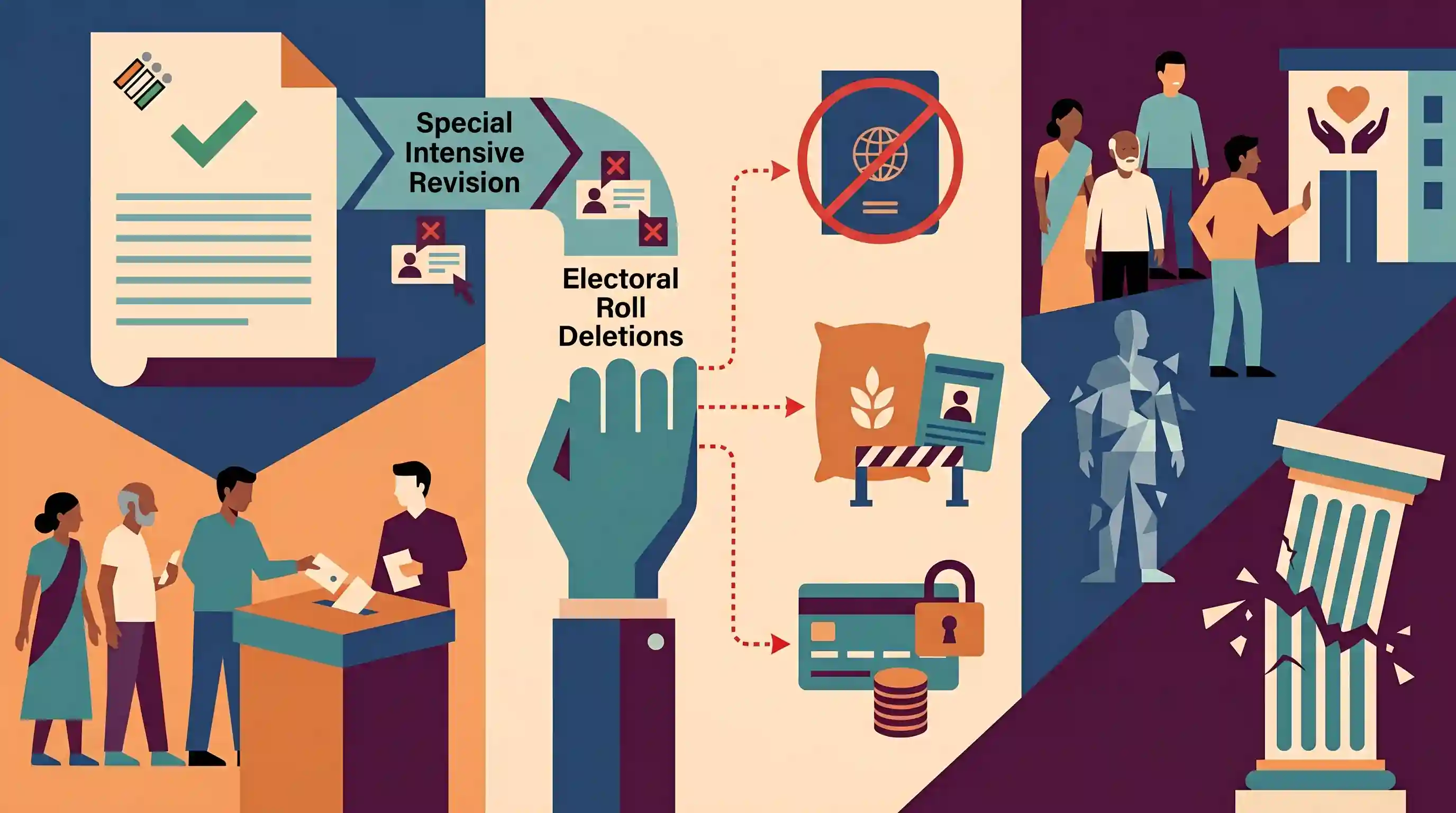
Why It Matters
This article provides an excellent conceptual critique of database conflation and the weaponization of voter deletions. For UPSC aspirants, it offers key arguments on constitutionalism, limited government, the distinction between voter rolls and citizenship, and how administrative overreach can impact Article 21 (right to livelihood/personal liberty) and welfare delivery.
Summary
Written by former Chief Election Commissioner S Y Quraishi, the article addresses the constitutional and civil risks of using electoral roll deletions (Special Intensive Revision) as grounds to deny basic administrative and welfare services. It highlights that while the voter list is meant solely to facilitate adult suffrage under Article 326, various state administrations have begun linking voter list deletions to the suspension of passports, public distribution system (PDS) ration, bank accounts, and other welfare benefits. Quraishi argues that conflating electoral status with citizenship or welfare eligibility represents a severe overreach that threatens fundamental rights under Article 21, erodes the rule of law, and risks systematically erasing vulnerable citizens from official existence due to minor administrative errors.
Key Points
- The article warns against the dangerous practice of linking electoral roll deletions (such as during Special Intensive Revision) to administrative exclusions, such as the denial of welfare benefits, passport renewals, and banking access.
- The primary constitutional purpose of the electoral roll is restricted to Article 326 (adult suffrage) and does not serve as a proof of citizenship, which is governed by the Citizenship Act of 1955.
- Instances of overreach include political statements in Bihar and West Bengal suggesting the cancellation of ration cards and bank accounts of deleted electors, as well as a former editor's passport renewal being delayed due to voter roll deletion.
- The Supreme Court has clarified that voter deletion is not conclusive proof of non-citizenship; treating it as such weaponizes administrative lapses (like a missed visit by a Booth Level Officer) and leads to 'civil death' and systemic profiling.
- Maintaining strict separation of databases and legal frameworks is critical to preserving the citizen-state relationship, limited government, and fundamental rights (including Article 21's guarantee of personal liberty and livelihood).
Important Terms
Representation of the People Act, 1950

A landmark parliamentary legislation providing the legal framework for the allocation of seats, delimitation of constituencies, preparation of electoral rolls, and voter qualifications prior to the conduct of elections.
UPSC context
GS Paper II (Polity & Governance); tests voter registration, administrative machinery of democracy, and electoral delimitation processes.
Representation of the People Act, 1951
A parliamentary legislation governing the actual conduct of elections, specifying candidate qualifications/disqualifications, regulating election expenditures, identifying corrupt practices, and establishing dispute resolution mechanisms.
UPSC context
GS Paper II (Polity & Governance); tests representation, qualifications/disqualifications of MPs/MLAs, and electoral integrity measures.
Article 326 of the Constitution of India
The constitutional provision that establishes universal adult suffrage, guaranteeing that elections to the Lok Sabha and State Legislative Assemblies are conducted on the basis of voting rights for all citizens aged 18 and older.
UPSC context
GS Paper II (Polity); tests the constitutional status of the right to vote, suffrage expansions, and disenfranchisement risks.
Article 21 of the Constitution of India
A fundamental right guaranteeing that no person shall be deprived of their life or personal liberty except according to a fair, just, and reasonable procedure established by law.
UPSC context
GS Paper II (Fundamental Rights); tests judicial expansion of life/liberty, protection from arbitrary state actions, and individual dignity.
Election Commission of India
An independent constitutional body established under Article 324 to superintend, direct, and control elections to Parliament, State Legislatures, and the offices of the President and Vice-President.
UPSC context
GS Paper II (Constitutional Bodies); tests institutional autonomy, the Model Code of Conduct, and management of large-scale elections.
Citizenship Act, 1955
The comprehensive parliamentary act enacted under Article 11 to govern the legal methods for acquiring, determining, and losing Indian citizenship after January 26, 1950.
UPSC context
GS Paper II (Polity); tests citizenship acquisition/loss, federal single citizenship, and legislative updates like the CAA.
Passports Act, 1967
Parliamentary legislation regulating the issuance of passports and travel documents, governing departures from India, and giving statutory backing to the fundamental right to travel abroad.
UPSC context
GS Paper II (Rights/Polity); tests the right to travel, administrative restrictions on liberty, and identity vs. citizenship proofs.
Prelims Trap
An individual's deletion from the electoral roll or lack of an EPIC is conclusive legal proof of their non-citizenship status.
Under the Citizenship Act 1955, citizenship can only be determined by designated central/judicial authorities. The Supreme Court has clarified that EPIC (voter card) is primarily for voting and does not serve as conclusive proof of citizenship status.
Static Concepts Connected
Is the 'Right to Vote' in India a Fundamental, Constitutional, or Statutory Right?
- Constitutional Right: Under Article 326 of the Constitution, the right to vote is explicitly sourced from the constitutional mandate of adult suffrage.
- Statutory Characterization: The Supreme Court in landmark cases (e.g., Jyoti Basu, NP Ponnuswami) characterized it as a statutory right subject to the limitations of the RPA.
- Judicial Evolution: In recent judgments like Anoop Baranwal (2023), the SC reaffirmed its status as a vital constitutional right, not a mere statutory privilege.
What is the division of domain between RPA 1950 and RPA 1951 regarding voter rolls?
- RPA 1950 Focus: Governs the preparation, revision, and maintenance of electoral rolls, delimitation of constituencies, and voter qualifications.
- RPA 1951 Focus: Governs the actual conduct of elections, qualifications/disqualifications of representatives, corrupt practices, and dispute resolution.
Cross-Topic Patterns
Database convergence and administrative overreach
Linking electoral databases with PDS and passports risks creating a unified state-controlled digital identity, violating the principle of purpose limitation in data privacy.
Welfare exclusion as 'Civil Death'
Denying food security based on voter list errors violates Article 21, illustrating how minor administrative lapses can escalate into systemic exclusion from fundamental rights.

Expect a 2026 Prelims question testing the legal limits of ECI's voter deletion powers and whether EPIC serves as proof of citizenship.
Linked PYQs · 4
Linked PYQs · 4
- 2017PrelimsGS1
Right to vote and to be elected in India is a
- 2019PrelimsGS1
Which Article of the Constitution of India safeguards one's right to marry the person of one's choice?
- 2023MainsGS2
e-governance, as a critical tool of governance, has ushered in effectiveness, transparency and accountability in governments. What inadequacies hamper the enhancement of these features ?
- 2021PrelimsGS1
Constitutional government means
