Electoral Rolls Deletion versus EVM Integrity Debates
Source:The Hindu ↗
Why It Matters
This political development is relevant for UPSC aspirants as it touches upon crucial debates surrounding India's electoral integrity. It contrasts concerns over EVM tampering with the structural issue of voter disenfranchisement through electoral roll deletions, directly linking to the Election Commission's role in ensuring free and fair elections. It also serves as a case study for the functional dynamics of coalition politics in a multi-party democracy.
Summary
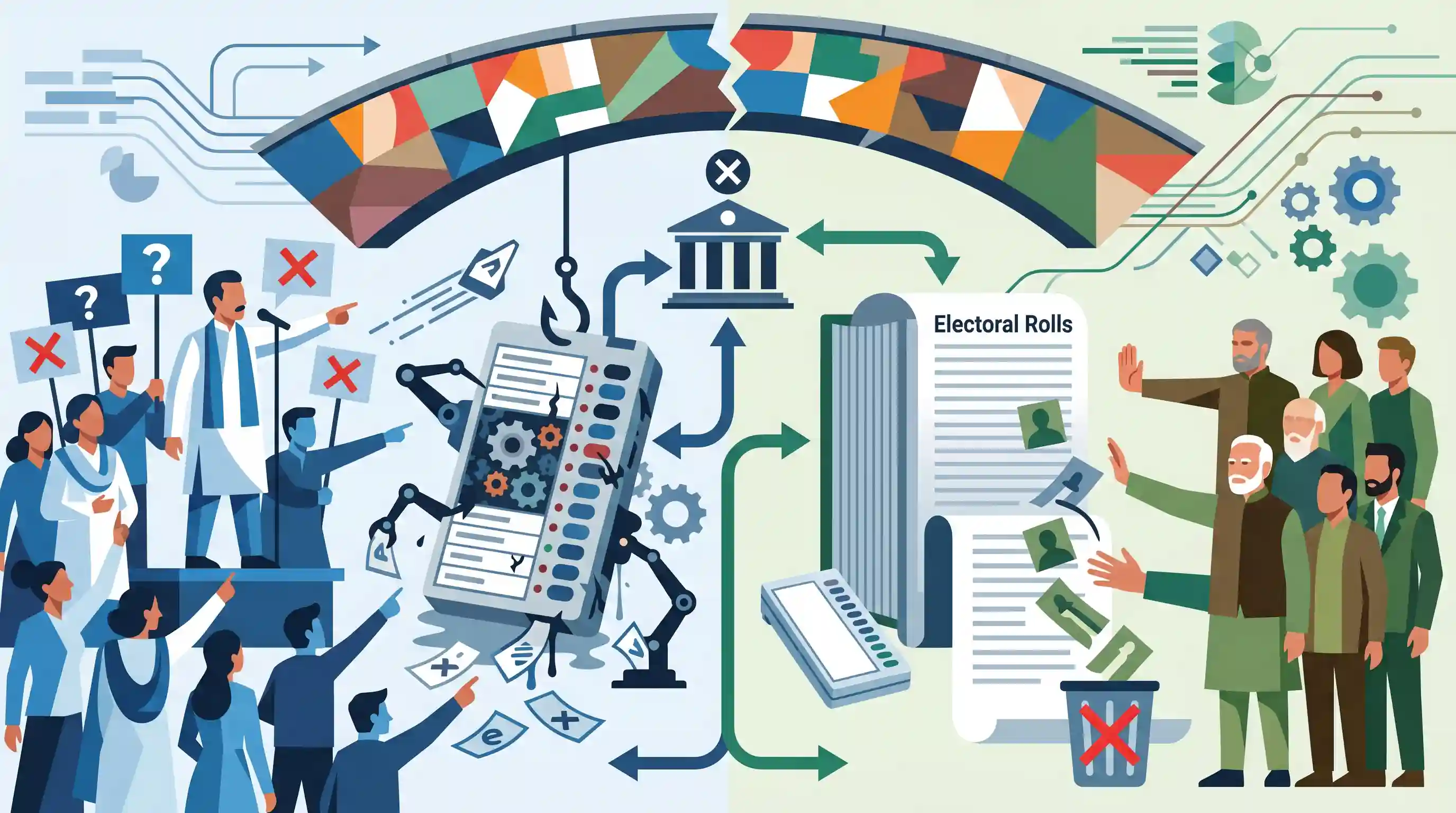
Jammu and Kashmir Chief Minister Omar Abdullah has distanced his National Conference party from the Congress-led campaign alleging 'vote theft' through EVMs, clarifying that the INDIA bloc as a whole is not driving this specific agenda. While Congress held a major rally targeting the BJP and the Election Commission over EVM manipulation, Abdullah argued that the real threat to democracy lies in the deletion of voters from electoral rolls rather than Electronic Voting Machines. The statements highlight differing priorities within the opposition alliance regarding electoral reforms and the defense of voting rights.
Key Points
- J&K Chief Minister Omar Abdullah distanced the National Conference from the Congress-led 'vote chori' (vote theft) campaign, stating it is not a collective INDIA bloc agenda.
- Congress organized a 'Vote Chor Gaddi Chhod' rally targeting the BJP and the Election Commission of India over alleged electoral manipulation via EVMs.
- Omar Abdullah emphasized that targeted deletions from electoral rolls under 'SIR' pose a far greater threat to democratic integrity than issues with Electronic Voting Machines (EVMs).
- The divergent stances underscore independent political strategies and internal differences among constituent parties of the opposition INDIA bloc regarding election integrity priorities.
Important Terms
Election Commission of India (ECI)

A permanent constitutional body (Article 324) responsible for the superintendence, direction, and control of elections to India's Parliament, State Legislatures, and the offices of President and Vice-President.
UPSC context
GS-II (Constitutional Bodies). Tests knowledge of institutional independence and the conduct of free and fair elections in a democracy.
Electronic Voting Machine (EVM)
An electronic device used for recording and counting votes, designed to replace paper ballots. It consists of a Control Unit and a Balloting Unit to enhance electoral efficiency.
UPSC context
GS-II (Electoral Reforms). Relevant for discussions on technological transparency, VVPAT verification, and challenges to electoral integrity.
Electoral Rolls
The official list of citizens registered and eligible to vote in a specific constituency, maintained and updated by the ECI under legal frameworks like the RPA 1950.
UPSC context
GS-II (Governance). Important for understanding voter disenfranchisement, inclusion, and the 'Right to Vote' as a legal/constitutional right.
INDIA Bloc
The Indian National Developmental Inclusive Alliance; a multi-party opposition coalition formed to contest the 2024 general elections against the ruling National Democratic Alliance (NDA).
UPSC context
GS-II (Political Parties). Examines the dynamics of coalition politics, federalism, and the multi-party system in India's electoral landscape.
National Conference (NC)
A prominent regional political party in Jammu and Kashmir, historically significant for its role in the region's accession and advocacy for regional autonomy and statehood.
UPSC context
GS-II (Regional Aspirations). Tests understanding of J&K’s unique political history and the role of regional parties in federal relations.
Representation of the People Act (RPA)
Parliamentary legislation governing electoral processes; the 1950 Act focuses on seat allocation and electoral rolls, while the 1951 Act governs the actual conduct of elections.
UPSC context
GS-II (Salient features of RPA). A core syllabus topic testing the legal mechanics and regulatory framework of Indian democracy.
Prelims Trap
"The preparation and revision of electoral rolls is governed by the Representation of the People Act, 1951."
Aspirants often confuse the two acts. RPA 1950 strictly deals with electoral rolls and voter qualifications, whereas RPA 1951 handles the actual conduct of elections.
Static Concepts Connected
How do RPA 1950 and RPA 1951 divide electoral responsibilities?
- RPA 1950: Deals with the allocation of seats, delimitation of constituencies, voter qualifications, and the preparation/revision of electoral rolls.
- RPA 1951: Deals with the actual conduct of elections, qualifications/disqualifications of candidates, corrupt practices, and the resolution of election disputes.
What is the Constitutional basis for the Right to Vote in India?
- Article 326: Guarantees universal adult suffrage to citizens above 18, officially classifying the Right to Vote as a Constitutional Right rather than a Fundamental Right.
- Article 324: Empowers the Election Commission of India with the superintendence, direction, and control over the preparation of these electoral rolls.
Cross-Topic Patterns
Electoral Rolls + Aadhaar Linkage
The debate over arbitrary voter deletion directly connects to the Election Laws (Amendment) Act, 2021, which allowed linking Aadhaar with electoral rolls, raising significant disenfranchisement and privacy concerns.
EVM Integrity + ADR Judgments
Focus frequently shifts from EVM tampering claims to systemic reforms, tying into recent Supreme Court judgments on VVPAT verification and the ECI's oversight mechanisms.

A multi-statement question comparing ECI's statutory powers under RPA 1950 (roll revision) vs RPA 1951 (election conduct) is highly likely.
Linked PYQs · 3
Linked PYQs · 3
- 2018MainsGS2
In the light of recent controversy regarding the use of Electronic Voting Machines (EVM), what are the challenges before the Election Commission of India to ensure the trustworthiness of elections in India?
- 2017MainsGS2
To enhance the quality of democracy in India the Election Commission of India has proposed electoral reforms in 2016. What are the suggested reforms and how far are they significant to make democracy successful?
- 2017PrelimsGS1
Right to vote and to be elected in India is a
