IFSCA Stance on Blockchain Risks and Financial Integrity
Source:Indian Express ↗
Why It Matters
This article perfectly illustrates the tension between emerging decentralized technologies and traditional regulatory/legal frameworks. It provides concrete examples of why Indian regulators remain hesitant about cryptocurrencies (linking S&T to Internal Security risks like money laundering), making it highly relevant for GS3 questions on the governance of new technologies and cyber security.
Summary
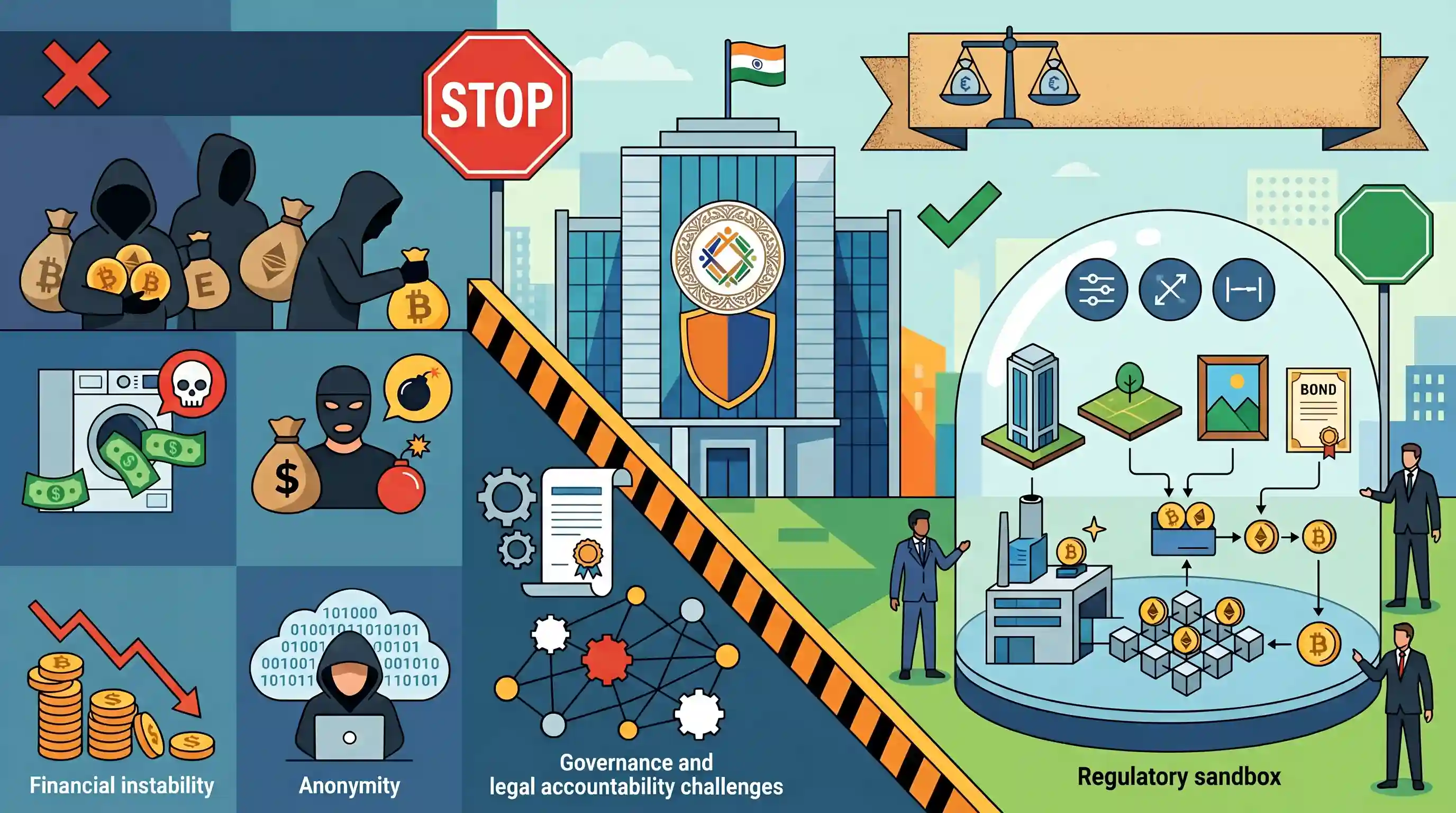
The International Financial Services Centres Authority (IFSCA) continues to exercise extreme caution regarding cryptocurrencies and decentralized blockchain technologies. IFSCA Chairperson K Rajaraman recently articulated that while blockchain has potential, cryptocurrencies remain banned in the GIFT City ecosystem due to severe risks associated with money laundering, terror financing, financial instability, and anonymity. A major hurdle for decentralized finance is governance and legal accountability; existing frameworks, such as the Indian Evidence Act, require certification by a specific person, which is incompatible with permissionless ledgers. Consequently, the IFSCA is prioritizing the 'same activity, same risk, same regulation' principle, favoring controlled exploration of blockchain through regulatory sandboxes for asset tokenisation rather than unregulated digital currencies.
Key Points
- IFSCA maintains a prohibition on cryptocurrencies in the GIFT City ecosystem due to risks involving anti-money laundering, counter-terror financing, extreme volatility, and anonymity.
- The regulatory approach is guided by the principle of 'same activity, same risk, same regulation', requiring decentralized finance to meet traditional financial safety standards.
- Decentralized and permissionless blockchains create significant governance and legal challenges, particularly in pinpointing legal responsibility and accountability.
- Admissibility of electronic evidence on blockchain under current laws like the Indian Evidence Act is problematic, as the law requires a 'person in charge' to certify digital records.
- Instead of open crypto trading, IFSCA is utilizing regulatory sandboxes to explore safer blockchain applications, such as the tokenisation of real-world assets.
Important Terms
International Financial Services Centres Authority (IFSCA)

A statutory unified regulator established under the IFSCA Act, 2019, to develop and oversee financial products, services, and institutions within India’s International Financial Services Centres (IFSCs).
UPSC context
GS III (Economy/Regulatory Bodies); relevant for financial sector reforms and India’s global financial competitiveness.
GIFT City
India's first operational smart city and sole International Financial Services Centre (IFSC) in Gandhinagar, Gujarat, designed to serve as a global hub for offshore financial services.
UPSC context
GS III (Economy/Infrastructure); tests knowledge of special economic zones and offshore financial hubs.
Bharatiya Sakshya Adhiniyam (BSA), 2023
The 2023 law replacing the 1872 Indian Evidence Act; it modernizes evidence rules by explicitly recognizing digital/electronic records as primary evidence, vital for blockchain-related legal accountability.
UPSC context
GS II (Polity) and GS III (Cyber Security); critical for understanding legal updates regarding digital evidence.
Regulatory Sandbox
A controlled regulatory environment allowing fintech companies to test innovative products or services with real customers under supervised exemptions from certain standard regulations.
UPSC context
GS III (S&T/Fintech); tests knowledge of fostering innovation while mitigating systemic risks.
Asset Tokenisation
The process of converting ownership rights of physical or financial assets (e.g., real estate) into digital tokens on a blockchain to improve liquidity and transparency.
UPSC context
GS III (S&T/Economy); relevant for blockchain applications and the future of digital finance.
Rashtriya Raksha University (RRU)
An Institution of National Importance specializing in security and law enforcement; it collaborates with financial regulators to develop training for combating economic and financial crimes.
UPSC context
GS III (Internal Security); relevant for institutional mechanisms against money laundering and tech-based financial fraud.
Prelims Trap
GIFT City allows regulated cryptocurrency trading as an offshore jurisdiction under the IFSCA sandbox framework.
IFSCA strictly bans cryptocurrencies in GIFT City due to AML/CFT risks. The sandbox is exclusively for controlled blockchain applications like asset tokenization.
Static Concepts Connected
What is the mandate and structure of the IFSCA?
- Unified Regulator: It is a statutory unified regulator established under the IFSCA Act, 2019, replacing the roles of RBI, SEBI, IRDAI, and PFRDA within IFSCs.
- Jurisdiction: It regulates financial products, services, and institutions solely in India's International Financial Services Centres (currently only GIFT City, Gujarat).
What is the difference between Permissioned and Permissionless Blockchains?
- Permissionless (Public): Open networks where anyone can read, write, and participate in consensus (e.g., Bitcoin). They lack a central authority, complicating legal accountability.
- Permissioned (Private): Access is restricted to identified participants by an administrator. This model is preferred by regulators like RBI and IFSCA for enterprise use cases.
Cross-Topic Patterns
Web3 tech meets New Criminal Laws
The clash between decentralized ledgers and the Bharatiya Sakshya Adhiniyam's electronic evidence rules creates a prime GS-2/GS-3 intersection on digital governance and legal accountability.
Regulatory sandboxes across agencies
IFSCA’s use of regulatory sandboxes mirrors RBI’s cohorts, reflecting a systemic regulatory shift toward controlled "test-before-launch" frameworks for emerging financial technologies.

Expect a Prelims question mixing IFSCA's statutory powers with Web3 terminology (asset tokenization, permissioned vs. permissionless).
Linked PYQs · 4
Linked PYQs · 4
- 2020PrelimsGS1
With reference to "Blockchain Technology", consider the following statements: 1. It is a public ledger that everyone can inspect, but which no single user controls. 2. The structure and design of blockchain is such that all the data in it are about cryptocurrency only. 3. Applications that depend on basic features of blockchain can be developed without anybody's permission. Which of the statements given above is/are correct?
- 2022PrelimsGS1
With reference to Web 3.0, consider the following statements: 1. Web 3.0 technology enables people to control their own data. 2. In Web 3.0 world, there can be blockchain based social networks. 3. Web 3.0 is operated by users collectively rather than a corporation. Which of the statements given above are correct?
- 2021MainsGS3
Discuss how emerging technologies and globalisation contribute to money laundering. Elaborate measures to tackle the problem of money laundering both at national and international levels.
- 2017MainsGS3
The scourge of terrorism is a grave challenge to national security. What solutions do you suggest to curb this growing menace? What are the major sources of terrorist funding?
