Vladimir Putin Praises India Strategic Autonomy Amid Western Pressures
Source:Indian Express ↗
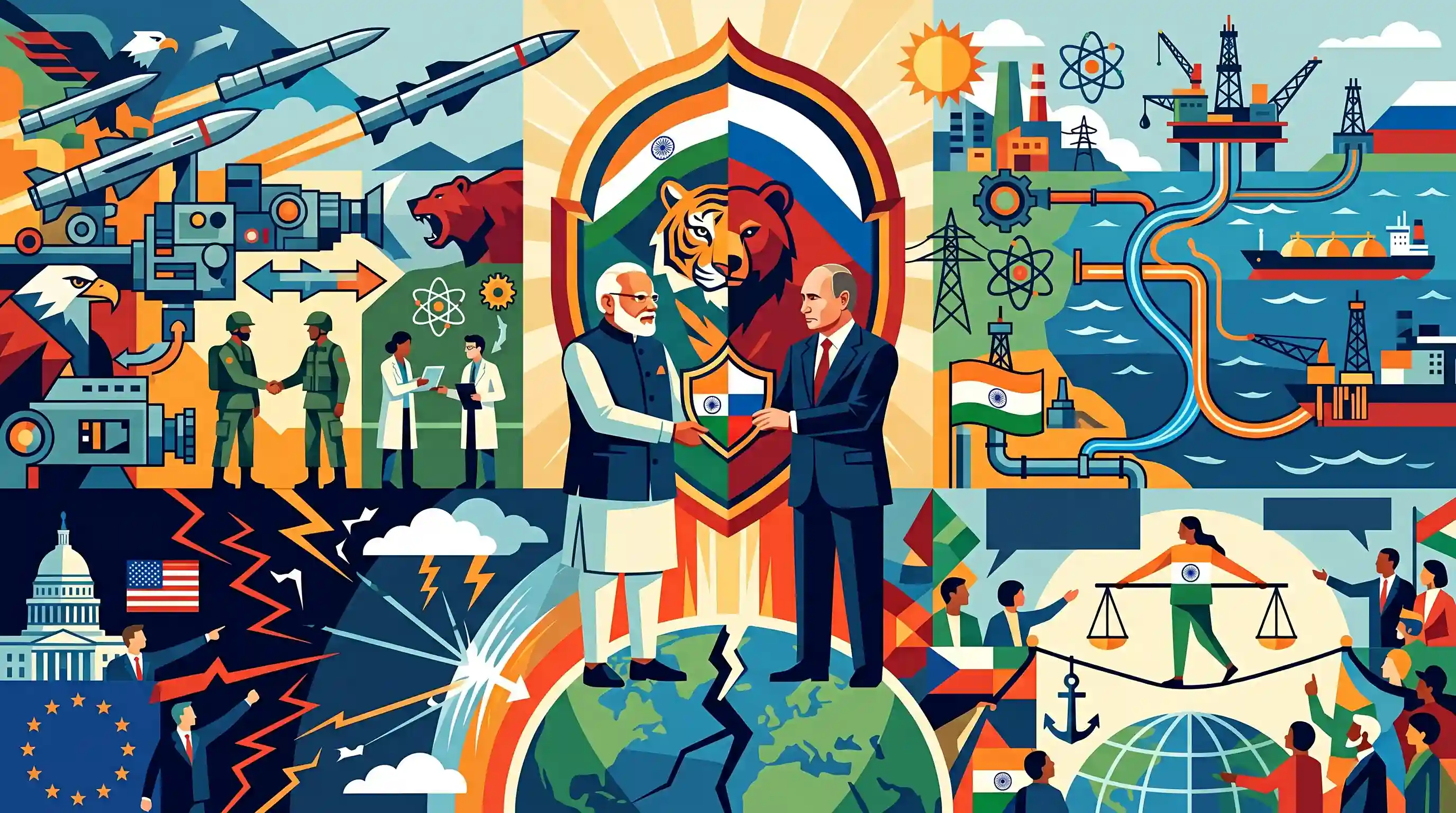
Why It Matters
India's ability to maintain strong ties with Russia despite US pressure is a textbook example of its 'Strategic Autonomy'. It is crucial for UPSC aspirants to understand how India balances its traditional security and energy dependence on Russia with its growing strategic partnership with the West.
Summary
Russian President Vladimir Putin commended Indian Prime Minister Narendra Modi for his commitment to India's strategic autonomy, asserting that it is "useless" for the United States or other Western nations to pressure India into downgrading its ties with Russia. Putin emphasized the historic and resilient nature of the India-Russia partnership, noting successful collaborations in defence—such as the BrahMos missile joint venture—and reliable energy trade. The comments highlight New Delhi's successful diplomatic balancing act, maintaining robust strategic and economic ties with Moscow despite intense global polarization and the threat of secondary sanctions.
Key Points
- Russian President Vladimir Putin praised Prime Minister Narendra Modi for maintaining an independent foreign policy and safeguarding India's national interests.
- Putin stated that Western attempts, particularly by the US, to pressure India or PM Modi into curtailing ties with Moscow are futile.
- The remarks underscore the resilience of the India-Russia 'Special and Privileged Strategic Partnership' amidst the ongoing war in Ukraine and Western sanctions.
- Putin highlighted successful bilateral defence cooperation, specifically mentioning the joint development of the BrahMos missile system and the potential for future cooperation on advanced military platforms.
- Russia reaffirmed its position as a reliable supplier of energy and resources to India, contributing to India's energy security despite global supply chain disruptions.
Important Terms
Strategic Autonomy

A nation's ability to pursue sovereign foreign and security policies without being constrained by external pressures, alliances, or bloc politics.
UPSC context
GS-II (International Relations); tests understanding of India's 'Multi-alignment' and independent stance in a multipolar world.
Special and Privileged Strategic Partnership
The official designation of India-Russia ties since 2010, reflecting deep, time-tested cooperation in defense, nuclear energy, space, and science.
UPSC context
GS-II (Bilateral Relations); tests knowledge of historic ties and strategic depth between New Delhi and Moscow.
Secondary Sanctions
Economic penalties used by a country (often the US) against third-party nations or companies to deter them from trading with primary sanctioned targets.
UPSC context
GS-II (Effect of policies of developed countries); critical for CAATSA-related discussions and India's oil imports.
BrahMos Missile
The world's fastest operational supersonic cruise missile, jointly developed by India's DRDO and Russia's NPO Mashinostroyeniya based on the 'fire and forget' principle.
UPSC context
GS-III (Science & Tech/Defence); highlights successful co-development and India's emerging role as a defense exporter.
Energy Security
Ensuring uninterrupted availability of energy sources at an affordable price, vital for economic stability and national growth.
UPSC context
GS-III (Economic Development/Infrastructure); relates to India's diversification of oil imports and strategic petroleum reserves.
Prelims Trap
CAATSA is a United Nations-mandated sanctions framework regulating defence transactions with Russia.
CAATSA is purely a US domestic law, not a UN mandate. India officially only recognizes multilateral UN sanctions, refusing to be bound by unilateral Western directives.
Static Concepts Connected
What characterizes India's "Special and Privileged Strategic Partnership" with Russia?
- 2010 Upgrade: Bilateral ties were elevated to this unique status in 2010, remaining the highest diplomatic categorization India uses for any bilateral relationship.
- Core Pillars: Anchored heavily on joint defence development (BrahMos), civil nuclear energy (Kudankulam), space cooperation (Gaganyaan), and institutionalized annual bilateral summits.
How do secondary sanctions under the US CAATSA law function?
- Unilateral Action: A US domestic law penalizing foreign entities and countries that engage in "significant transactions" with designated US adversaries (Russia, Iran, North Korea).
- Presidential Waiver: Contains a modified provision allowing the US President to grant a waiver to exempt strategic partners (like India for the S-400 deal) from penalties.
Cross-Topic Patterns
De-dollarization & Rupee Vostro Accounts
Bypassing SWIFT to buy Russian oil catalyzed the RBI's push for Special Rupee Vostro Accounts (SRVA), bridging energy security with the internationalization of the Rupee.
Multi-alignment vs Non-alignment
Balancing the Quad (US) and SCO (Russia) exemplifies India's shift from Cold War passive non-alignment to aggressive, issue-based multi-alignment prioritizing national interests.

CAATSA waiver criteria, Rupee Vostro mechanisms, and BrahMos export destinations are prime targets for multi-statement Prelims MCQs in 2026.
Linked PYQs · 2
Linked PYQs · 2
- 2020MainsGS2
What is the significance of Indo-US defence deals over Indo-Russian defence deals? Discuss with reference to stability in the Indo-Pacific region.
- 2023PrelimsGS1
Consider the following statements: 1. Ballistic missiles are jet-propelled at subsonic speeds throughout their flights, while cruise missiles are rocket-powered only in the initial phase of flight. 2. Agni-V is a medium-range supersonic cruise missile, while BrahMos is a solid-fuelled intercontinental ballistic missile. Which of the statements given above is/are correct?
