Operational performance and strategic importance of Vizhinjam Port
Source:The Hindu ↗
Why It Matters
Vizhinjam Port addresses a critical bottleneck in Indian logistics: the lack of a deep-draft domestic transshipment hub, which previously forced India to rely on foreign ports like Colombo and Singapore for ~75% of its transshipped cargo. By offering direct berthing to ultra-large container ships, it slashes transport costs, reduces foreign exchange drainage, and showcases how PPP execution can transform national infrastructure.
Summary
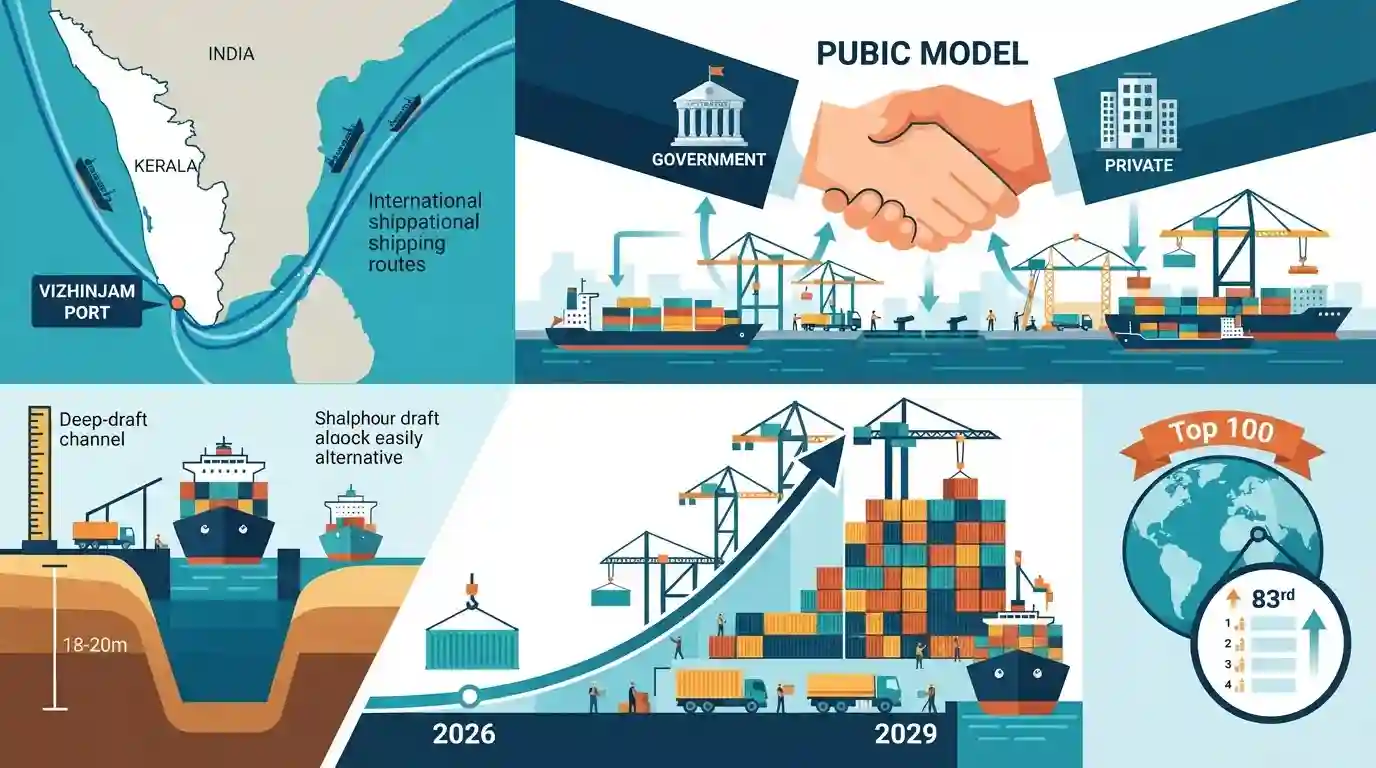
The Vizhinjam International Seaport in Kerala, developed under a PPP model by Adani Ports and the state government, has registered record operational benchmarks in January 2026. Within a year of launching commercial operations, it has climbed to the 83rd spot globally among container ports, handling mega-vessels due to its natural deep draft of 18-20m and proximity to international trade routes. A ₹16,000 crore Phase 2 expansion has commenced to scale its transshipment capacity to 5.7 million TEUs by 2029, cementing its role as India's premier gateway to international maritime trade.
Key Points
- Vizhinjam International Seaport in Kerala recorded its highest-ever monthly container throughput of 1,23,092 TEUs in January 2026, handling 62 vessels and achieving a Gross Crane Rate (GCR) of 30.12 container lifts an hour.
- The port has climbed to the 83rd position globally in terms of handling-volume, processing 740 vessels and 1.57 million TEUs since its commercial operations commenced about a year ago.
- It has successfully handled over 50 Ultra Large Container Vessels (ULCVs) of lengths exceeding 399m, including MSC Verona (South Asia's deepest-draft vessel at 17.1m) and MSC IRINA (the world's largest container ship).
- Geographical advantages include a natural deep draft of 18–20 meters, proximity to East-West global shipping lanes, minimal littoral drift, and a 3-km breakwater, allowing year-round operations with minimal maintenance dredging.
- The port serves as India's premier indigenous transshipment hub, offering a viable alternative to Colombo, Dubai, Singapore, and Port Klang, which historically handled the majority of India's transshipped cargo.
- Phase 2 expansion began on January 24, 2026, with a ₹16,000 crore investment to extend the container berth to 2,000 meters and the breakwater to 3,900 meters by 2028, aiming to scale capacity to 5.7 million TEUs by 2029.
Important Terms
Public-Private Partnership (PPP) model

A long-term collaborative arrangement between the government and a private sector entity to finance, construct, or manage public infrastructure, sharing risks, responsibilities, and technical expertise.
UPSC context
GS Paper 3 (Investment Models). Tests understanding of infrastructure financing mechanisms and bridging public funding gaps.
Adani Ports and Special Economic Zone Limited (APSEZ)
A major Indian private port operator partnering with the Kerala government under a Design, Build, Finance, Operate, and Transfer (DBFOT) concession to develop the Vizhinjam seaport.
UPSC context
GS Paper 3 (Investment Models). Serves as a practical case study for private sector execution in mega-infrastructure projects.
Vizhinjam International Seaport
India's premier deep-water, multipurpose transshipment hub in Kerala, developed under a Landlord PPP model to handle ultra-large container vessels and enhance global trade capacity.
UPSC context
GS Paper 1 & 3 (Infrastructure, Economic Geography). Highlights India's strategic maritime trade and logistics capabilities.
Transshipment Hub
A maritime port where cargo containers are transferred from one vessel to another en route to their final destination, rather than being imported or exported locally.
UPSC context
GS Paper 3 (Logistics & Maritime Trade). Focuses on global supply chains and reducing dependence on foreign ports.
Deep Draft Port
A seaport with a deep underwater clearance (typically 18-20m) enabling the docking of ultra-large, next-generation container ships without the need for extensive capital dredging.
UPSC context
GS Paper 3 (Infrastructure). Relevant for understanding port efficiency, maritime economics, and natural geographical advantages.
Twenty-foot Equivalent Unit (TEU)
A standardized unit of measurement used in the maritime shipping industry, based on a 20-foot container, to determine a vessel's or port's cargo-carrying capacity.
UPSC context
GS Paper 3 (Economy). Important baseline metric for quantifying maritime trade logistics and port capacity benchmarks.
Prelims Trap
Vizhinjam is India's newest Major Port administered by the Central Government.
Vizhinjam is a 'non-major' port under Kerala state jurisdiction, developed via PPP. Major Ports are administered directly by the Central Government under the Major Port Authorities Act, 2021.
Static Concepts Connected
What distinguishes Transshipment Hubs from standard Gateway Ports?
- Gateway Ports: Serve a domestic hinterland directly via robust rail and road networks for regional imports and exports (e.g., JNPT).
- Transshipment Hubs: Act as maritime intermediaries primarily transferring cargo between ultra-large ocean-going mother vessels and smaller regional feeder ships.
- Deep Draft Necessity: Transshipment hubs require extreme natural depths (18-20m+) to berth mega-vessels, a rare geographical feature Vizhinjam possesses without extensive dredging.
What are the core features of the Viability Gap Funding (VGF) scheme?
- Economic vs Financial: Provides capital support as a grant to PPP infrastructure projects that are economically justified but commercially unviable without initial assistance.
- Funding Limits: The Central government typically funds up to 20% of the Total Project Cost, with state governments allowed to provide an additional 20%.
- First Port Application: Vizhinjam is India's first port project to receive VGF, utilizing a hybrid Landlord DBFOT (Design, Build, Finance, Operate, Transfer) framework.
Cross-Topic Patterns
Littoral drift and West Coast geography
Vizhinjam's low maintenance dredging relies on minimal littoral (longshore) drift and natural depth, classic UPSC physical geography parameters distinguishing East versus West coast port formation.
Current Account and logistics forex drain
Establishing indigenous transshipment hubs curbs the $200M+ annual forex drain to foreign hubs like Colombo, directly interlinking logistics infrastructure to macro-economic Current Account management.

Expect a 2026 prelims question linking Vizhinjam's 'non-major' state jurisdiction with its unique Viability Gap Funding and DBFOT PPP.
Linked PYQs · 2
Linked PYQs · 2
- 2022MainsGS3
Why is Public Private Partnership (PPP) required in infrastructural projects ? Examine the role of PPP model in the redevelopment of Railway Stations in India.
- 2026PrelimsGS1
In what way(s) does the Vizhinjam International Seaport represent a structural shift in India's maritime trade and logistics policy? 1. By functioning exclusively as a domestic cargo hub to reduce reliance on coastal shipping and eliminate the need for foreign collaborations. 2. By focusing primarily on passenger cruise tourism and heritage shipping to increase Kerala's profile as a maritime heritage destination. 3. By leveraging its natural deep draft and strategic location to reduce dependence on foreign trans-shipment ports, enhance revenue retention, and reposition India in regional maritime trade. Select the answer using the code given below :
