Vizag Steel Plant accident sparks safety concerns and official probe
Source:Indian Express ↗
Why It Matters
The Vizag Steel Plant accident serves as a critical case study on industrial disaster management and occupational hazards in India. It highlights the systemic issues within PSUs, such as operational constraints, the consequences of relying heavily on contract labour, and the vital necessity of stringent safety and maintenance protocols in hazardous heavy industries.
Summary
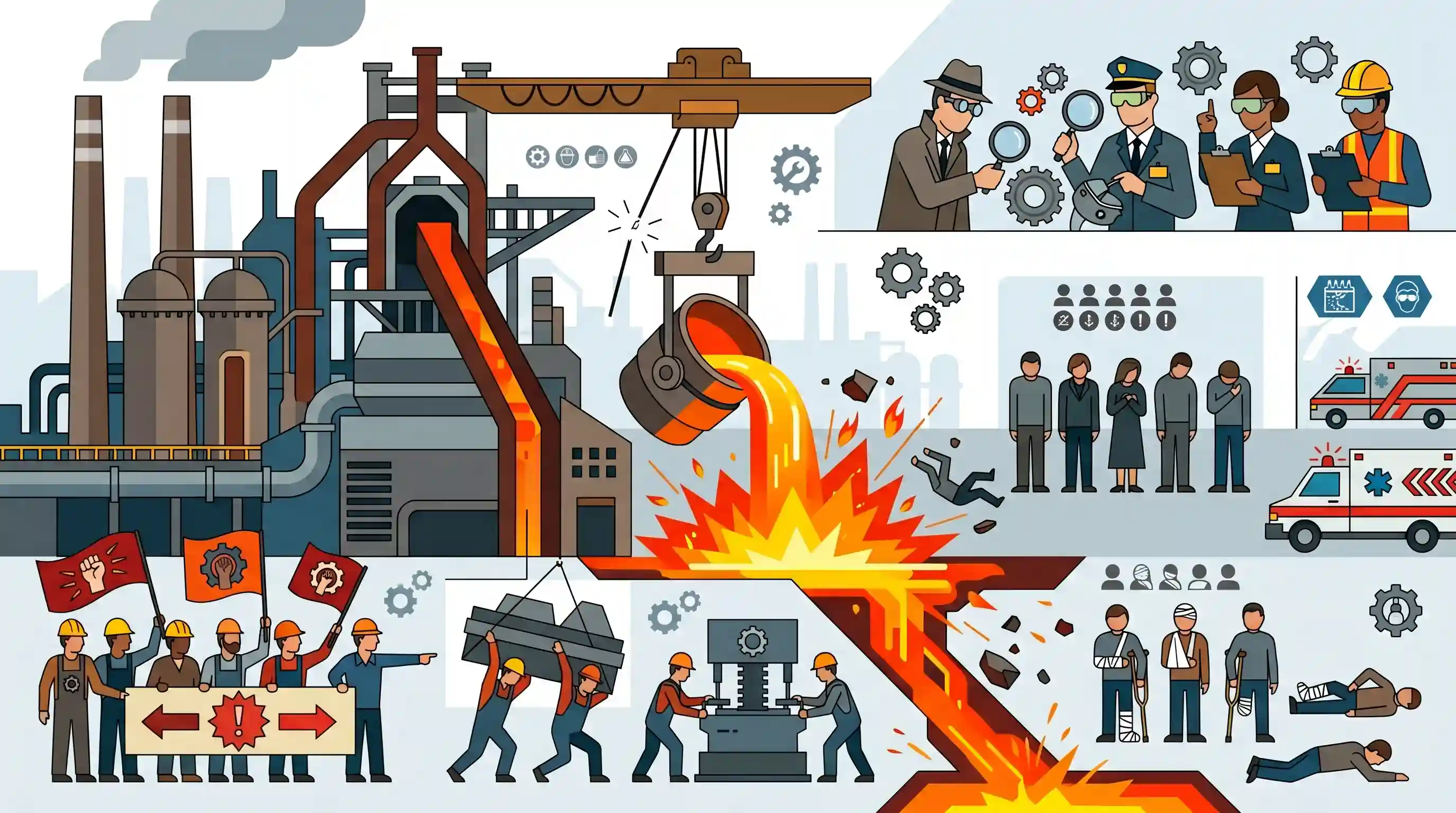
A catastrophic accident at the state-run Vizag Steel Plant (Rashtriya Ispat Nigam Ltd) in Visakhapatnam claimed the lives of eight workers and injured six others. The tragedy occurred when an overhead crane carrying molten steel snapped, spilling liquid metal at 1,500°C and triggering an explosion. While the Ministry of Steel and RINL have launched separate investigations to ascertain the root cause, trade unions allege that the disaster stems from severe understaffing and forced excessive workloads that compromise vital safety protocols. The incident underscores urgent concerns regarding occupational safety, labour rights, and the operational challenges facing public sector undertakings.
Key Points
- An explosion and spillage of molten steel at the Vizag Steel Plant (RINL) resulted in the deaths of eight workers, including five employees and three contract labourers.
- The accident occurred at Caster-2 of Steel Melt Shop-1 when a ladle carrying liquid steel at around 1,500-1,600°C crashed after the overhead crane failed.
- The Ministry of Steel has constituted a three-member external committee, headed by a senior official from SAIL Bokaro, to investigate the root cause of the incident.
- Trade unions, including CITU, have blamed the accident on a massive staff crunch, stating the plant has only about half the required workforce, leading to compromised safety and maintenance.
- The incident highlights critical systemic issues regarding occupational safety, reliance on contract labour, and financial/staffing struggles in public sector undertakings (PSUs).
Important Terms
Rashtriya Ispat Nigam Ltd (RINL)

A central Public Sector Undertaking (PSU) under the Ministry of Steel, RINL operates the Visakhapatnam Steel Plant, India's first shore-based integrated steel facility with Navratna status.
UPSC context
GS Paper 3: Industrial Growth and PSUs; GS Paper 3: Disaster Management (industrial safety).
Ministry of Steel
The nodal agency for the iron and steel industry, responsible for policy formulation, infrastructure development, and administrative oversight of major PSUs like SAIL and RINL.
UPSC context
GS Paper 2: Statutory and Regulatory Bodies; GS Paper 3: Industrial Policy.
Steel Authority of India Ltd (SAIL)
A Maharatna central PSU and India's largest steel producer, managing five integrated plants. It sets benchmark operational and safety standards for the domestic steel sector.
UPSC context
GS Paper 3: Investment Models and Public Sector Undertakings; industrial safety protocols.
Centre of Indian Trade Unions (CITU)
A national trade union federation politically linked to the CPI(M), advocating for labor rights and safety standards while opposing the privatization of PSUs like Vizag Steel.
UPSC context
GS Paper 2: Pressure Groups and Formal/Informal Associations; GS Paper 3: Labor Issues.
Bokaro Steel Plant
A major integrated steel plant under SAIL located in Jharkhand. It serves as a case study for recurring industrial hazards and safety management in heavy manufacturing.
UPSC context
GS Paper 3: Disaster Management; Industrial safety in heavy manufacturing sectors.
Occupational Safety, Health and Working Conditions (OSH) Code, 2020
A 2020 legislative reform consolidating 13 labor laws into a single code to unify standards for workplace health, safety, and welfare across diverse industries.
UPSC context
GS Paper 2: Governance and Government Policies; GS Paper 3: Labor Reforms.
Prelims Trap
"Vizag Steel Plant (RINL) is India's first integrated steel plant."
Aspirants confuse RINL with TISCO (oldest) or the 2nd Five-Year Plan plants (Bhilai, Durgapur, Rourkela). RINL (Vizag) is India's first *shore-based* integrated steel plant, established much later (1970s/80s).
Static Concepts Connected
Why are modern steel plants increasingly shore-based?
- Raw material import: Coastal locations drastically reduce inland transport and freight costs for heavy imported raw materials like high-grade coking coal (e.g., from Australia).
- Export competitiveness: Proximity to deep-water ports provides a logistical advantage for exporting finished steel products to international markets.
- Resource integration: Shore-based plants typically establish captive power plants and desalination units to ensure uninterrupted energy and the massive water supply needed for cooling.
What are the key safety mandates under the OSHWC Code 2020?
- Consolidation: It subsumes 13 central labour laws, including the Factories Act, 1948, and the Contract Labour Act, 1970, to streamline compliance.
- Safety Committees: Mandates the formation of bilateral safety committees (comprising employer and worker representatives) in factories employing 500 or more workers.
- Contract worker threshold: Increases the threshold for contract labour applicability to establishments with 50 or more contract workers (up from 20), bringing new welfare liabilities.
Cross-Topic Patterns
Disinvestment limbo and industrial safety
RINL's ongoing privatization talks have allegedly caused hiring freezes and chronic understaffing. This links macroeconomic disinvestment policies directly to ground-level industrial hazards and compromised safety protocols.
The contract labour safety gap
The tragic deaths of contract laborers at Vizag highlight the growing formal-informal divide in heavy manufacturing, testing the efficacy and enforcement mechanisms of the newly consolidated OSHWC Code 2020.

Expect a GS3 Mains question on industrial disasters linking NDMA guidelines with the safety and liability provisions of the OSHWC Code 2020.
Linked PYQs · 3
Linked PYQs · 3
- 2024MainsGS3
Discuss the merits and demerits of the four 'Labour Codes' in the context of labour market reforms in India. What has been the progress so far in this regard?
- 2020MainsGS3
Discuss the recent measures initiated in disaster management by the Government of India departing from the earlier reactive approach.
- 2020MainsGS1
Account for the present location of iron and steel industries away from the source of raw material, by giving examples.
