Vizag Science and Technology Cluster advances Make in India
Source:The Hindu ↗
Why It Matters
Highlights successful institutional models (like AMTZ) for indigenizing the import-dependent medical device sector and translating scientific R&D into scalable industrial applications, highly relevant to GS3 (Science & Technology / Industrial Policy).
Summary
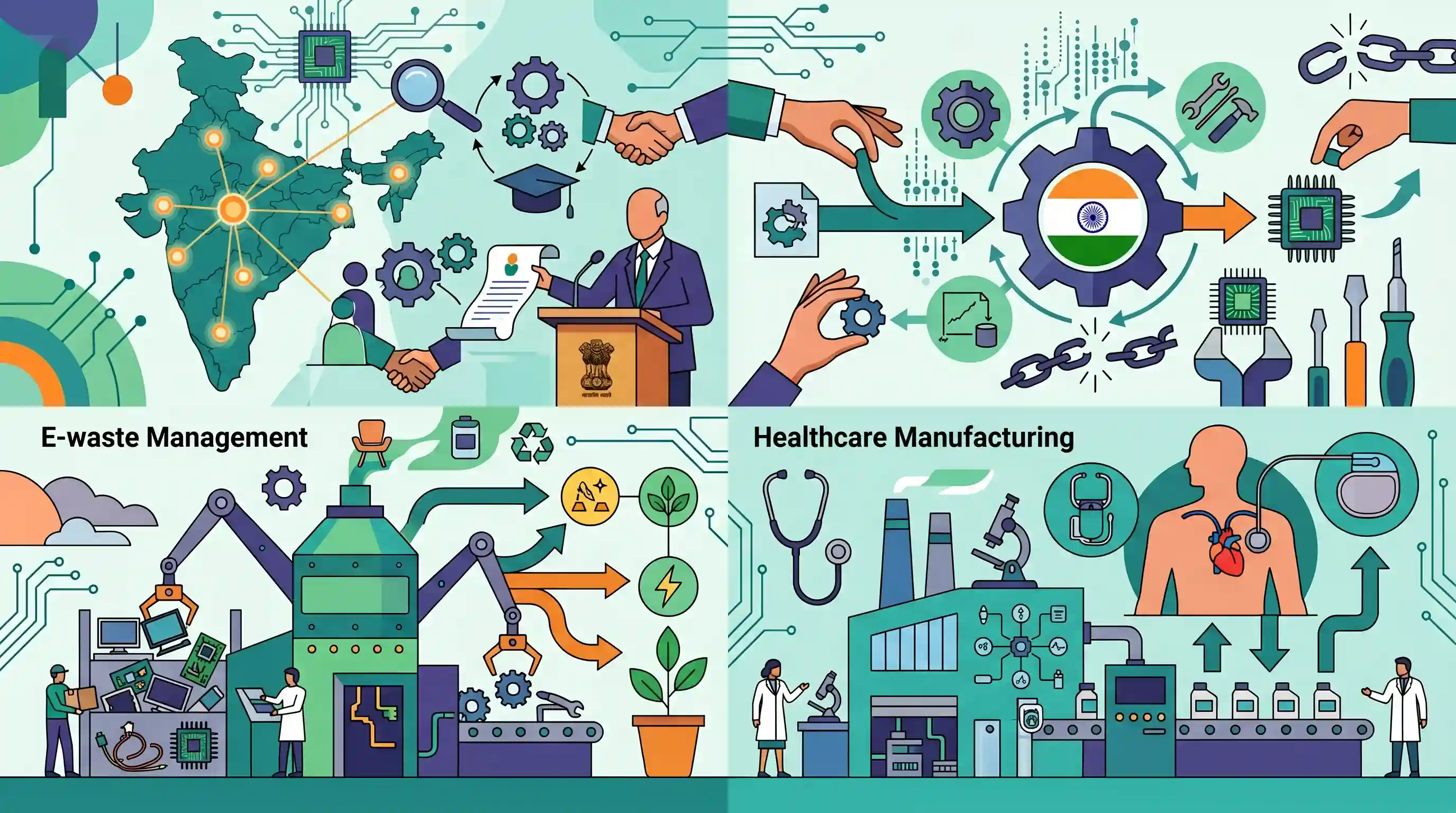
The Vizag Science and Technology Cluster (VSTC), housed at the Andhra Pradesh MedTech Zone (AMTZ), has been highlighted as a critical catalyst for innovation in the Science and Technology Clusters Annual Report 2024–25, released by Principal Scientific Adviser Ajay Sood. Operating as one of eight regional hubs nationwide, VSTC synergizes science, industry, and academia to advance 'Make in India' in healthcare. Notable outcomes include the indigenous development of cardiac pacemaker leads and the establishment of 'e-yantram'—a sustainable e-waste management facility developed with the National Metallurgical Laboratory.
Key Points
- Vizag Science and Technology Cluster (VSTC), based at AMTZ, is featured as one of India's eight strategic innovation hubs in the S&T Clusters Annual Report 2024–25.
- The cluster drives industry-academia collaboration to support 'Make in India' and 'Atmanirbhar Bharat' by indigenizing critical medical devices, such as pacemaker leads.
- VSTC launched 'e-yantram', a sustainable e-waste management facility developed in partnership with the National Metallurgical Laboratory (NML).
- These decentralized clusters (spanning cities like Bengaluru, Hyderabad, Pune, and Bhubaneswar) act as regional catalysts for translating scientific R&D into self-reliant industrial solutions.
Important Terms
Make in India

Launched in 2014, this flagship initiative aims to transform India into a global manufacturing hub by encouraging domestic and international companies to manufacture products within the country.
UPSC context
GS Paper 3: Indian Economy; tests knowledge of manufacturing growth, FDI policies, and industrial development strategies.
Atmanirbhar Bharat
A vision launched in 2020 focusing on self-reliance across five pillars: Economy, Infrastructure, Systems, Vibrant Demography, and Demand, aiming to integrate India into global supply chains.
UPSC context
GS Paper 3: Economic Development; relevant for indigenization of technology and achieving strategic autonomy in critical sectors.
Science and Technology (S&T) Clusters
A flagship initiative by the Office of the PSA that establishes regional hubs to synergize academia, industry, and government for solving regional challenges through technology-led solutions.
UPSC context
GS Paper 3: Science and Technology; covers innovation ecosystems, regional development, and industry-academia-government collaboration (Triple Helix model).
Office of the Principal Scientific Adviser (PSA)
The primary advisory body to the Prime Minister and Cabinet on S&T matters, responsible for evolving strategies, missions, and institutional frameworks for science and innovation.
UPSC context
GS Paper 2: Governance; GS Paper 3: S&T; tests understanding of institutional mechanisms for scientific policy-making.
Andhra Pradesh MedTech Zone (AMTZ)
India's first and largest dedicated medical technology park, providing common manufacturing and scientific facilities to reduce production costs and import dependency in healthcare.
UPSC context
GS Paper 3: Science and Technology; relevant for healthcare infrastructure, indigenization of medical devices, and self-reliance in pharmaceuticals.
National Metallurgical Laboratory (NML)
A premier research institution under the Council of Scientific & Industrial Research (CSIR) focused on minerals, metallurgy, and sustainable materials processing.
UPSC context
GS Paper 3: Science and Technology; significant for mineral security, waste-to-wealth initiatives (e-waste), and materials research.
Prelims Trap
"The S&T Clusters initiative is a flagship program of NITI Aayog to promote decentralized regional innovation."
The S&T Clusters initiative was launched by the Office of the Principal Scientific Adviser (OPSA) based on PM-STIAC recommendations, not NITI Aayog.
Static Concepts Connected
What is the mandate and structure of the PM-STIAC?
- Advisory Role: An overarching council that advises the Prime Minister on all matters related to science, technology, and innovation.
- Leadership: It is headed by the Principal Scientific Adviser (PSA) to the Government of India.
- Mission Implementation: It oversees and drives the implementation of 9 national science missions, including Deep Ocean, AI, and Quantum Tech.
What are the key provisions of the E-Waste (Management) Rules, 2022?
- EPR Framework: Introduces a market-based Extended Producer Responsibility (EPR) certificate regime for managing electronic waste.
- Expanded Coverage: Expands the regulated list to include solar photo-voltaic modules/panels, keeping up with renewable energy expansion.
- Material Recovery: Mandates specific targets for the extraction and recovery of valuable materials (like rare earths) from e-waste.
Cross-Topic Patterns
Urban Mining for Critical Minerals
India's clean-energy transition requires critical minerals. Initiatives like 'e-yantram' link sustainable e-waste management with 'urban mining' to extract rare earth elements and lithium, reducing import reliance on China.
MedTech Indigenization & PLI Scheme
The indigenization of pacemaker leads at AMTZ connects directly to the PLI scheme for medical devices, addressing India's historical 80% import dependency in the high-end medical equipment sector.

Expect a 2026 multi-statement question combining PM-STIAC/PSA's administrative role with urban mining and the E-Waste (Management) Rules.
Linked PYQs · 3
Linked PYQs · 3
- 2023MainsGS3
Faster economic growth requires increased share of the manufacturing sector in GDP, particularly of MSMEs. Comment on the present policies of the Government in this regard.
- 2018MainsGS3
What are the impediments in disposing the huge quantities of discarded solid wastes which are continuously being generated? How do we remove safely the toxic wastes that have been accumulating in our habitable environment?
- 2021MainsGS3
What are the research and developmental achievements in applied biotechnology? How will these achievements help to uplift the poorer sections of the society?
