Data centers in Visakhapatnam face environmental NGO protests
Source:The Hindu ↗
ఇది ఎందుకు ముఖ్యం
The rapid expansion of AI and digital infrastructure introduces significant, often overlooked environmental footprints. Understanding the resource intensity (water and energy) of hyperscale data centers is crucial for sustainable urban planning and environmental governance.
సారాంశం
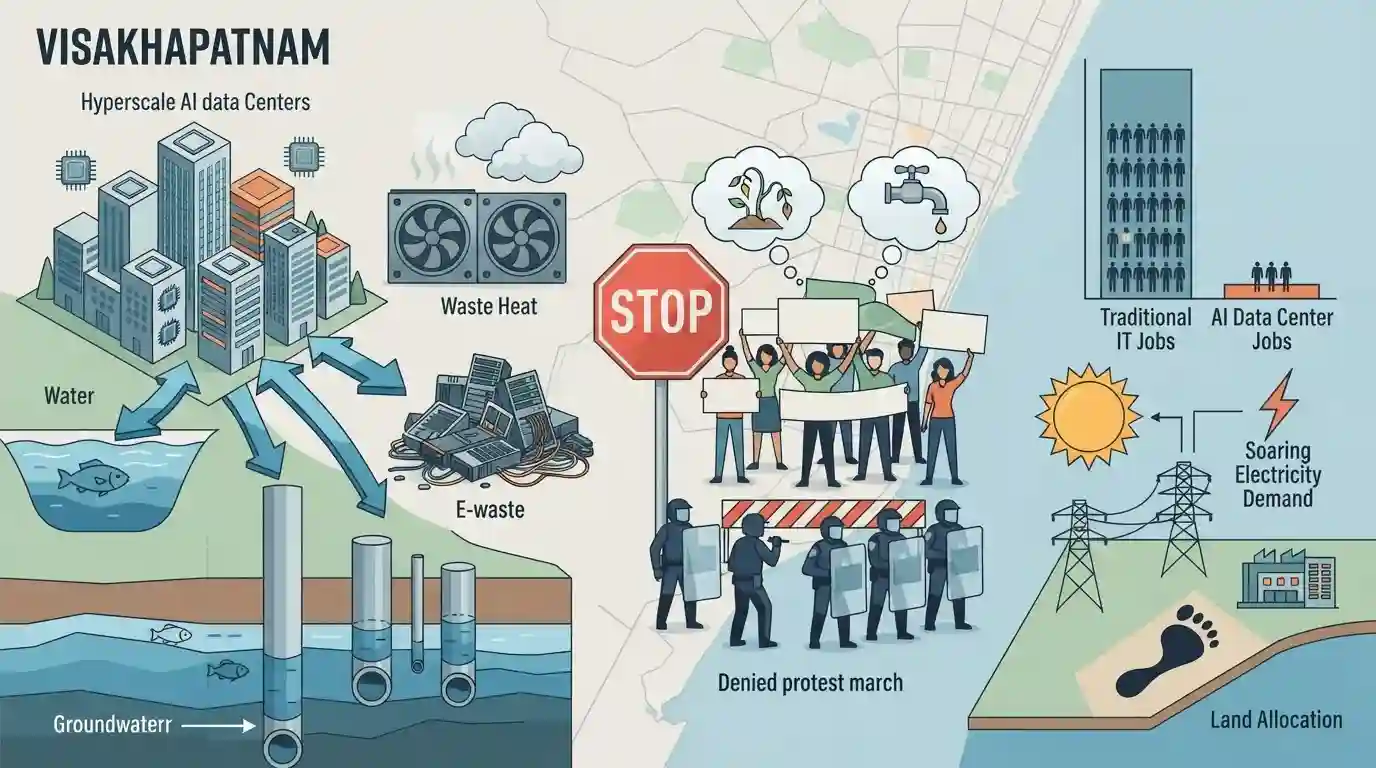
Vizag police denied permission for a rally organized by the NGO Green Visakha to protest the environmental consequences of hyperscale AI data centers proposed in Visakhapatnam. Activists raised alarms over the severe water consumption required for cooling, warning of potential groundwater depletion and stress on local reservoirs. Additional concerns include soaring electricity demands, waste heat, e-waste, and the allocation of prime land for projects that yield minimal direct employment compared to traditional IT infrastructure.
ముఖ్య అంశాలు
- Visakhapatnam police denied permission for a rally by environmental NGO Green Visakha against the establishment of hyperscale AI data centers, redirecting them to designated protest sites.
- Activists highlighted that AI data centers require millions of liters of water daily for cooling, which could severely deplete local water bodies like the Mudasarlova and Meghadrigedda reservoirs and local groundwater.
- Hyperscale data centers demand massive amounts of electricity, indirectly driving up greenhouse gas emissions, alongside generating significant waste heat and e-waste.
- Concerns were also raised regarding land allocation policies, noting that allocating large tracts of land (e.g., 130 acres to Adani Group) for data centers generates far fewer jobs compared to traditional IT parks.
ముఖ్యమైన పదాలు
Green Visakha

An environmental NGO in Andhra Pradesh advocating for ecological sustainability. It recently spearheaded civil society protests against the massive water and energy consumption of proposed hyperscale AI data centers in Visakhapatnam.
UPSC context
GS Paper 2 (Role of NGOs) & GS Paper 3 (Environment). Highlights civil society's role in seeking environmental accountability.
Hyperscale AI Data Centres
Massive computing facilities designed to support robust artificial intelligence applications. They require enormous amounts of electricity and water for cooling, raising severe ecological and groundwater-depletion concerns in water-stressed regions.
UPSC context
GS Paper 3 (Science & Tech, Environment). Tests knowledge on the ecological footprint and resource management of emerging digital infrastructure.
Adani Group
A major Indian multinational conglomerate. Through joint ventures, it is developing massive digital infrastructure, including a 1 GW AI data center hub in Visakhapatnam, which has sparked local environmental debates.
UPSC context
GS Paper 3 (Infrastructure, Investment Models). Relevant for analyzing corporate-led digital infrastructure development and its socio-environmental impacts.
CPI(M)
A prominent left-wing political party in India. In developmental debates, it frequently mobilizes political opposition alongside civil society against large-scale corporate projects that threaten local resources and environments.
UPSC context
GS Paper 2 (Political Parties, Pressure Groups). Illustrates the role of political opposition in environmental and infrastructural governance.
ప్రిలిమ్స్ ఉచ్చు
"The Right to Protest is explicitly enshrined as a Fundamental Right under Article 19 of the Constitution."
The Constitution does not explicitly mention the "Right to Protest". It is an implicit right derived jointly from Article 19(1)(a) and Article 19(1)(b).
అనుసంధానమైన స్థిర భావనలు
What are the constitutional provisions governing the right to assemble and protest?
- Derived Right: It is an implicit right derived from Article 19(1)(a) (freedom of speech) and Article 19(1)(b) (right to assemble peaceably and without arms).
- Reasonable Restrictions: Under Article 19(3), the State can impose restrictions on assembly in the interests of the sovereignty and integrity of India, or public order.
- Right to Strike: The Supreme Court has consistently held that while peaceful protest is fundamental, there is no fundamental or statutory right to strike.
What is employment elasticity in the context of capital-intensive investments?
- Definition: It measures the percentage change in employment associated with a 1 percent change in economic growth, indicating how labor-intensive a sector is.
- Sectoral Disparity: Hyperscale data centers require massive capital and land but have extremely low employment elasticity compared to traditional IT services, leading to "jobless growth" concerns.
అంతర-అంశ నమూనాలు
AI water footprint + Urban water crisis
Tropical data centres require millions of liters of water for cooling, directly aggravating urban water scarcity in coastal and peninsular cities already grappling with severe groundwater depletion.
E-Waste Rules + Bulk Consumers
Rapid hardware obsolescence in AI hyperscale centres brings them under strict scrutiny as major corporate entities governed by Extended Producer Responsibility (EPR) under the E-Waste (Management) Rules, 2022.

AI data centres' massive water and energy footprint will likely be tested as a multi-statement Prelims question on tech-ecology overlap.
అనుసంధాన PYQలు · 2
అనుసంధాన PYQలు · 2
- 2008APPSC_PRELIMSGS1
Which method of producing electricity causes maximum pollution ?
- 2024APPSC_PRELIMSGS1
With regard to the Startup Ecosystem in India, which of the following statement/statements is/are valid ? I. National Institute of Agricultural Extension Management (MANAGE) Centre will not be presiding over the selection process of the applications that are received under Startup Agri-Business Incubation Programme. II. Mentorship, Advisory, Assistance, Resilience and Growth (MAARG) Portal is an exclusive one-stop platform intended for guiding startups in the emerging Artificial Intelligence (AI) sector only. III. Startup India Seed Fund Scheme (SISFS) aims to provide financial assistance to startups for conducting 'proof of concept' trials. IV. Fund of Funds Scheme (FFS) for Startups is meant to contribute to various Alternative Investment Funds (AIFs) registered with the SEBI. Select the correct answer using the codes given below :
