Public Health Initiatives Improve India Key Vital Statistics
Source:The Hindu ↗
Why It Matters
Vital statistics such as IMR, MMR, and Life Expectancy are fundamental barometers of social development and human capital. Understanding these trends provides crucial evidence for evaluating public health policies and welfare schemes, directly relevant to GS2 (Issues relating to development and management of Social Sector/Services relating to Health) and GS1 (Population and associated issues).
Summary
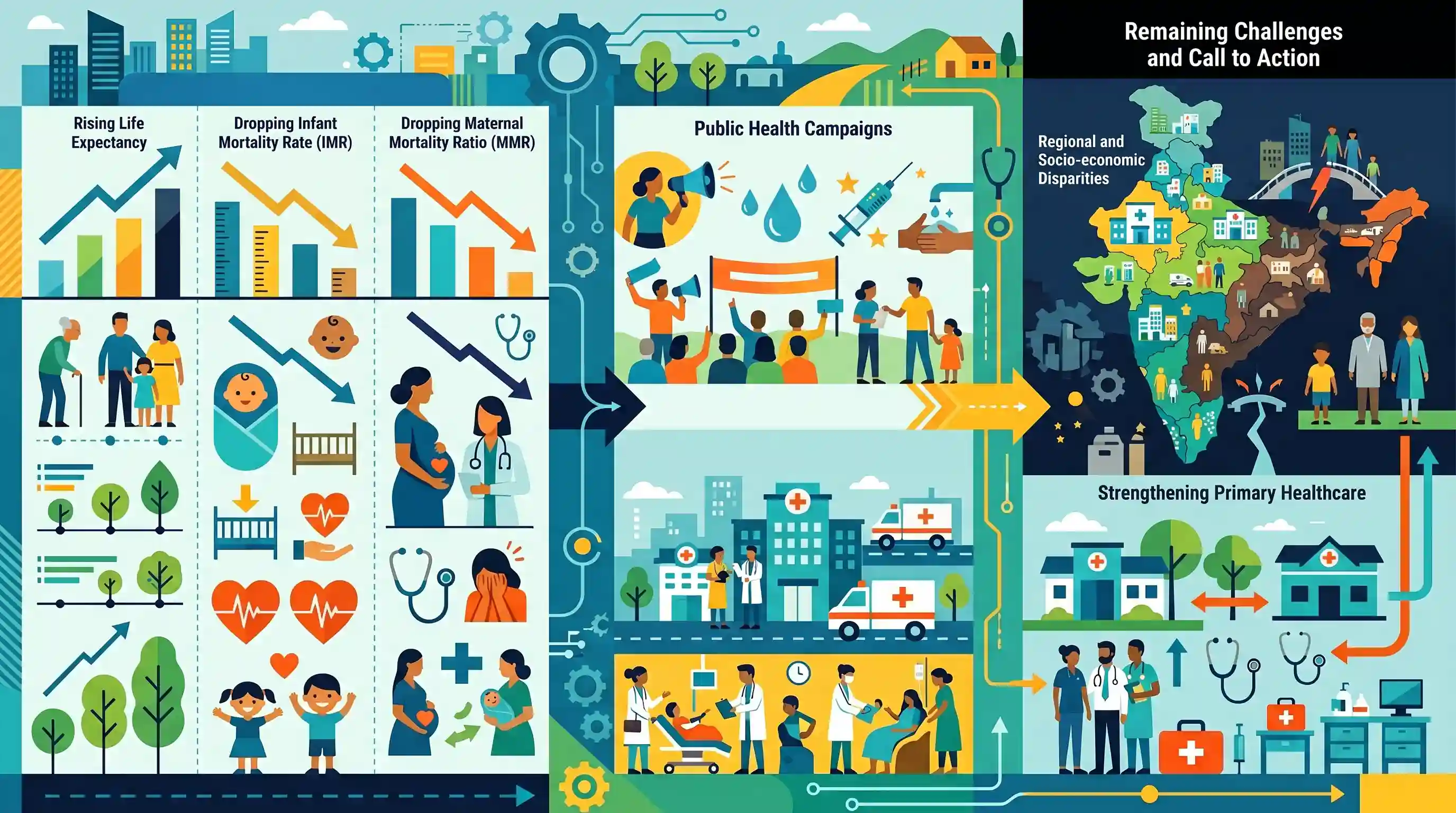
The article highlights the substantial progress India has made in improving its vital health indicators over the years. Reductions in the Infant Mortality Rate (IMR) and Maternal Mortality Ratio (MMR), coupled with a rise in life expectancy, underscore the success of public health campaigns and improved institutional delivery networks. While celebrating these vital gains, the article emphasizes the ongoing need to strengthen primary healthcare infrastructure to eliminate persisting regional and socio-economic disparities in health outcomes.
Key Points
- India has recorded significant improvements in key vital statistics, including a steady decline in the Infant Mortality Rate (IMR) and Maternal Mortality Ratio (MMR).
- There has been a consistent increase in Life Expectancy at birth, indicating better overall disease control, nutritional standards, and living conditions.
- Public health initiatives, particularly those incentivizing institutional deliveries and expanding immunization coverage, have been fundamental to these health gains.
- Despite the progress, policy interventions must focus on bridging the rural-urban divide and addressing inter-state disparities by strengthening primary healthcare at the grassroots level.
Important Terms
National Health Mission (NHM)

A flagship initiative launched in 2013 (subsuming NRHM and NUHM) to ensure universal access to equitable, affordable, and quality healthcare, focusing on maternal-child health and disease control.
UPSC context
GS 2: Social Justice (Health); GS 3: Welfare Schemes. Tests knowledge of public health infrastructure and healthcare delivery models.
Ministry of Health and Family Welfare (MoHFW)
India's apex administrative body responsible for formulating national health policy, implementing major health programs, and regulating medical services, medical education, and drug standards across the country.
UPSC context
GS 2: Governance and Social Sector. Essential for understanding the institutional framework and executive leadership in India's health sector.
Sample Registration System (SRS)
A large-scale demographic survey conducted by the Registrar General of India that provides reliable annual estimates of vital statistics, such as Infant Mortality Rate and Maternal Mortality Ratio.
UPSC context
GS 1: Population and Associated Issues; GS 2: Health. Key for analyzing demographic trends and assessing the efficacy of health policies.
World Health Organization (WHO)
A specialized United Nations agency established in 1948 to coordinate international public health, set global norms, and assist nations in achieving Sustainable Development Goals related to health.
UPSC context
GS 2: International Institutions. Important for understanding global health governance and India's international commitments to universal health coverage.
Prelims Trap
Maternal Mortality Ratio (MMR) is the number of maternal deaths per 1,000 live births.
MMR is measured per 100,000 live births, whereas the Infant Mortality Rate (IMR) is measured per 1,000. UPSC frequently swaps these base denominators to trick candidates.
Static Concepts Connected
What is the Sample Registration System (SRS) and who operates it?
- Authority: It is operated by the Office of the Registrar General, India, under the Ministry of Home Affairs.
- Purpose: It provides reliable annual estimates of birth rate, death rate, IMR, and MMR at national and sub-national levels, acting as India's largest demographic sample survey.
How are key vital health indicators (IMR and MMR) defined?
- IMR: The number of infant deaths (under one year of age) per 1,000 live births in a given year.
- MMR: The number of maternal deaths during a given time period per 100,000 live births during the same time period.
Cross-Topic Patterns
Health outcomes and Demographic Dividend
Improving life expectancy and reducing IMR/MMR are structural prerequisites for reaping India's demographic dividend, linking GS2 health interventions directly with GS3 economic growth and labor productivity.
Cash transfers driving institutional changes
Janani Suraksha Yojana (JSY) exemplifies how conditional cash transfers (DBT) alter behavioral economics at the grassroots, shifting cultural preferences toward institutional deliveries and driving down MMR.

Expect a comparative statement linking SRS vital statistics (IMR/MMR) with NFHS-5 data and specific SDG targets in 2026 prelims.
Linked PYQs · 5
Linked PYQs · 5
- 2024PrelimsGS1
The total fertility rate in an economy is defined as:
- 2009PrelimsGS1
Consider the following statements: 1. Infant mortality rate takes into account the death of infants within a month after birth. 2. Infant mortality rate is the number of infant deaths in a particular year per 100 live births during that year. Which of the above statements is/are correct?
- 2020MainsGS2
In order to enhance the prospects of social development, sound and adequate health care policies are needed particularly in the fields of geriatric and maternal health care. Discuss.
- 2024MainsGS2
In a crucial domain like the public healthcare system the Indian State should play a vital role to contain the adverse impact of marketisation of the system. Suggest some measures through which the State can enhance the reach of public healthcare at the grassroots level.
- 2021MainsGS2
“Besides being a moral imperative of a Welfare State, primary health structure is a necessary precondition for sustainable development.” Analyze.
