VISTAR and India Real Time Statistical System Modernisation
Source:The Hindu ↗
Why It Matters
Reliable and timely data is the bedrock of economic policy, planning, and GDP computation. Understanding VISTAR provides insights into India's statistical reforms and administrative governance.
Summary
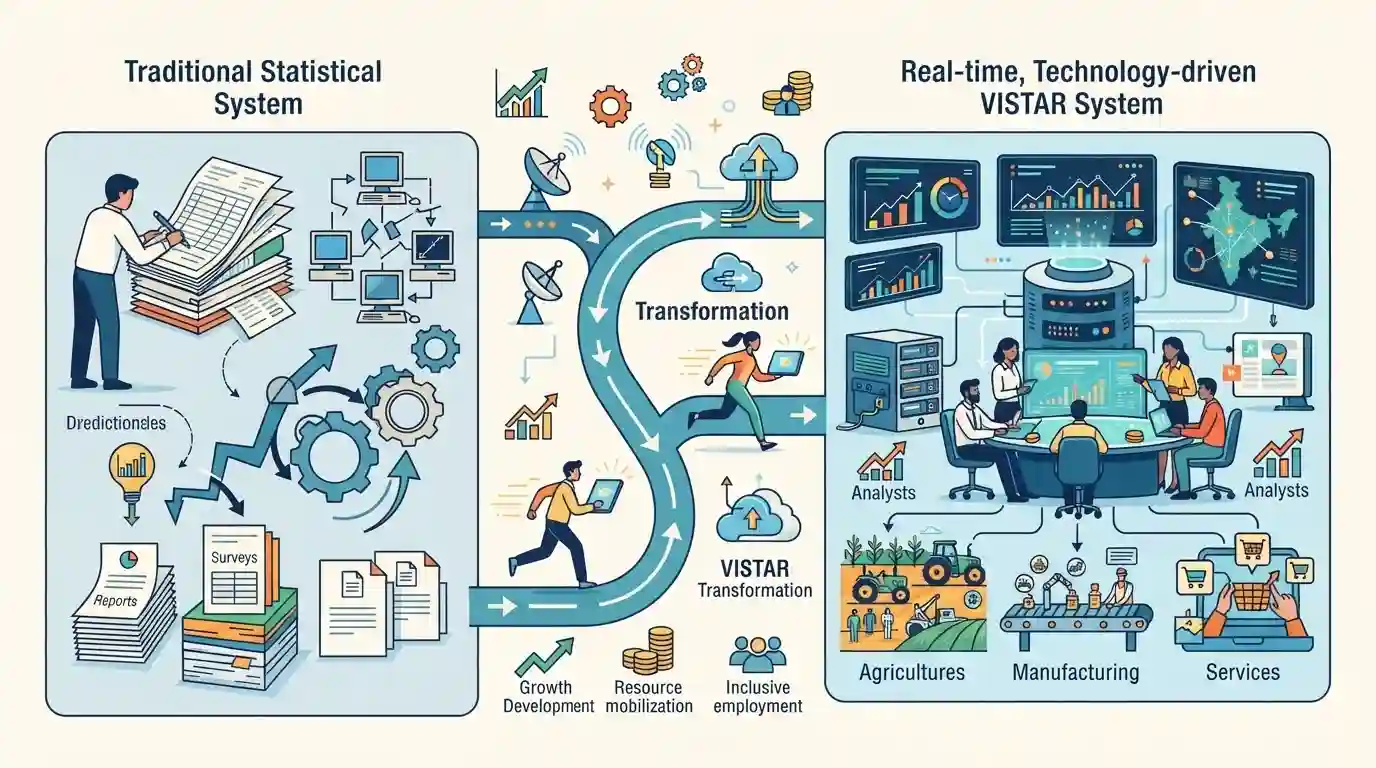
VISTAR is India's strategic push towards a real-time, technology-driven statistical system designed to modernize economic data collection, minimize lags, and improve the accuracy and speed of macroeconomic governance.
Key Points
- VISTAR represents India's transition towards a real-time, technology-driven statistical system to modernise data collection and economic tracking.
- The initiative aims to address existing lags and gaps in official macroeconomic statistics and policy formulation.
- It leverages digital architecture to integrate data streams for timely economic governance.
Important Terms
VISTAR

Viksit Bharat Initiative for Statistical Transformation, Analytics & Research (VISTAR) is a central sector scheme aimed at modernizing India's statistical system into a real-time, AI-ready, future-oriented framework.
UPSC context
GS Paper III (Economy): Tests understanding of economic planning, data modernization, and governance reforms for Viksit Bharat 2047.
Ministry of Statistics and Programme Implementation
The nodal central ministry responsible for the formulation, coordination, and maintenance of official statistical standards, national accounts, and large-scale socio-economic surveys in India.
UPSC context
GS Paper II/III: Important for governance, institutional framework of economic planning, and macroeconomic data integrity in India.
MOSPI
Abbreviation for the Ministry of Statistics and Programme Implementation, the apex government body overseeing India's macroeconomic data collection and national statistical machinery.
UPSC context
GS Paper III (Economy): Essential administrative body linked to GDP estimation, inflation tracking, and policy database management.
Prelims Trap
VISTAR is a real-time monetary policy instrument introduced by the Reserve Bank of India to regulate liquidity.
Aspirants often confuse VISTAR with a direct monetary policy tool of the RBI, whereas it is a statistical architecture initiative by the Ministry of Statistics and Programme Implementation (MoSPI) to modernize data collection.
Static Concepts Connected
What are the key institutional bodies responsible for macroeconomic data collection and compilation in India?
- MoSPI role: Responsible for the compilation of national accounts, Index of Industrial Production (IIP), and Consumer Price Index (CPI).
- NSSO function: An autonomous body under MoSPI responsible for conducting large-scale sample surveys across the country.
- RBI contribution: Maintains database on money supply, banking statistics, foreign exchange, and external sector data.
Cross-Topic Patterns
Digital Public Infrastructure + Fiscal Governance
Modernizing national statistics through digital public infrastructure directly supports evidence-based fiscal targeting and better macroeconomic stabilization policies under the Fiscal Responsibility and Budget Management (FRBM) framework.
Real-Time Data + Monetary Policy Framework
Real-time economic tracking minimizes information asymmetries, empowering the RBI's Monetary Policy Committee with high-frequency data for inflation targeting and growth management.

VISTAR initiative and digital statistical modernization likely to feature in prelims as a statement-based question on economic governance.
Linked PYQs · 1
Linked PYQs · 1
- 2021MainsGS3
Explain the difference between computing methodology of India's Gross Domestic Product (GDP) before the year 2015 and after the year 2015.
