Guru Ravidas Vision of Begampura and Egalitarian Society
Source:Indian Express ↗
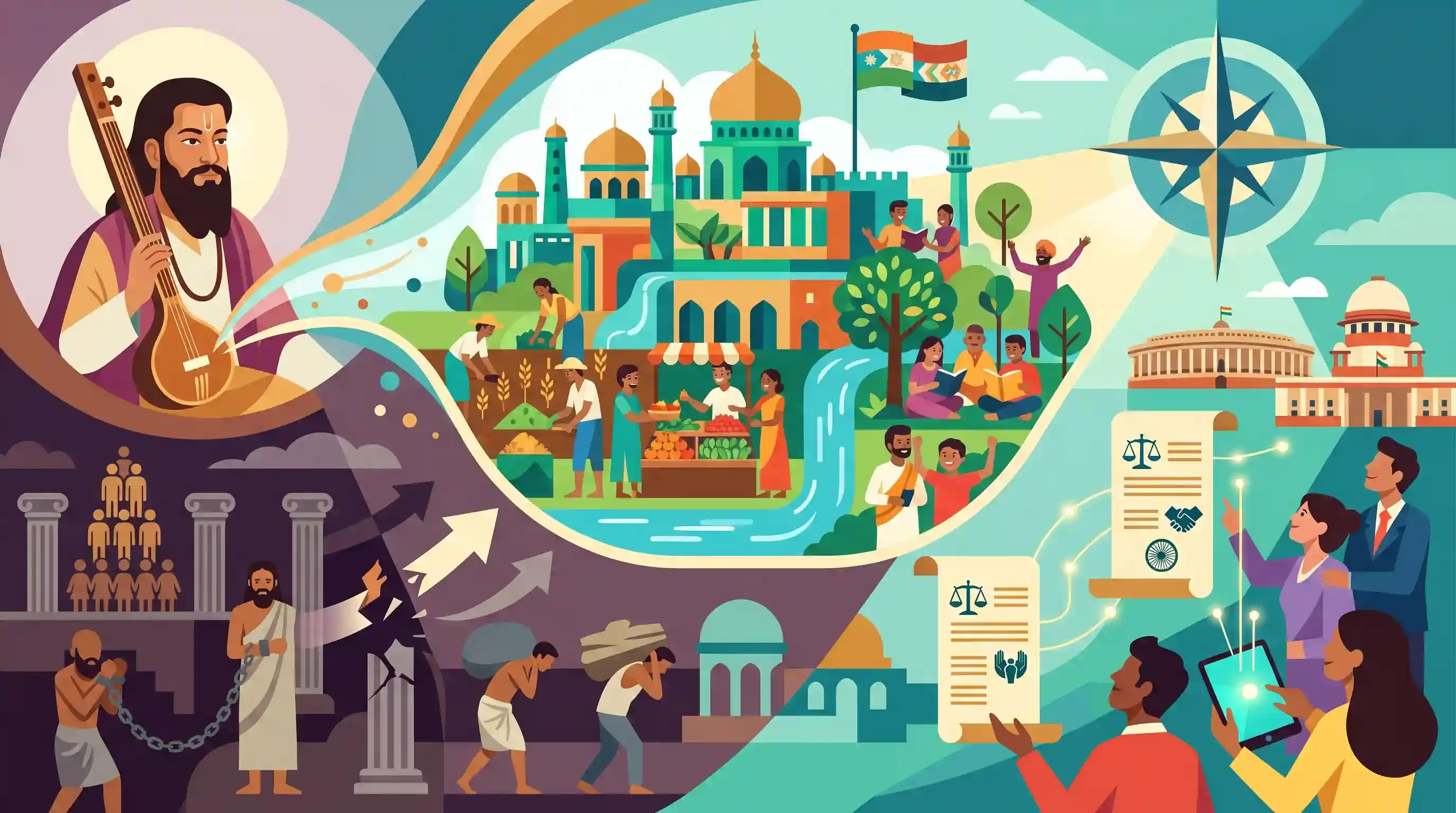
Why It Matters
Guru Ravidas and the concept of Begampura are central to understanding the socio-cultural reform dimensions of the Bhakti movement. It provides a philosophical foundation for answers on social justice, caste discrimination, and constitutional morality in GS1, GS2, and GS4.
Summary
The article discusses 'Begampura', an egalitarian utopian vision articulated by the 15th-century Bhakti poet-saint Guru Ravidas. It highlights how Begampura represents a society free from sorrow, caste hierarchy, taxes, and discrimination, serving as a historical critique of social oppression. The piece emphasizes the enduring relevance of Guru Ravidas's vision as a moral compass for building a truly inclusive and socially just society, reflecting the core egalitarian principles embedded in the Indian Constitution.
Key Points
- Guru Ravidas, a 15th-century Bhakti saint, envisioned 'Begampura'—a utopian 'city without sorrow' characterized by a casteless, classless, and stateless society.
- The concept serves as a powerful critique of social stratification, caste-based discrimination, and economic exploitation.
- Begampura champions human dignity, egalitarianism, and unhindered social and spiritual freedom for all individuals.
- The ethical and social vision of Begampura deeply aligns with modern Indian constitutional values, particularly the Right to Equality and Directive Principles of State Policy.
Prelims Trap
"Begampura was a medieval city founded by the followers of the Saguna Bhakti tradition in North India."
Begampura is a metaphorical, utopian concept representing a casteless, classless society, not a historical physical kingdom or administrative center established by a ruler.
Static Concepts Connected
What distinguishes the Nirguna and Saguna schools of the Bhakti movement?
- Form of God: Nirguna worships a formless, universal supreme being, while Saguna focuses on a deity with distinct attributes, avatars, and physical forms.
- Key figures: Kabir, Guru Nanak, and Ravidas belong to the Nirguna school; Tulsidas, Surdas, and Chaitanya Mahaprabhu represent the Saguna tradition.
- Social critique: Nirguna saints generally provided a more radical, anti-establishment critique of caste hierarchies and religious orthodoxy compared to Saguna saints.
How does the Indian Constitution structurally mandate the egalitarian ideals seen in historical philosophies?
- Right to Equality: Articles 14 to 18 abolish untouchability and prohibit discrimination on grounds of religion, race, caste, sex, or place of birth, ensuring civic egalitarianism.
- Economic Justice (DPSP): Article 39 mandates policies preventing the concentration of wealth and ensuring equal pay, echoing the classless economic ideals of 'Begampura'.
Cross-Topic Patterns
Bhakti ideals in the Indian Constitution
UPSC increasingly maps historical reform movements to constitutional provisions. Ravidas's 'Begampura' perfectly aligns with fundamental rights (Equality under Articles 14-18) and socio-economic justice goals in the DPSPs.
Ramananda's radical disciple network
Ramananda's disciples bridged massive social divides. Guru Ravidas (a cobbler) acting as the spiritual guide to Mirabai (a Rajput royal) highlights the movement's subversion of rigid caste and gender hierarchies.

Expect a 2026 Prelims question pairing Bhakti saints like Ravidas with their utopian concepts (Begampura) or constitutional overlaps.
Linked PYQs · 5
Linked PYQs · 5
- 2021MainsGS1
Evaluate the nature of the Bhakti literature and its contribution to Indian culture.
- 2018MainsGS1
The Bhakti movement received a remarkable re-orientation with the advent of Sri Chaitanya Mahaprabhu. Discuss.
- 2017PrelimsGS1
One of the implications of equality in society is the absence of
- 2021PrelimsGS1
Under the Indian Constitution, concentration of wealth violates
- 2015MainsGS4
“Social values are more important than economic values.” Discuss the above statement with examples in the context of inclusive growth of a nation.
