Vision 2030 roadmap launched to boost inland fisheries in Bihar
Source:dd-india ↗
Why It Matters
State-specific initiatives related to agriculture, allied sectors, and economic growth are heavily tested in BPSC Prelims. Memorizing the proposed clusters and their respective districts (e.g., Scampi in Saran, Cage in Munger) is important for matching questions.
Summary
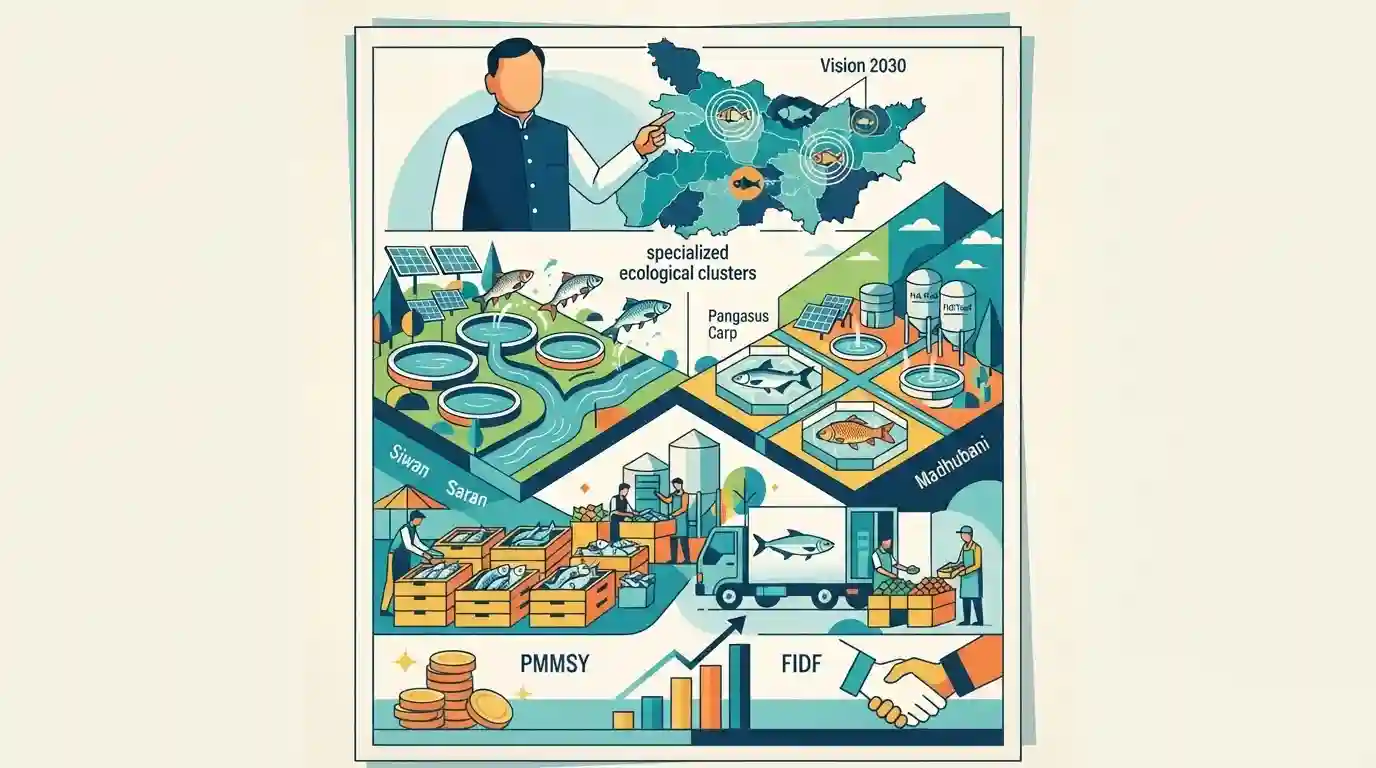
The Bihar state government has rolled out the 'Vision 2030 – Bihar Fisheries Priority Projects' to elevate the state into a premier inland fisheries hub in India. Discussed at a review meeting by Chief Minister Samrat Choudhary, the roadmap sets specific targets for fish production and geographic intervention areas. Crucially, the plan introduces specialized ecological clusters across various districts—such as Siwan, Saran, Munger, and Madhubani—to promote species-specific and ecosystem-based aquaculture, backed by national schemes like PMMSY and FIDF.
Key Points
- Bihar Chief Minister Samrat Choudhary reviewed the 'Vision 2030 – Bihar Fisheries Priority Projects' with the aim of establishing Bihar as a leading inland fisheries state.
- The Vision 2030 project targets 1,848.75 hectares for direct intervention and 9,357 hectares for overall project impact, aspiring to produce an additional 50,200 metric tonnes of fish.
- The initiative relies on financial assistance from the Fisheries and Aquaculture Infrastructure Development Fund (FIDF) and Pradhan Mantri Matsya Sampada Yojana (PMMSY).
- Specialized regional clusters have been proposed based on geographic advantages: a Wetland Cluster in Siwan, a Scampi (freshwater prawn) Cluster in Saran, a Cage Cluster in Munger, wetland fish farming in Mithila (Madhubani), and a comprehensive cluster in Motihari.
Important Terms
Vision 2030 – Bihar Fisheries Priority Projects

A strategic state roadmap to elevate Bihar into a leading inland fisheries hub by establishing specialized ecological clusters, aiming to produce 50,200 metric tons of fish through sustainable aquaculture.
UPSC context
GS Paper 3 (Agriculture/Blue Economy). Highlights state-specific initiatives for allied sector growth and regional development.
Pradhan Mantri Matsya Sampada Yojana (PMMSY)
A flagship ₹20,050 crore Central umbrella scheme launched in 2020 to catalyze a Blue Revolution. It aims to modernize the fisheries value chain, ensure ecological sustainability, and double fishers' incomes.
UPSC context
GS Paper 3 (Agriculture). Tests knowledge of central sector schemes aimed at expanding the Blue Economy and rural livelihoods.
Fisheries and Aquaculture Infrastructure Development Fund (FIDF)
A dedicated ₹7,522.48 crore central fund providing concessional finance to states, cooperatives, and private entities for creating and modernizing fisheries infrastructure, such as fishing harbors and cold storages.
UPSC context
GS Paper 3 (Infrastructure/Economy). Tests understanding of institutional credit mechanisms supporting allied agricultural sectors.
Fisherman Cooperative Societies
Grassroots collectives that empower fishers by pooling resources, providing access to institutional credit, securing fair market prices, and acting as key implementation agencies for state and central aquaculture schemes.
UPSC context
GS Paper 2 & 3 (Cooperatives). Tests the role of decentralized, community-driven organizations in socio-economic empowerment and scheme delivery.
Prelims Trap
Marine fisheries constitute the majority of India's total fish production.
Aspirants often assume India's vast coastline dictates fish production. In reality, inland fisheries and aquaculture now contribute over 70% of the total national fish production, heavily outpacing marine sources.
Static Concepts Connected
What are the primary ecological concerns associated with Cage Aquaculture?
- Eutrophication: Accumulation of unused feed and fish excreta in enclosed net cages can lead to severe localized water pollution and algal blooms.
- Disease Outbreaks: High stocking densities in cages make fish highly susceptible to rapid transmission of pathogens and parasites.
- Genetic Pollution: Farmed fish escaping from cages can interbreed with wild populations, potentially altering local aquatic genetics and biodiversity.
What are the key mechanisms of the Fisheries and Aquaculture Infrastructure Development Fund (FIDF)?
- Interest Subvention: FIDF provides up to 3% interest subvention per annum for developing critical infrastructure like cold storages and fish landing centers.
- Eligible Entities: State governments, cooperatives, and private entrepreneurs can access this concessional finance to modernize the post-harvest fisheries value chain.
Cross-Topic Patterns
Blue Economy + Forex Exports
Bihar's focus on a Scampi (freshwater prawn) cluster ties directly into India's export economy, where frozen shrimp dominates, accounting for nearly 65% of India's seafood export earnings.
Disaster Geography + Wetland Livelihoods
The integration of wetland fisheries in Mithila and Siwan demonstrates how North Bihar's flood-prone topography (Chaurs/Mauns) is being ecologically repurposed for sustainable livelihood generation.

Expect a 2026 Prelims question comparing inland vs marine fisheries production trends combined with PMMSY's cluster approach.
Linked PYQs · 2
Linked PYQs · 2
- 2023BPSC_PRELIMSGS1
Bihar Government has planned to make Bihar State ‘pollution-free’ by reducing carbon emissions by which year?
- 2020BPSC_PRELIMSGS1
Bihar Government launched a new scheme 'Satat Jivikoparjan Yojana' in August 2018. The objective of this scheme is
