Vishu Festival and Socio-Economic Health Governance in Kerala
Source:The Hindu ↗
Why It Matters
The article blends regional cultural traditions with pressing socio-economic issues. The protests by ASHA workers underline the ongoing challenges faced by community-level healthcare workers, a critical component of India's public health infrastructure. Furthermore, the 'Care for Rare' initiative highlights innovative funding mechanisms in public health governance.
Summary
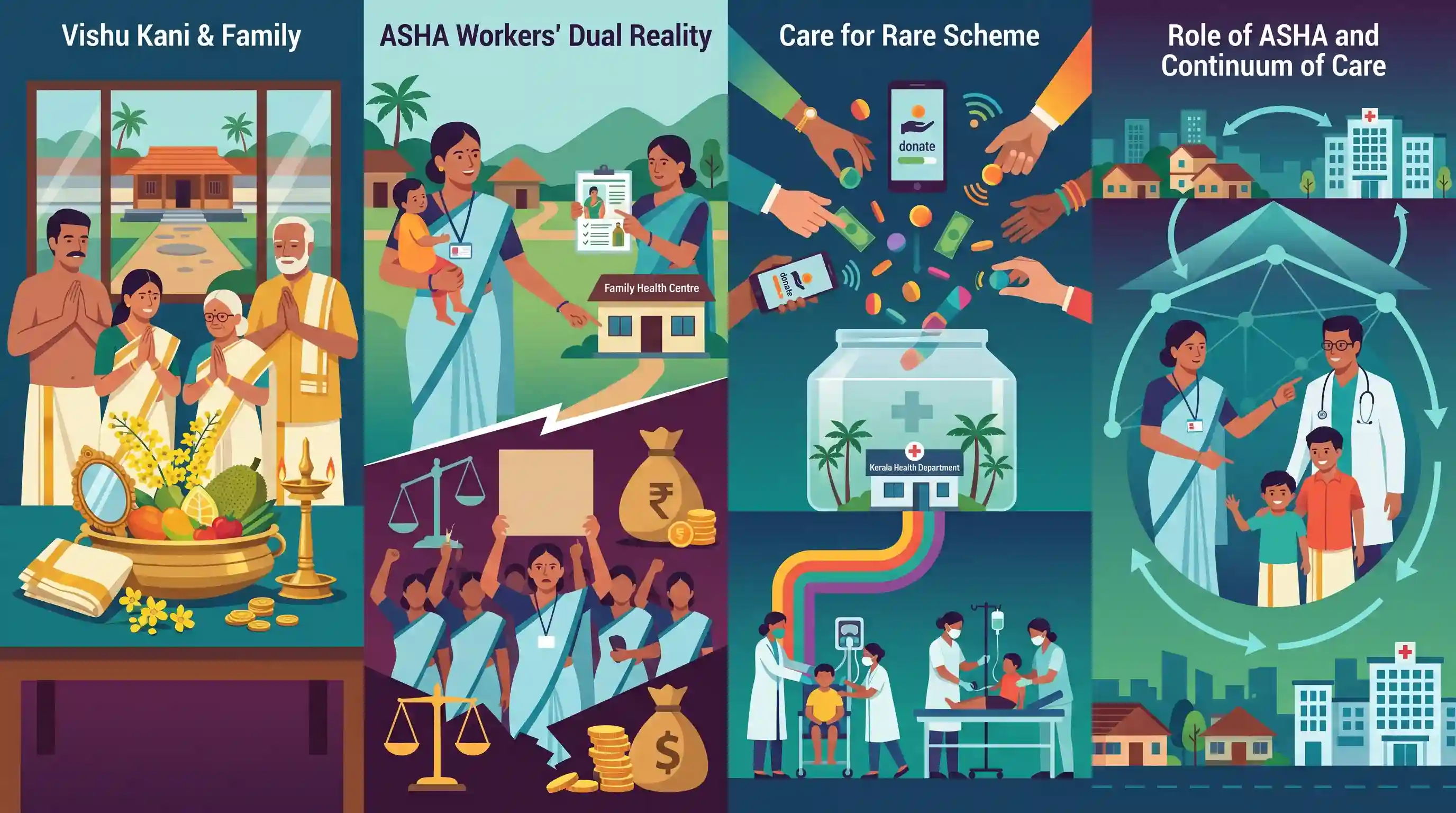
The article describes the cultural celebration of Vishu, the Malayalam New Year, in Kerala, defined by family gatherings and the traditional 'Vishu Kani' ritual. Alongside the festivities, it highlights the ongoing socio-economic struggles of ASHA workers, who protested for fair honorariums, and introduces the 'Care for Rare' scheme launched by the Kerala Health Department to crowdsource funds for children battling rare diseases.
Key Points
- Vishu, the Malayalam New Year, is celebrated on the first day of the Medam month, marked by the traditional 'Vishu Kani' ritual symbolizing prosperity.
- Devotees thronged major temples across Kerala, including Sabarimala Ayyappa Temple, Guruvayoor Sree Krishna Temple, and Sree Padmanabha Swamy Temple, to offer prayers.
- ASHA workers in Kerala staged protests by setting up 'Vishu Kanis' at agitation venues, demanding better honorariums and highlighting their financial struggles.
- The Kerala Health Department launched an online scheme called 'Care for Rare' to raise funds for the treatment of children suffering from rare diseases.
Important Terms
Vishu

Malayalam New Year celebrating the spring equinox. It marks the sun's move into Medam (Aries), symbolizing new beginnings, agricultural cycles, and the balance of light and darkness.
UPSC context
Relevant for GS Paper I: Indian Culture, specifically regional festivals and their astronomical/mythological significance.
Vishu Kani
The "first sight" ritual of Vishu involving a curated arrangement of auspicious items (gold, flowers, fruits) viewed at dawn to ensure a prosperous year ahead.
UPSC context
Tests knowledge of regional cultural traditions and rituals under GS Paper I: Art and Culture.
Accredited Social Health Activist (ASHA)
Trained female community health volunteers under India's National Health Mission who serve as a critical interface between marginalized communities and the public health system.
UPSC context
GS Paper II: Governance and Social Justice; tests knowledge of grassroots health delivery and welfare of vulnerable sections.
Care for Rare (KARE) Scheme
A Kerala state initiative (also known as KARE) that provides comprehensive care and crowdfunding for children battling rare diseases, supplementing the National Policy for Rare Diseases.
UPSC context
GS Paper II: Issues relating to the development and management of the Social Sector/Services relating to Health.
National Health Mission (NHM)
India’s flagship health program comprising Rural (NRHM) and Urban (NUHM) missions, aimed at achieving universal access to equitable, affordable, and quality health care.
UPSC context
Crucial for GS Paper II: Government policies and interventions for development in various sectors.
Prelims Trap
ASHA workers are permanent employees of the State Health Department with fixed monthly salaries.
ASHA workers are not permanent salaried employees. Under the National Health Mission, they are classified as 'honorary volunteers' receiving performance-based incentives and a base honorarium.
Static Concepts Connected
What are the key architectural and geographical features of major Kerala temples?
- Sabarimala Temple: Situated geographically deep inside the Periyar Tiger Reserve in the Western Ghats.
- Padmanabhaswamy Temple: Features a unique blend of indigenous Kerala and Dravidian architecture. It is one of the 108 'Divya Desams' praised by Tamil Alvar saints.
What is the mandate and remuneration structure of ASHA workers?
- Volunteer Status: Classified as 'honorary volunteers' under the National Health Mission (NHM), acting as the interface between the community and the public health system.
- Remuneration: They receive a fixed base honorarium plus performance-based incentives.
- Funding Ratio: NHM funding for their honorariums is typically shared between the Centre and States in a 60:40 ratio.
Cross-Topic Patterns
Rare Diseases + Crowdfunding Mechanisms
Kerala's 'Care for Rare' scheme operationalizes the National Policy for Rare Diseases (NPRD) 2021, which explicitly encourages digital crowdfunding to supplement the ₹50 lakh government support under Rashtriya Arogya Nidhi.
Equinox Festivals + Cultural Geography
Vishu aligns with the spring equinox harvest, joining a cluster of traditional regional New Years (Baisakhi, Rongali Bihu, Puthandu) that are frequently tested together in Prelims matching questions.

A Prelims question merging the volunteer status/funding of ASHA workers under NHM with state-level welfare protests is highly probable.
Linked PYQs · 4
Linked PYQs · 4
- 2012PrelimsGS1
With reference to National Rural Health Mission, which of the following are the jobs of 'ASHA'; a trained community health worker? 1. Accompanying women to the health facility for antenatal care checkup 2. Using pregnancy test kits for early detection of pregnancy 3. Providing information on nutrition and immunization 4. Conducting the delivery of baby Select the correct answer using the codes given below:
- 2018MainsGS2
Appropriate local community-level healthcare intervention is a prerequisite to achieve 'Health for All' in India. Explain.
- 2020MainsGS2
In order to enhance the prospects of social development, sound and adequate health care policies are needed particularly in the fields of geriatric and maternal health care. Discuss.
- 2024MainsGS2
In a crucial domain like the public healthcare system the Indian State should play a vital role to contain the adverse impact of marketisation of the system. Suggest some measures through which the State can enhance the reach of public healthcare at the grassroots level.
