Visakhapatnam citizens forum seeks action plan on air pollution
Source:The Hindu ↗
Why It Matters
The article provides a localized case study of urban environmental degradation (both air and marine) and demonstrates the proactive role of civil society in demanding administrative accountability and proposing policy interventions (like NCAP enforcement).
Summary
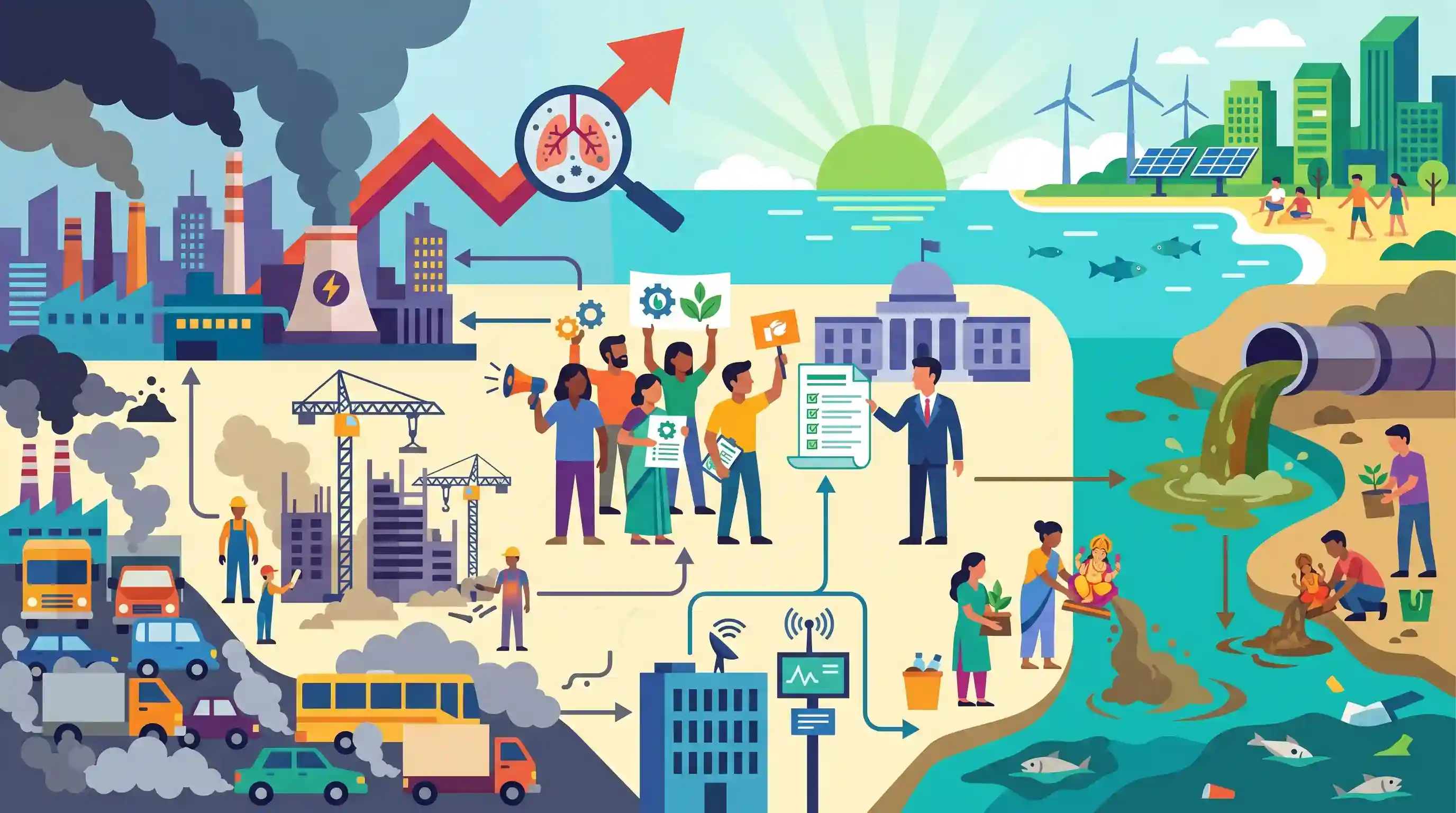
The Greater Visakhapatnam Citizens' Forum has urged the local administration to adopt a six-point action plan to combat the city's worsening air and water quality. Citing NCAP data that shows a nearly 33% rise in PM10 levels since 2017, the forum is demanding strict curbs on industrial coal dust, construction emissions, and vehicular pollution, along with expanded real-time air quality monitoring. The citizens' group also highlighted the need to address coastal water pollution by better managing sewage discharge and promoting eco-friendly alternatives for religious idol immersion.
Key Points
- Visakhapatnam's PM10 levels rose 32.9% between 2017-18 and 2024-25, according to National Clean Air Programme (NCAP) data.
- The Greater Visakhapatnam Citizens’ Forum proposed a six-point action plan to the district administration to mitigate worsening air pollution.
- Recommendations include strictly regulating coal dust from ports, mandating pollution-monitoring units at construction sites, and increasing checks on vehicular emissions.
- The forum emphasized the need for more Continuous Ambient Air Quality Monitoring Stations (CAAQMS), making them mandatory for red-category industries.
- Concerns were also raised over marine pollution from sewage discharge and idol immersion, with the forum advocating for artificial immersion ponds and clay idols.
Important Terms
National Clean Air Programme (NCAP)

India's flagship 2019 strategy targeting a 40% reduction in particulate matter (PM10 and PM2.5) by 2026 across 131 cities.
UPSC context
GS III Environment; key policy framework for air quality management and time-bound pollution targets.
PM10 (Particulate Matter)
Inhalable particles with a diameter of 10 micrometers or less, typically resulting from road dust, construction activities, and industrial emissions.
UPSC context
GS III Environment; health impacts and pollutant classification for air quality monitoring.
Non-attainment Cities
Cities that have consistently failed to meet the National Ambient Air Quality Standards (NAAQS) for a period of five consecutive years.
UPSC context
GS III Environment; core targeting mechanism for urban air pollution mitigation under NCAP.
Central Pollution Control Board (CPCB)
A statutory body established in 1974 that sets national standards for air and water quality and advises the central government.
UPSC context
GS II Governance / Statutory Bodies; apex regulatory agency for environmental monitoring and enforcement.
Coastal Regulation Zone (CRZ)
Notified under the Environment Protection Act, 1986, to regulate human activity and industrial discharge near India's coastlines.
UPSC context
GS III Environment; vital for coastal conservation and regulating sewage discharge in marine ecosystems.
Civil Society Organizations (CSOs)
An umbrella term for groups like the GVCF that represent public interests and advocate for better urban governance and accountability.
UPSC context
GS II Governance; focuses on the role of citizen forums as pressure groups in policy implementation.
Prelims Trap
"Continuous Ambient Air Quality Monitoring Stations track Carbon Dioxide (CO2) levels."
AQI and CAAQMS monitor Carbon Monoxide (CO), but NOT CO2 or Methane. Aspirants frequently confuse global greenhouse gases with local toxic air pollutants.
Static Concepts Connected
What are the core features of the National Clean Air Programme (NCAP)?
- Reduction Target: Aims for a 40% reduction in PM2.5 and PM10 concentrations by 2026, using 2017 as the base year for comparison.
- Non-Attainment Cities: Targets 131 cities that consistently failed to meet the National Ambient Air Quality Standards (NAAQS) over a consecutive five-year period.
- Legal Status: It is a collaborative, cross-sectoral scheme relying on awareness and state action plans, lacking strict legal penal provisions for non-compliance.
How does Plaster of Paris (PoP) idol immersion degrade aquatic ecosystems?
- Deoxygenation: Insoluble PoP and organic matter decomposition drastically reduce Dissolved Oxygen (DO), causing mass mortality of fish and aquatic life.
- Heavy Metal Toxicity: Chemical paints release toxic heavy metals like lead, cadmium, and mercury, which bioaccumulate in marine and estuarine food webs.
- pH Alteration: Chemical runoff alters water alkalinity and pH levels, disrupting the sensitive chemical balance required for local flora and fauna.
Cross-Topic Patterns
Industrial ports vs. Urban sprawl
Visakhapatnam exemplifies the clash between expanding commercial port zones (handling fugitive coal dust) and adjacent residential sprawl, making it a prime case study for GS1 Urbanization and industrial planning.
Civil society in environmental governance
The reliance on citizens' forums to mandate real-time pollution monitoring highlights systemic enforcement gaps and under-capacity of State Pollution Control Boards in regulating red-category industries.

NCAP non-attainment criteria and identifying exact AQI pollutants (CO vs CO2) are highly likely to form a multi-statement Prelims question.
Linked PYQs · 4
Linked PYQs · 4
- 2020MainsGS3
What are the key features of the National Clean Air Programme (NCAP) initiated by the Government of India?
- 2021MainsGS3
Describe the key points of the revised Global Air Quality Guidelines (AQGs) recently released by the World Health Organisation (WHO). How are these different from its last update in 2005? What changes in India's National Clean Air Programme are required to achieve these revised standards?
- 2024MainsGS3
Industrial pollution of river water is a significant environmental issue in India. Discuss the various mitigation measures to deal with this problem and also the government's initiatives in this regard.
- 2021MainsGS2
Can Civil Society and Non-Governmental Organizations present an alternative model of public service delivery to benefit the common citizen? Discuss the challenges of this alternative model.
