Foreign Contribution Regulation Act Amendments and NGO Transparency
Source:Indian Express ↗
Why It Matters
The regulation of NGOs and civil society organizations via the FCRA is a critical issue at the intersection of governance, human rights, and national security. For UPSC aspirants, this highlights the ongoing debate between ensuring unhindered civil society functioning and preventing the misuse of foreign funds for anti-national activities. It also provides examples of equivalent international laws (like the US FARA) to substantiate arguments on sovereign regulatory rights.
Summary
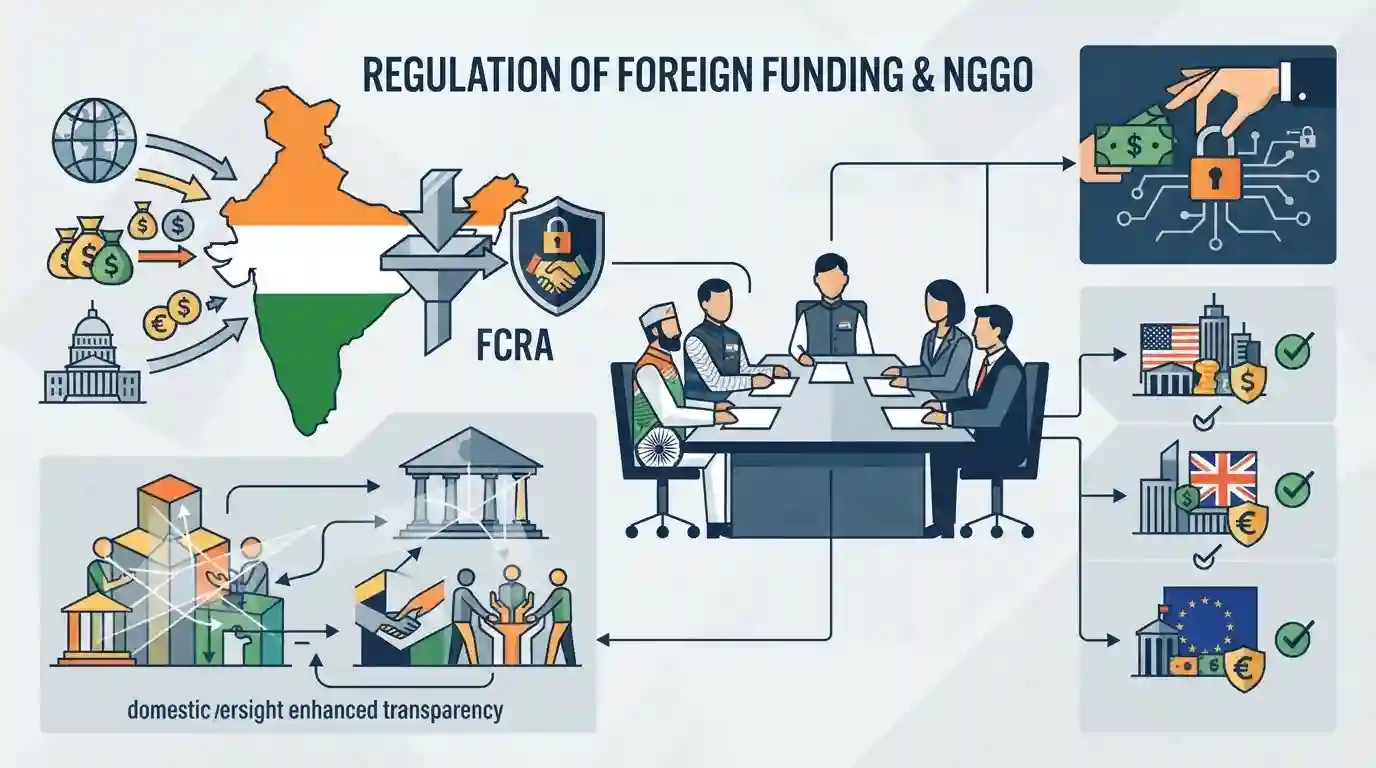
India's Ambassador to the US, Vinay Mohan Kwatra, defended recent amendments to the Foreign Contribution (Regulation) Act (FCRA), asserting they are designed to enhance transparency in the functioning of NGOs and civil society. Responding to concerns raised by US Republican lawmaker Riley Moore regarding restrictions on foreign funding, Kwatra emphasized that India, akin to other democracies like the US, UK, and EU, has the sovereign right to regulate foreign financial flows to prevent their misuse and protect national security. The Ministry of External Affairs firmly stated that India's robust legal framework governing NGOs is an internal matter, dismissing external apprehensions.
Key Points
- India's Ambassador to the US defended FCRA amendments as essential tools for bringing transparency to NGO and civil society funding.
- The statements were in response to US Republican lawmaker Riley Moore's concerns that India is restricting foreign funding to charitable institutions.
- India asserted its sovereign right to regulate the flow of foreign funds to prevent misuse and safeguard national security.
- Ambassador Kwatra drew parallels with similar domestic laws in Western democracies, such as the US FARA and FATCA, to justify India's regulatory framework.
- The Ministry of External Affairs reiterated that the regulation of domestic NGOs is strictly an internal matter of India.
Important Terms
Foreign Contribution (Regulation) Act (FCRA)

An Indian law regulating the acceptance and utilization of foreign funds by individuals and organizations to ensure transparency, prevent misuse, and safeguard national security and sovereignty.
UPSC context
Crucial for GS Paper 2 (Governance, NGO regulation) and GS Paper 3 (Internal Security, preventing money laundering).
Non-Governmental Organizations (NGOs)
Independent, non-profit organizations operating outside government control to address social, developmental, and environmental challenges, acting as a crucial link between the state and the grassroots.
UPSC context
Essential for GS Paper 2, testing knowledge on the role of NGOs, SHGs, and civil society in India's development processes.
Civil Society
The "third sector" comprising non-state, non-profit institutions like advocacy groups and community movements that function voluntarily to promote shared values and hold the government accountable.
UPSC context
Key to GS Paper 2 (Governance), evaluating citizen participation, policy advocacy, and bridging gaps between state and society.
Ministry of External Affairs (MEA)
The Indian government agency responsible for implementing foreign policy, managing diplomatic relations, and safeguarding India's strategic and geopolitical interests abroad.
UPSC context
Relevant for GS Paper 2 (International Relations) when analyzing bilateral ties, external interference, and foreign policies affecting India.
Foreign Agents Registration Act (FARA)
A US law requiring individuals and organizations representing foreign interests to disclose their activities and funding, often cited as a global precedent for regulating foreign influence.
UPSC context
Relevant for GS Paper 2 (Governance & IR), providing a comparative international framework to justify domestic regulations like the FCRA.
Prelims Trap
Receiving foreign contributions is a fundamental right of NGOs, and the FCRA is administered by the Ministry of Finance.
FCRA is exclusively administered by the Ministry of Home Affairs, not Finance. Also, the Supreme Court ruled in 2022 that receiving foreign donations is not an absolute fundamental right.
Static Concepts Connected
What were the key structural restrictions introduced by the FCRA 2020 amendments?
- Ban on transfers: Completely prohibits the sub-granting or transfer of foreign contributions to secondary partners or other NGOs.
- Administrative expense cap: Reduces the maximum allowed usage of foreign funds for administrative expenses from 50% to 20%.
- Mandatory SBI account: Requires all initial foreign inflows to be received exclusively in a designated SBI branch in New Delhi.
Which specific categories of individuals are entirely prohibited from accepting foreign contributions?
- Political actors: Election candidates, members of legislatures (MPs, MLAs), political parties, and their office-bearers.
- Public servants: Judges, government servants, or employees of any corporation owned or controlled by the government.
- Media personnel: Publishers, editors, columnists, or correspondents of registered newspapers and electronic media outlets.
Cross-Topic Patterns
FCRA + FATF Mutual Evaluations
India justifies strict NGO regulations by aligning them with FATF recommendations to curb terror financing, seamlessly connecting GS2 (Civil Society) with GS3 (Money Laundering and Internal Security).
Sovereign regulation vs foreign diplomatic pressure
India's pushback on FCRA mirrors its rejection of Western democratic indices, signaling a consistent foreign policy stance that domestic legal frameworks are immune to external scrutiny.

Expect a Prelims question mixing the 2026 FCRA 'Designated Authority' proposal with the SC ruling that foreign funding isn't a core right.
Linked PYQs · 3
Linked PYQs · 3
- 2015MainsGS2
Examine critically the recent changes in the rules governing foreign funding of NGOs under the Foreign Contribution (Regulation) Act (FCRA), 1976.
- 2025MainsGS2
Civil Society Organizations are often perceived as being anti-State actors than non-State actors. Do you agree? Justify.
- 2021MainsGS3
Analyse the multidimensional challenges posed by external state and non-state actors, to the internal security of India. Also discuss measures required to be taken to combat these threats.
