Kangra Airport Displaced Families Demand Rehabilitation Packages
Source:tribune ↗
Why It Matters
Understanding the socioeconomic challenges associated with large-scale infrastructure projects is crucial for civil servants. Issues related to the Right to Fair Compensation and Transparency in Land Acquisition, Rehabilitation and Resettlement Act, 2013, land classification, and the execution of relief packages are frequent topics in policy discourse and general studies.
Summary
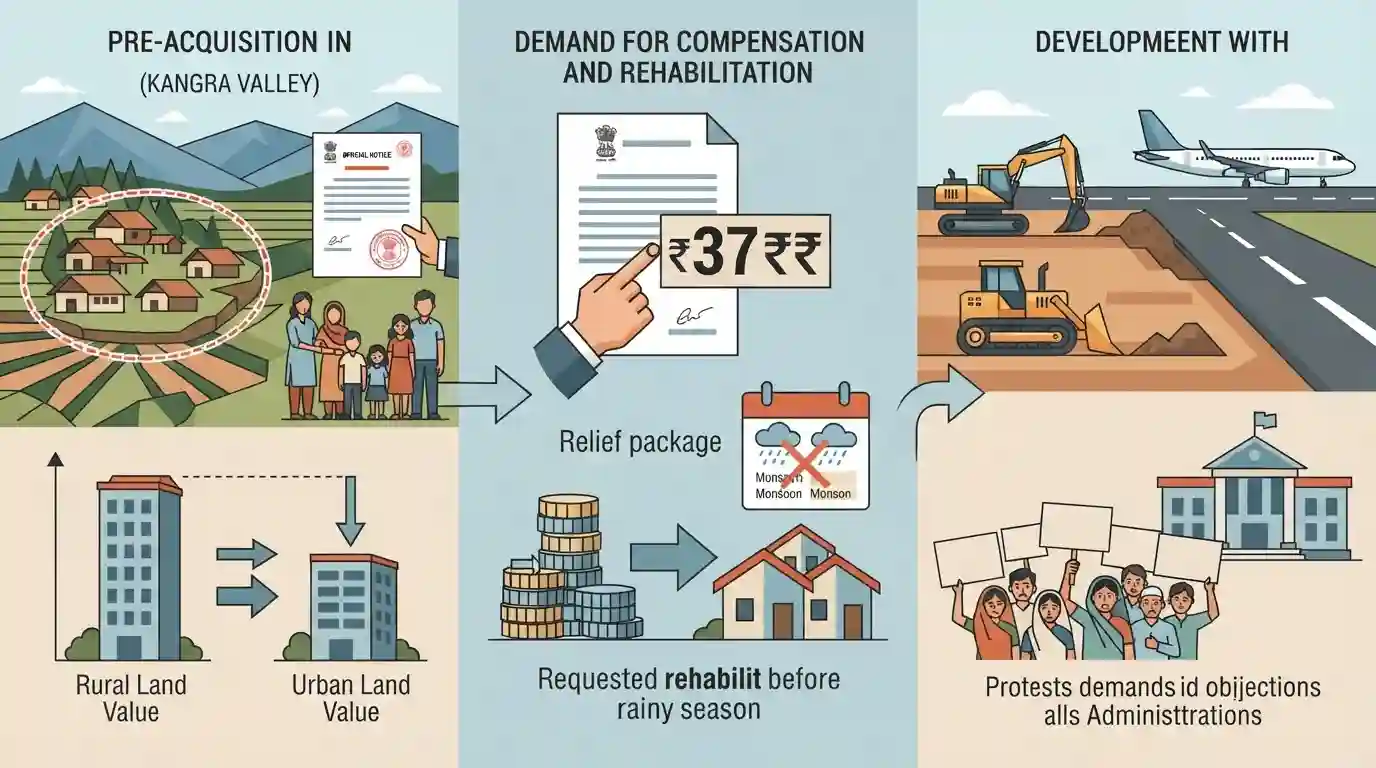
Families facing displacement due to the expansion of the Kangra (Gaggal) airport are demanding the swift release of their rehabilitation and resettlement packages. The villagers have raised strong objections to the compensation being offered, citing that their lands were re-classified from rural to urban, which artificially lowered the prevailing circle rates used for compensation calculation. Having been served notices under the Land Acquisition, Rehabilitation and Resettlement Act, the residents are demanding a ₹37 lakh relief package per family as announced by Chief Minister Sukhvinder Singh Sukhu, insisting it be paid in a single installment before they vacate their properties amidst the monsoon.
Key Points
- Villagers displaced by the Kangra airport expansion project are protesting against disparities in land compensation and delays in rehabilitation packages.
- The affected residents from villages like Ichhi, Jugehar, and Baghni have been issued notices under Section 11 of the Land Acquisition, Rehabilitation and Resettlement Act.
- A major grievance is the sudden re-classification of their land from rural to urban by the Town and Country Planning (TCP) Department, which reportedly lowered the circle rates and subsequent compensation.
- The displaced families are demanding the immediate release of a promised ₹37 lakh rehabilitation package in a single installment before they are forced to vacate their homes, especially during the monsoon season.
Important Terms
Land Acquisition, Rehabilitation and Resettlement Act

A 2013 Indian law regulating land acquisition, which mandates fair compensation, transparency, and comprehensive rehabilitation packages for affected persons. It replaced the colonial-era Land Acquisition Act of 1894 to protect landowners.
UPSC context
Relevant for HPAS GS 2 (Governance). Tests understanding of statutory protections for vulnerable populations facing forced displacement during state infrastructure projects.
Circle Rate
The minimum property value fixed by the state government for specific areas, used to calculate stamp duty and determine baseline compensation during land acquisition for public or private development projects.
UPSC context
Essential for HPAS GS 3 (Economy). Highlights systemic administrative issues where outdated or reclassified rates lead to disputes over fair land compensation.
Kangra (Gaggal) Airport
The busiest domestic airport in Himachal Pradesh. An ongoing expansion project will extend its runway over the Manjhi River to accommodate larger aircraft, requiring significant land acquisition and leading to local displacement concerns.
UPSC context
Crucial for HPAS GS 1 and GS 3. Covers state-level infrastructure developments, regional tourism growth, and associated socio-environmental challenges.
Prelims Trap
Gaggal airport runway bridge over Manjhi Khad is India's first runway bridge constructed over a river.
It is the first in the Himalayan region but the second in India; Chennai Airport was the first to build a runway over a river (Adyar).
Static Concepts Connected
How does the LARR Act 2013 differentiate rural and urban land compensation?
- Rural Multiplier: The base market value of rural land is multiplied by a factor of 1 to 2 (determined by the State) based on distance from urban centers.
- Urban Multiplier: For urban land, the base market value is calculated with a strict multiplier of 1.
- Solatium Requirement: Both rural and urban land acquisitions mandate an additional 100% solatium applied on top of the final multiplied base amount.
What are the key geographical and infrastructure features of the Gaggal Airport expansion?
- Tourism Capital Objective: Located in Kangra district, the expansion of the runway (to 3,010m) aims to facilitate larger narrow-body jets and establish Kangra as the Tourism Capital of HP.
- Manjhi Khad Bridge: Features a 380-meter dedicated runway bridge built over the Manjhi Khad stream, marking it as the first such structure in the Himalayas.
Cross-Topic Patterns
Reclassification as a compensation loophole
TCP rural-to-urban reclassification lowers the LARR compensation multiplier from up to 2x down to 1x, highlighting an administrative loophole in state infrastructure acquisitions.
Rehabilitation of non-landowning occupants
Providing financial packages to non-landowning shopkeepers sets a humanitarian precedent in HP, highly relevant as a case study for Mains GS-2 social justice answers.

Gaggal airport's Manjhi Khad bridge (2nd in India) and LARR rural/urban compensation multipliers will likely form a multi-statement Q.
Linked PYQs · 1
Linked PYQs · 1
- 2016HPAS_PRELIMSGS1
AMRUT was launched on :
