Allahabad High Court Ruling on Panchayat Pradhan Administrators
Source:times-of-india ↗
Why It Matters
This article is directly relevant to the UPPSC Prelims syllabus under 'Panchayati Raj and Public Policy'. It highlights the strict constitutional limits on panchayat duration under Article 243E, the mandate of the State Election Commission under Article 243K, and how state-level amendments to the UP Panchayat Raj Act must align with central constitutional provisions. It also addresses the contemporary legal-political hurdle of determining OBC reservation quotas in local bodies.
Summary
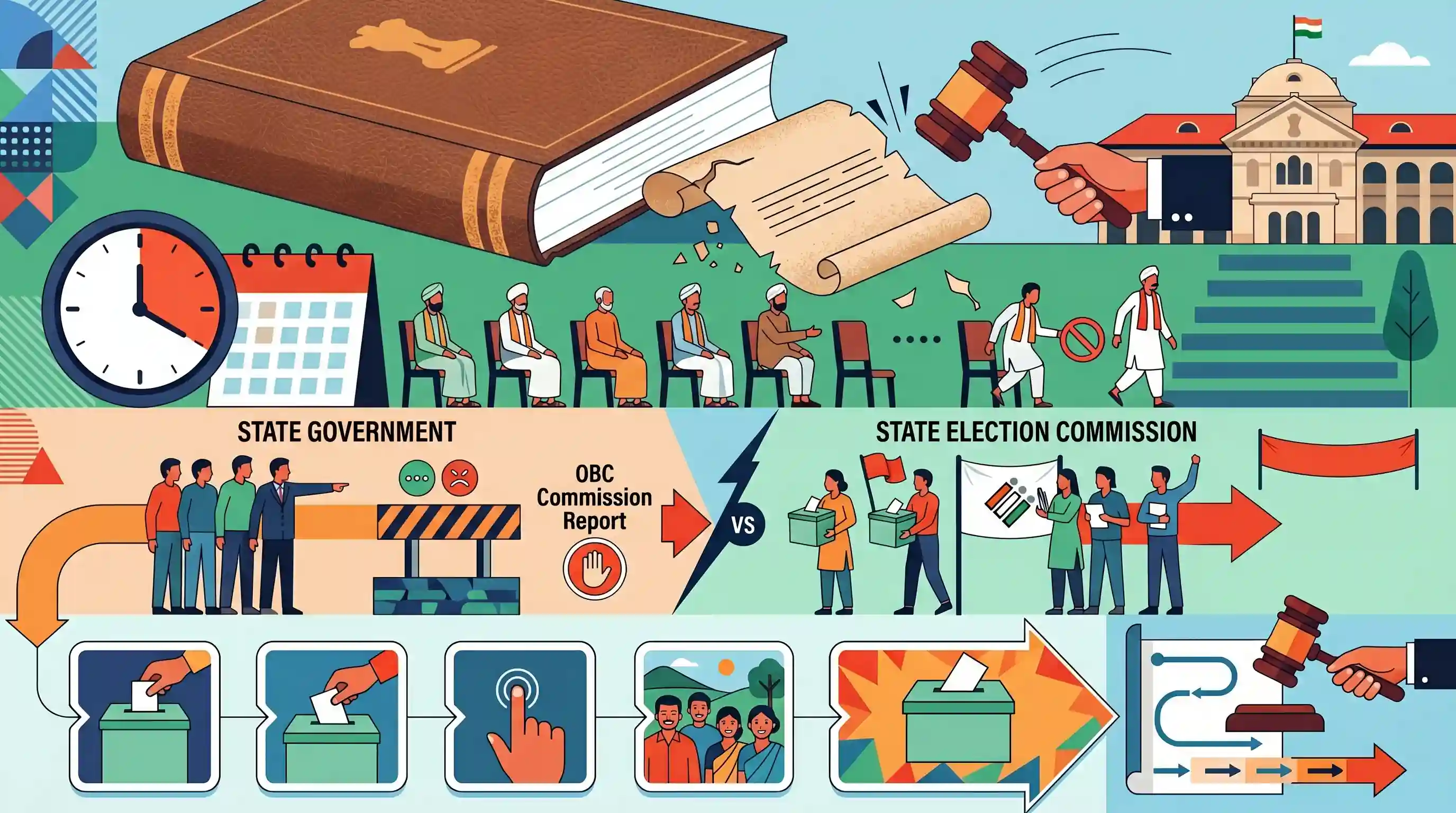
The Allahabad High Court ruled that elected gram pradhans in Uttar Pradesh cannot be allowed to continue functioning as panchayat administrators after completing their five-year term, declaring the state's move unconstitutional under Article 243E. The court observed that the UP state government's orders utilizing Section 12(3-A) of the UP Panchayat Raj Act, 1947, are 'non-est' (legally void), in alignment with a 2000 High Court precedent. The state government blamed the election delay on a pending OBC Commission report for local body reservations, while the State Election Commission declared readiness to conduct the polls. The court directed the state to submit a clear timeline for conducting the panchayat elections.
Key Points
- The Allahabad High Court ruled that elected gram pradhans (village heads) in Uttar Pradesh cannot continue functioning as administrators after their five-year terms expire.
- Under Article 243E of the Indian Constitution, the tenure of a panchayat is strictly fixed at five years from its first meeting and cannot be extended further.
- The court declared the state government's orders appointing existing pradhans as administrators under Section 12(3-A) of the UP Panchayat Raj Act, 1947, as 'non-est' (unconstitutional/void). This adheres to the precedent set in the 2000 division bench ruling, Pram Lal Patel vs. State of UP.
- The UP state government defended the delay in conducting local elections by citing the pending report of the OBC Commission, which was appointed to determine reservations for the Other Backward Classes category.
- The State Election Commission (SEC) confirmed that electoral rolls were published on June 10, 2026, and expressed readiness to hold the elections once the state government provides the necessary logistical support.
- The High Court directed the Principal Secretary of Panchayati Raj to submit a personal affidavit explaining under what circumstances the unconstitutional order was issued and to outline a clear timeline for holding the panchayat elections.
Important Terms
Constitution of India (Article 243E)

A constitutional provision under Part IX that mandates a fixed five-year term for Panchayats and requires fresh elections to be conducted before the expiry of their term or within six months of dissolution.
UPSC context
GS Paper II: Polity & Governance; tests knowledge of democratic decentralization and constitutional boundaries on state panchayat laws.
Constitution of India (Article 243K)
A constitutional provision that vests the superintendence, direction, and control of all Panchayat elections, including the preparation of electoral rolls, in the State Election Commission.
UPSC context
GS Paper II: Indian Polity; critical for understanding the autonomy and role of local election machinery.
State Election Commission (SEC)
An independent constitutional body created under Article 243K to supervise, direct, and conduct free, fair, and timely elections for urban and rural local bodies in Indian states.
UPSC context
GS Paper II: Constitutional Bodies; important for assessing federal election issues and local self-governance reforms.
OBC Reservation in Local Bodies
The allocation of reserved seats for Other Backward Classes in local governments, which must adhere to the Supreme Court's 'triple-test' criteria without delaying mandatory civic elections.
UPSC context
GS Paper II: Social Justice & Federalism; tests the balance between representation and constitutional election mandates.
Uttar Pradesh Panchayat Raj Act, 1947
The state legislation regulating the establishment and administration of Panchayati Raj structures in UP, whose provisions (e.g., Section 12(3-A)) are subordinate to constitutional mandates.
UPSC context
GS Paper II: State Legislations & Local Governance; tests understanding of legislative hierarchy and constitutional supremacy.
Panchayati Raj Institutions (PRIs)
A three-tier rural local self-government system in India constitutionalized by the 73rd Amendment, aimed at empowering rural populations and implementing local developmental plans.
UPSC context
GS Paper II: Local Self-Government; key area for questions on devolution of power, financial autonomy, and grassroots democracy.
Prelims Trap
The State Legislature can temporarily extend the five-year term of an elected Panchayat under extraordinary circumstances such as delayed reservation reports.
Article 243E(1) strictly caps tenure at five years ('and no longer'). The Supreme Court in Kishansing Tomar ruled administrative delays cannot justify term extensions or postponing elections.
Static Concepts Connected
What is the 'Triple Test' for local body OBC reservations?
- Dedicated Commission: Establish a dedicated commission to conduct an empirical inquiry into the nature and implications of backwardness across local bodies.
- Proportion Specification: Specify the exact reservation proportion required in local bodies based on the commission's findings.
- Fifty Percent Cap: Ensure total reservation for SCs, STs, and OBCs combined does not exceed 50% of the total seats.
What does Article 243E mandate regarding Panchayat tenure?
- Absolute Tenure: Caps Panchayat duration strictly at five years from its first meeting, using the restrictive phrase 'and no longer'.
- Pre-expiry Elections: Mandates completing elections to constitute a new Panchayat before the five-year term of the existing one expires.
Cross-Topic Patterns
Local decentralisation vs State executive overreach
Explores the constitutional limits on State List Entry 5, proving that state executive discretion cannot dilute the mandatory democratic provisions of Part IX.
Judicial enforcement of the electoral calendar
Links to Article 324/243K jurisprudence, where courts use mandamus to prevent governments from delaying polls due to political or administrative inconvenience.

Expect a 2026 Prelims question on the absolute nature of Article 243E's five-year term limit versus state legislative powers under Entry 5.
Linked PYQs · 3
Linked PYQs · 3
- 2023UPPSC_PRELIMSGS1
All elections to the Panchayats are conducted by -
- 2020UPPSC_PRELIMSGS1
The superintendence, direction and control of all elections to the Panchayats are vested in
- 2022UPPSC_PRELIMSGS1
Given below are two statements, one is labelled as Assertion (A) and the other as Reason (R). Assertion (A) : The 73rd Amendment of the Constitution is considered to be a watershed in the history of local self government in India. Reason (R) : The 73rd Constitution Amendment conferred the much coveted Constitutional status on Panchayats. Select the correct answer from the code given below.
