Viksit Gujarat Industrial Policy Outlines Growth And Incentives
Source:adaptassociates ↗
Why It Matters
Crucial for aspirants tracking Gujarat's state-specific economic policies, industrial incentives, and regional development frameworks relevant to GPSC Prelims and Mains.
Summary
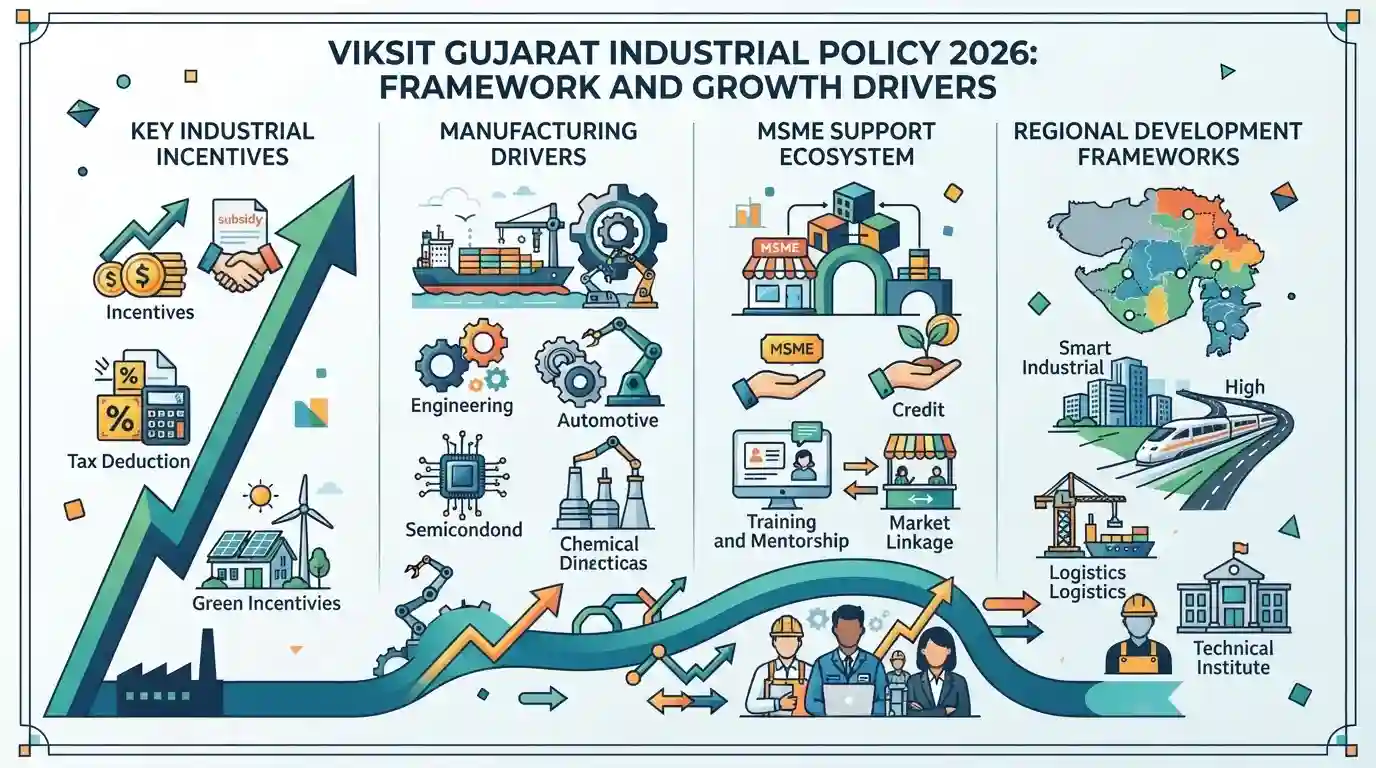
An explanatory breakdown of the Viksit Gujarat Industrial Policy 2026, highlighting key industrial incentives, manufacturing drivers, MSME support, and regional development frameworks in Gujarat.
Key Points
- The Viksit Gujarat Industrial Policy 2026 outlines strategic frameworks, fiscal incentives, and capital subsidies to promote manufacturing, MSMEs, and industrial growth in Gujarat.
- The policy focuses on regional balanced development by categorizing talukas, encouraging sustainable green practices, and boosting foreign and domestic investments.
- Gujarat continues to maintain a top-tier position in industrial output, fixed capital, and logistics ease within India.
Important Terms
Viksit Gujarat Industrial Policy 2026

A five-year state framework launched in 2026 to position Gujarat as a global hub for advanced manufacturing, clean energy, and MSME growth, targeting a USD 3.5 trillion economy by 2047.
UPSC context
Important for GS Paper III (Indian Economy, Industrial Policy & Growth). Tests knowledge of state-level economic planning and manufacturing incentives.
NITI Aayog
India's apex public policy think tank that provides directional and policy inputs, assisting state governments in aligning regional development plans with national growth goals like Viksit Bharat.
UPSC context
Crucial for GS Paper II and III (Governance, Planning, Cooperative Federalism). Tests understanding of institutional frameworks driving national and regional economic strategies.
Government of Gujarat
The executive branch of the state of Gujarat, responsible for formulating and implementing economic development, industrial growth initiatives, and infrastructure policies within the state.
UPSC context
Relevant for Gujarat-specific administrative and economic governance in the GPSC syllabus. Tests awareness of state administrative machinery and policy execution.
Prelims Trap
Category B talukas offer higher fiscal incentive ceilings of up to 45% compared to Category A talukas.
Aspirants might confuse the incentive ceilings, assuming Category B developed hubs get higher subsidies than backward talukas, whereas Category A offers up to 45% eFCI.
Static Concepts Connected
What are the key objectives and components of State Industrial Policies in India?
- Investment Promotion: Facilitates capital investment through subsidies, tax exemptions, and stamp duty concessions to generate employment.
- Regional Balance: Uses taluka/district categorization to channel investments into economically backward areas for balanced regional growth.
- Thrust Sectors: Identifies sunrise and high-value sectors (e.g., semiconductors, EV, aerospace) for prioritized financial backing.
Cross-Topic Patterns
Industrial Subsidies & Fiscal Federalism
Industrial policy incentives closely intersect with fiscal federalism and State-level competition for capital under the 15th/16th Finance Commission frameworks.
Green Manufacturing & PLI Linkages
The focus on green energy and semiconductor manufacturing links state industrial subsidies with India's broader Atmanirbhar Bharat and PLI schemes.

Expect statement-based MCQs on taluka categorization, eFCI incentive ceilings, and investment thresholds for ultra-mega projects in Gujarat.
Linked PYQs · 3
Linked PYQs · 3
- 2025GPSC_PRELIMSGS1
According to the Socio-Economic Review, 2024-2025 of Gujarat, Gujarat comes in ______ category in Logistic Ease Across Different States (LEADS), 2024.
- 2025GPSC_PRELIMSGS1
Which of the following statements are correct regarding the economy of Gujarat according to the Socio-Economic Review, 2024-2025 of Gujarat? 1. Gujarat has consistently contributed over 8% to India's GST collections, highlighting its economic vitality and strength. 2. During the year 2022-23, Gujarat stood first in handling total cargo among the states of India. 3. According to the results of Annual Survey of Industries (ASI) 2022-23, Gujarat is first in the country in Industrial Production and Fixed Capital.
- 2025GPSC_PRELIMSGS1
______ is one of the cities chosen by the NITI Aayog for its Growth Hub (G-HUB) programme to boost their economic growth.
