Viksit Gujarat Industrial Policy Framework Decoded for Growth
Source:roedl ↗
Why It Matters
Important for candidates preparing for GPSC Class 1-2 exams to understand Gujarat's evolving industrial policy framework, economic vision, and incentives for manufacturing and MSMEs.
Summary
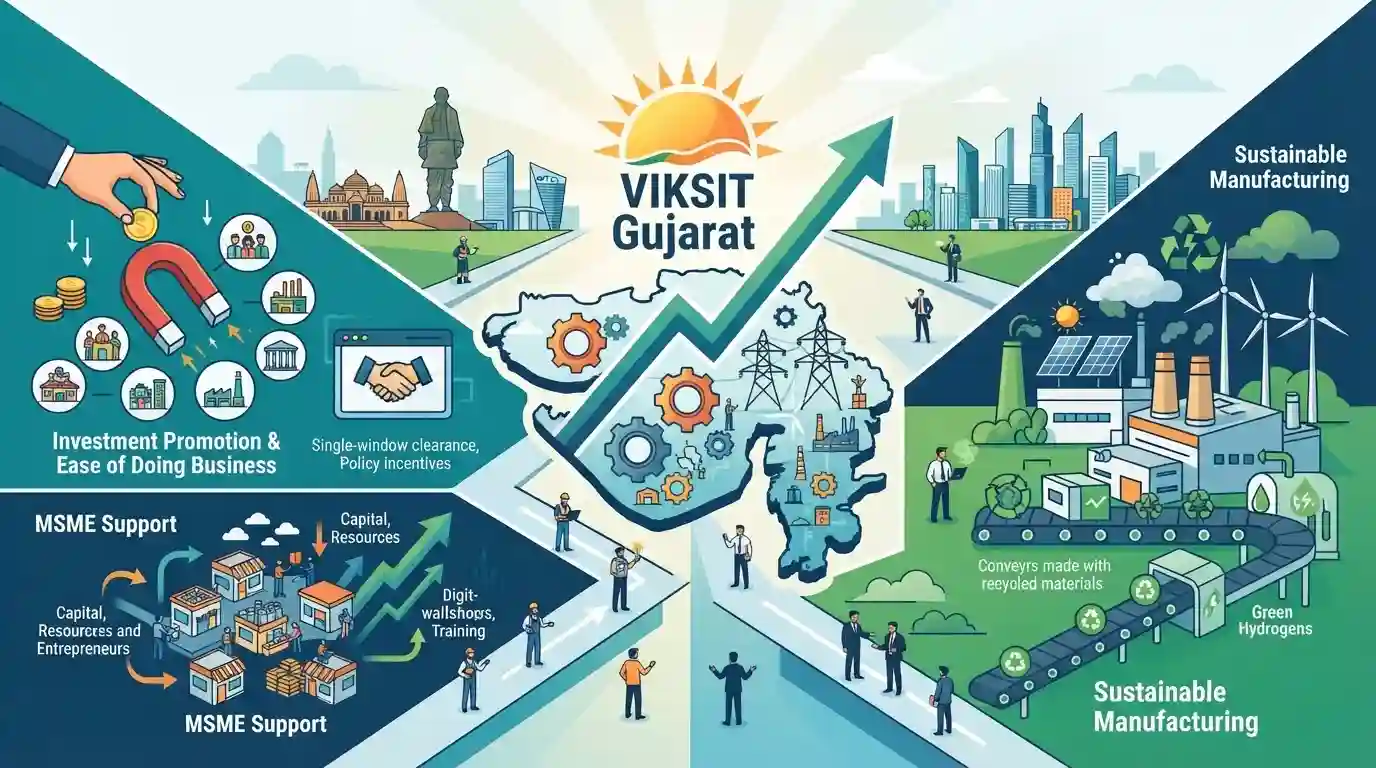
An overview of the new industrial policy framework in Gujarat aimed at fostering economic growth, sustainable manufacturing, MSME support, and investment promotion in alignment with the broader Viksit Gujarat vision.
Key Points
- The new industrial policy for Gujarat aims to transform the state into a global manufacturing and economic hub under the vision of Viksit Gujarat.
- Focuses heavily on MSME promotion, sustainable manufacturing, green technology, and attracting foreign direct investment (FDI).
- Provides structured financial incentives, infrastructure development, and ease of doing business reforms to stimulate regional growth.
Important Terms
Viksit Gujarat Industrial Policy 2026

A five-year state framework launched in 2026 by Gujarat to transition into a $3.5 trillion economy by 2047, featuring custom investment incentives and MSME support.
UPSC context
GPSC Paper-2/3 (Economy & Governance): Tests knowledge of state industrial incentives, manufacturing policies, and long-term economic visions.
Government of Gujarat
The apex executive authority of Gujarat responsible for formulating state economic policies, budget allocations, and industrial development frameworks.
UPSC context
GPSC Paper-2 (Polity & Governance): Tests understanding of state administration, policy execution, and regional governance structures.
NITI Aayog
The apex public policy think tank of the Government of India that fosters cooperative federalism and bottom-up economic planning through state-level integration.
UPSC context
GPSC Paper-2/3 (Polity & Economy): Tests understanding of national advisory bodies, center-state relations, and economic policy planning frameworks.
Static Concepts Connected
What are the key tiers and classification criteria for industrial backward talukas under Gujarat Industrial Policies?
- Categorization Basis: Gujarat classifies talukas into categories (e.g., Category A, B, C) based on socio-economic backwardness to calibrate financial incentives.
- Higher Incentives: Backward talukas receive higher capital investment subsidies, lower power tariffs, and extended tax exemptions to attract investments.
- Balanced Growth: The system aims to promote balanced regional development and curb concentration in industrialized belts like Ahmedabad-Vadodara.
Cross-Topic Patterns
State Industrial Policy & National Missions
Gujarat's thrust on semiconductors and green hydrogen directly links state-level industrial policy with national schemes like the India Semiconductor Mission and National Green Hydrogen Mission.
Regional Disparities & Backward Taluka Incentives
Provisions for Category-A backward talukas connect industrial growth with decentralized regional development, addressing intra-state economic disparities.

Expect a statement-based question combining Gujarat's 21 thrust sectors, ZLD norms for green parks, and capital subsidy caps for MSMEs.
Linked PYQs · 1
Linked PYQs · 1
- 2025GPSC_PRELIMSGS1
______ is one of the cities chosen by the NITI Aayog for its Growth Hub (G-HUB) programme to boost their economic growth.
