Viksit Gujarat New Industrial Policy Strategic Decoding
Source:roedl ↗
Why It Matters
Understanding state-level industrial policies is crucial for assessing regional economic growth, investment trends, and implementation of national development goals like Viksit Bharat at the state level.
Summary
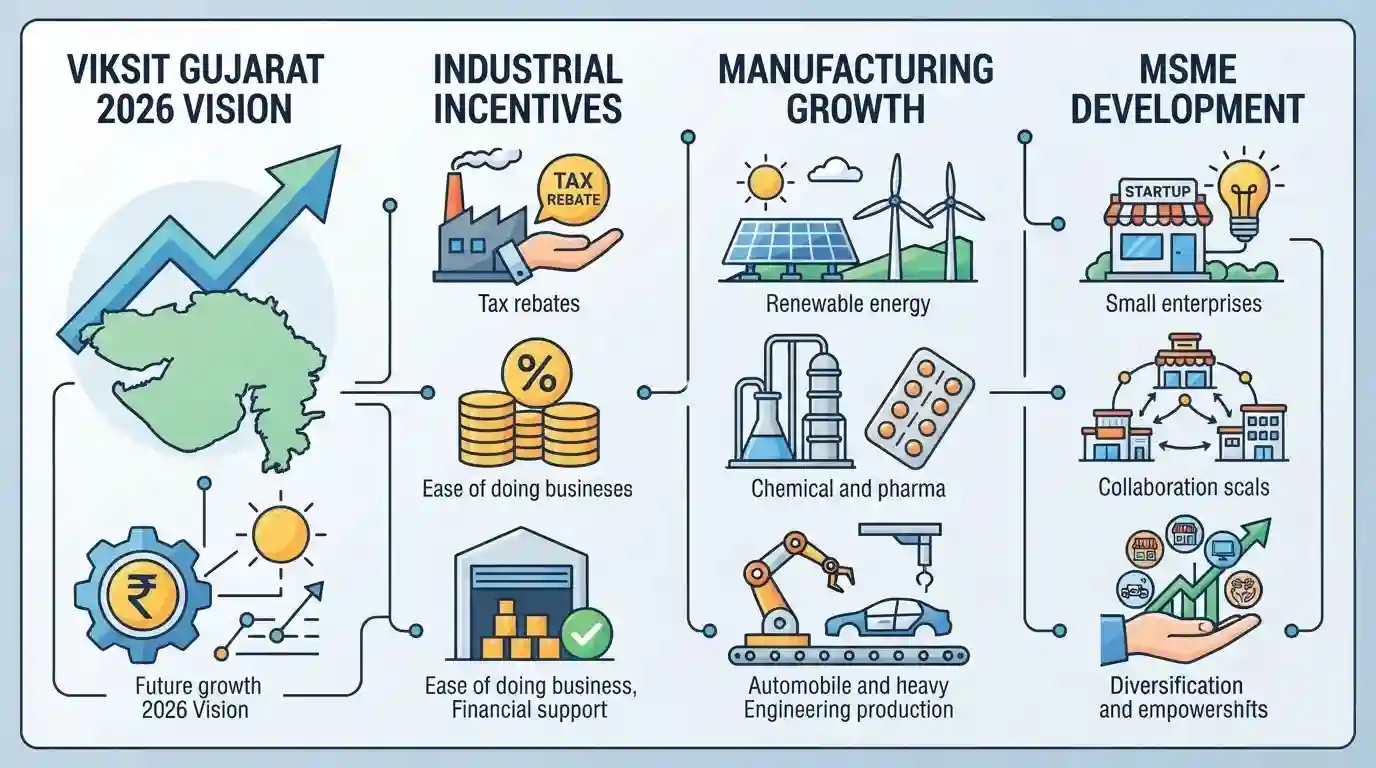
An analysis of Gujarat's New Industrial Policy (Viksit Gujarat 2026), focusing on industrial incentives, manufacturing growth, MSME development, and state economic strategies.
Key Points
- The New Industrial Policy of Gujarat (often discussed in the framework of Viksit Gujarat 2026) targets comprehensive economic transformation, manufacturing excellence, and sustainable growth.
- It emphasizes financial incentives, infrastructure support, and MSME promotion to attract investments into the state.
- Aligns with broader national frameworks like Viksit Bharat and regional growth hubs coordinated with bodies like NITI Aayog.
Important Terms
Viksit Gujarat Industrial Policy 2026

Gujarat’s five-year framework effective June 2026, aimed at transitioning the state into a USD 3.5 trillion economy by 2047 through manufacturing growth, MSME support, and customizable incentives.
UPSC context
GPSC Paper 3 (Economy & Planning): Tests knowledge of state-level industrial policies, manufacturing hubs, and economic development strategies.
NITI Aayog
The apex public policy think tank of the Government of India providing strategic inputs, competitive indexing (such as the Investment Friendliness Index), and federal planning support.
UPSC context
GPSC Paper 3 (Polity & Governance / Economy): Evaluates cooperative federalism, policy evaluation, and economic growth indices across Indian states.
Prelims Trap
MSMEs in all talukas receive uniform financial incentives up to 45% of eligible fixed capital investment under the policy.
Aspirants often confuse Category-A and Category-B taluka incentive percentages or attribute general startup sustenance allowances uniformly without noting the special provision for women co-founders.
Static Concepts Connected
What are the key tiers and classification criteria of Gujarat's Industrial Policy taluka categorization?
- Category-A Talukas: Category-A talukas represent industrially backward regions and receive the highest financial incentive caps (up to 45% of eFCI).
- Category-B Talukas: Category-B talukas cover moderately developed or transitional regions offering slightly lower investment subsidy ceilings (up to 35% of eFCI).
- Inclusive Subsidies: Special provisions under these categories grant extra cushions for SC/ST and women entrepreneurs to promote inclusive socio-economic growth.
Cross-Topic Patterns
State Subsidies + Fiscal Federalism
Gujarat industrial subsidies and taluka categorization mirror central schemes like industrial promotion packages in backward districts, testing fiscal federalism and state-level cooperative federalism concepts in Mains.
Industrial Policy + High-Tech Manufacturing Missions
Targeting semiconductor, green hydrogen, and aerospace investments bridges industrial policy with India's techno-nationalism and futuristic technology missions.

Viksit Gujarat Industrial Policy 2026 taluka-wise incentives and startup caps likely to feature in a direct statement-based Prelims question.
Linked PYQs · 1
Linked PYQs · 1
- 2025GPSC_PRELIMSGS1
______ is one of the cities chosen by the NITI Aayog for its Growth Hub (G-HUB) programme to boost their economic growth.
