Regulatory Cholesterol Reduction for Viksit Bharat
Source:Indian Express ↗
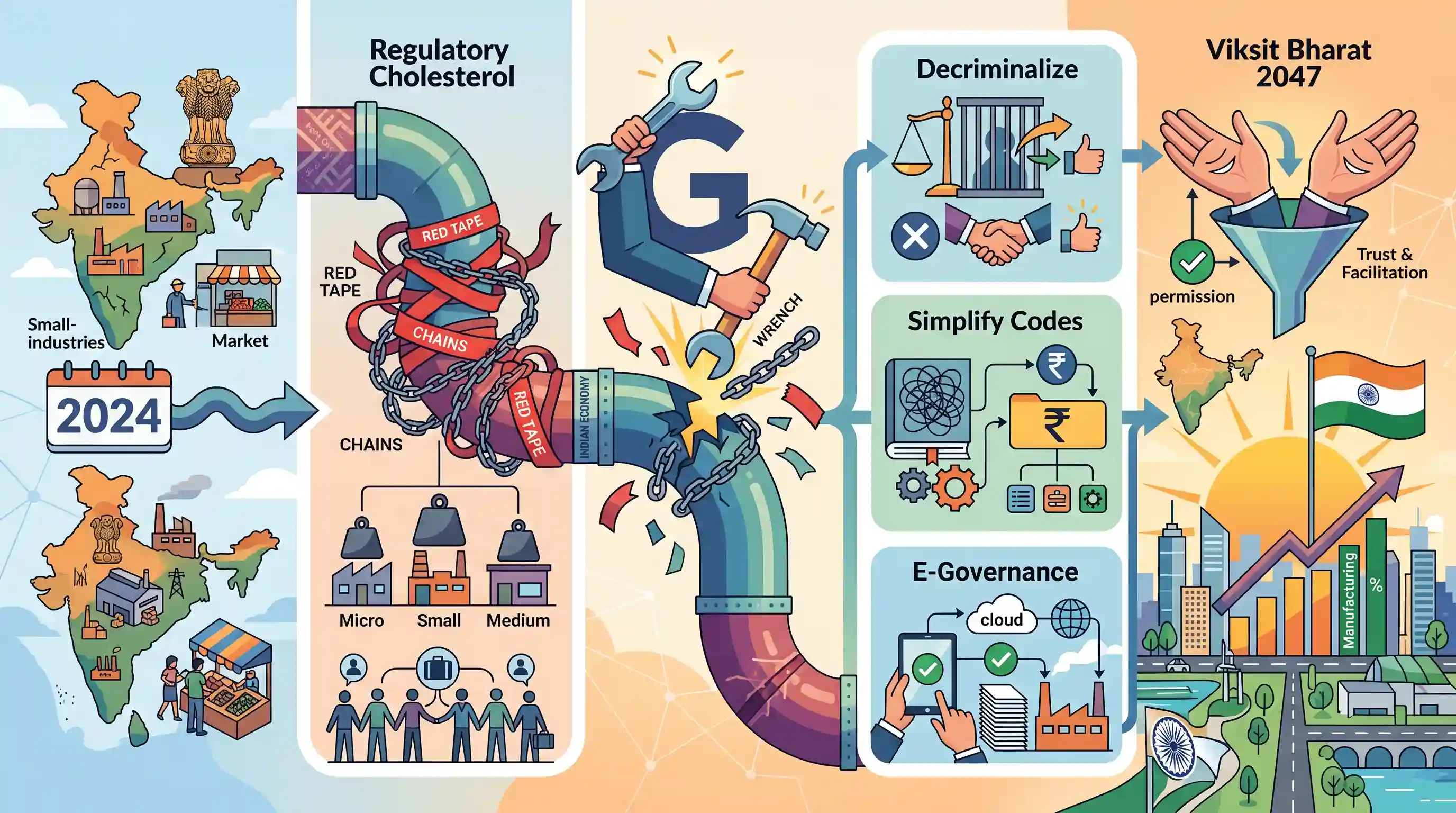
Why It Matters
The concept of 'regulatory cholesterol' is a highly useful framework for UPSC aspirants to explain why India's manufacturing sector and formal employment have underperformed despite initiatives like Make in India. It is critical for answering questions on MSME policies, economic formalization, and bureaucratic hurdles.
Summary
The article argues that for India to realize its ambitious 'Viksit Bharat' goal by 2047, the state must urgently dismantle 'regulatory cholesterol'—the excessive compliance burden and bureaucratic red tape suffocating Indian enterprises. Highlighting that heavy regulation disproportionately harms MSMEs and stifles formal job creation, it emphasizes the need to decriminalize minor economic offenses, simplify labor and tax codes, and leverage e-governance. Shifting the administrative machinery from a mindset of 'control and permission' to 'trust and facilitation' is framed as essential for boosting the manufacturing sector's share in the GDP.
Key Points
- Achieving the 'Viksit Bharat' (Developed India) vision by 2047 necessitates a radical improvement in the ease of doing business through structural and administrative reforms.
- The Indian entrepreneurial ecosystem suffers from 'regulatory cholesterol'—a massive web of complex compliances, filings, and archaic rules that disproportionately penalize MSMEs.
- The threat of criminal prosecution for minor procedural or economic offenses induces firm 'dwarfism' and discourages the formalization of the economy.
- Slashing red tape, expanding decriminalization efforts (like the Jan Vishwas Act), and migrating towards trust-based e-governance systems are crucial to unleash job creation and boost the manufacturing sector.
Important Terms
Viksit Bharat 2047

The central government's vision to transform India into a developed nation by 2047, targeting a $30-40 trillion economy and high per-capita income.
UPSC context
GS Paper III (Economy/Growth); tests long-term strategic planning and developmental goals for India's centenary.
Jan Vishwas (Amendment of Provisions) Act
A 2023 law decriminalizing 183 minor economic and procedural offenses across 42 Central Acts to foster trust-based governance and ease of doing business.
UPSC context
GS Paper II (Governance) & GS III (Economy); tests knowledge of administrative reforms and decriminalization of business laws.
Regulatory Cholesterol
A metaphorical term for the excessive compliance burden, outdated regulations, and bureaucratic red tape that stifle enterprise growth and formal job creation.
UPSC context
GS Paper III (Economy); evaluates understanding of structural bottlenecks in India’s business environment and industrial growth.
MSMEs
Enterprises classified by investment and turnover; they contribute roughly 30% to India's GDP and 45% of total manufacturing output.
UPSC context
GS Paper III (Industrial Policy); critical for questions on inclusive growth, employment, and the backbone of the economy.
Make in India
A flagship initiative launched in 2014 to transform India into a global manufacturing hub and increase the sector's GDP share to 25%.
UPSC context
GS Paper III (Industrial Sector); tests knowledge of manufacturing growth strategies and foreign direct investment (FDI) policies.
Prelims Trap
"The Jan Vishwas Act eliminates all penalties for minor economic offenses to promote MSME growth."
The Act decriminalizes minor procedural offenses by converting imprisonment clauses into monetary penalties (fines). It does not eliminate penalties entirely.
Static Concepts Connected
What is 'firm dwarfism' in the context of the Indian economy?
- Definition: A phenomenon where enterprises deliberately remain small and informal to avoid complex regulatory scrutiny, labor laws, and tax compliance.
- Economic Impact: It prevents economies of scale, stifles formal job creation, keeps productivity low, and limits global competitiveness.
- Policy Solution: Decriminalizing minor economic offenses, simplifying taxation, and reducing overall compliance burden.
How does the Jan Vishwas Act promote Ease of Doing Business?
- Decriminalization: It decriminalizes minor, procedural economic offenses across multiple central acts to reduce the fear of criminal prosecution among businesses.
- Monetary Fines: Replaces imprisonment provisions with financial penalties or administrative fines, fostering a trust-based governance model.
- Administrative Mechanism: Introduces mechanisms for compounding offenses and periodic revision of fines to ensure they remain relevant without court intervention.
Cross-Topic Patterns
MSME Formalization via Digital Public Infra
Regulatory easing combined with Digital Public Infrastructure (DPI) like the Udyam portal and GSTN is crucial for transitioning MSMEs from the informal to the formal sector.
Labour Codes and the Demographic Dividend
Dismantling regulatory cholesterol must coincide with the implementation of the four new Labour Codes to successfully absorb India's youth bulge into formal manufacturing.

Expect a GS-3 Mains question linking 'firm dwarfism' and 'regulatory cholesterol' to India's inability to create formal manufacturing jobs.
Linked PYQs · 3
Linked PYQs · 3
- 2023MainsGS3
Faster economic growth requires increased share of the manufacturing sector in GDP, particularly of MSMEs. Comment on the present policies of the Government in this regard.
- 2023MainsGS2
e-governance, as a critical tool of governance, has ushered in effectiveness, transparency and accountability in governments. What inadequacies hamper the enhancement of these features ?
- 2024MainsGS2
e-governance is not just about the routine application of digital technology in service delivery process. It is as much about multifarious interactions for ensuring transparency and accountability. In this context evaluate the role of the 'Interactive Service Model' of e-governance.
