Ecological Degradation Risks to Viksit Bharat Vision
Source:Indian Express ↗
Why It Matters
The intersection of infrastructure development and environmental degradation is a recurring theme in UPSC Mains. Analyzing recent events like Delhi floods and Uttarakhand landslides helps aspirants answer questions on urban flooding (GS3), ecological carrying capacity (GS1/GS3), and the balance between economic growth and environmental conservation (GS3/Essay).
Summary
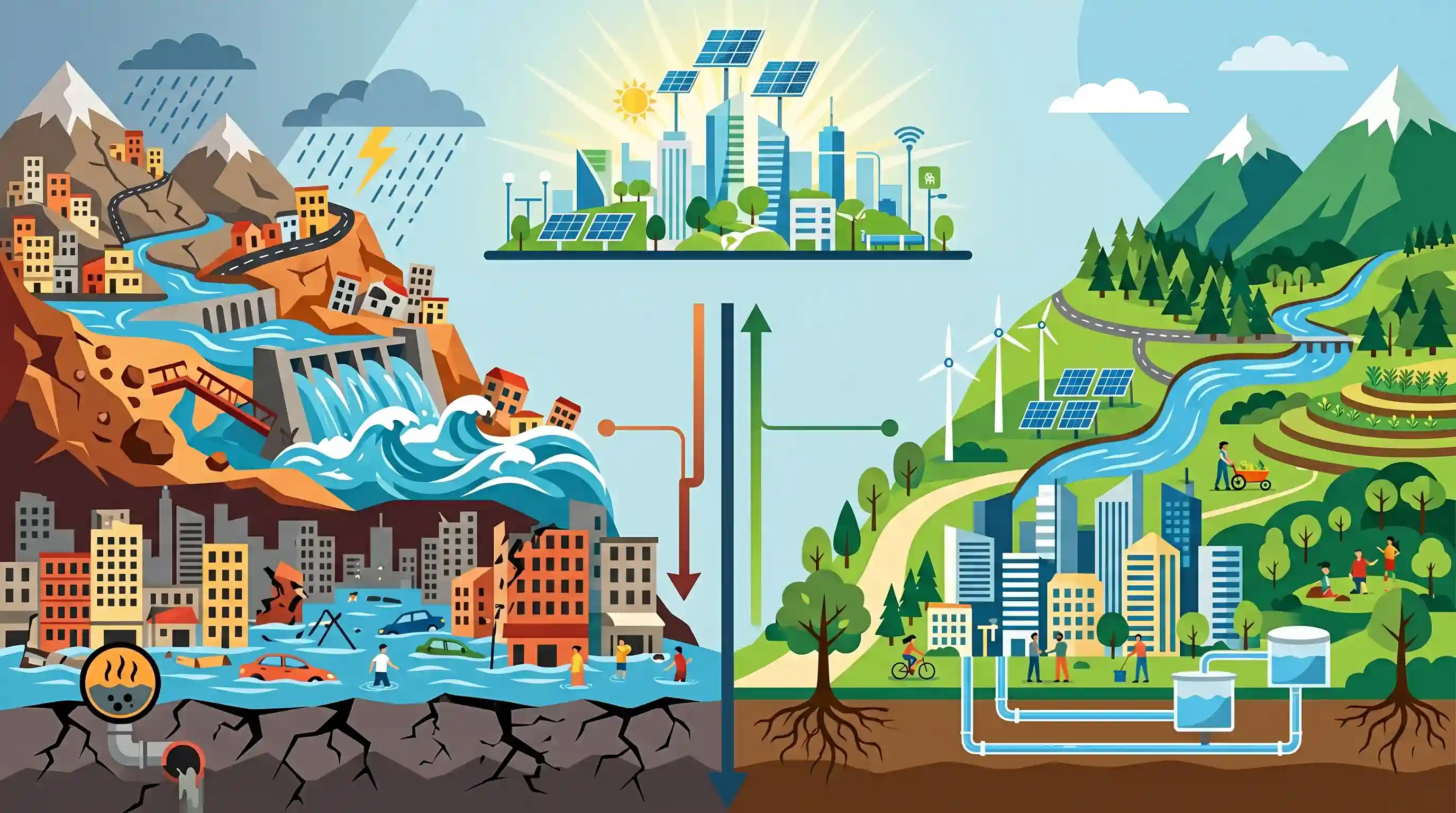
The article emphasizes that India's aspirations to become a developed nation ('Viksit Bharat') cannot be built on a foundation of broken ecosystems. It highlights the recurring flash floods and landslides in Uttarakhand and the severe urban flooding in Delhi as explicit warnings of ecological mismanagement. The author argues that unplanned infrastructure expansion, ignoring the ecological carrying capacity of sensitive zones like the Himalayas, and inadequate urban drainage systems are significantly increasing disaster vulnerability. Achieving true sustainable development requires integrating climate resilience into economic planning and respecting ecological boundaries.
Key Points
- India's vision of 'Viksit Bharat' (Developed India) by 2047 will be jeopardized if ecological integrity is sacrificed for short-term economic gains.
- Fragile ecosystems like the Himalayas are witnessing recurring disasters (flash floods, landslides) due to infrastructure projects and tourism that exceed their ecological carrying capacity.
- Metropolitan centers like Delhi are experiencing severe urban flooding and waterlogging because of poor urban planning, choked drainage systems, and extreme weather events.
- Development paradigms must shift to integrate climate resilience, strict adherence to hazard zonation, and sustainable urban infrastructure.
- There is an urgent need to balance economic growth with environmental conservation to ensure inter-generational equity and disaster mitigation.
Important Terms
Viksit Bharat @2047

The Government of India's vision to transform the nation into a developed, $30-40 trillion economy by 2047, focusing on four pillars: Yuva (Youth), Garib (Poor), Mahilayen (Women), and Annadata (Farmers).
UPSC context
GS Paper III (Economy/Governance); tests understanding of long-term development goals, inclusive growth, and administrative targets for India’s centenary.
Ecological Carrying Capacity
The maximum level of human activity, infrastructure, or population an ecosystem can sustain without permanent degradation or loss of essential ecological functions.
UPSC context
GS Paper III (Environment); vital for assessing sustainable tourism and infrastructure development in fragile regions like the Himalayas.
Urban Flooding
Flooding in densely populated areas caused by intense rainfall overwhelming inadequate or encroached drainage systems, often exacerbated by 'concretization' and the loss of natural urban wetlands.
UPSC context
GS Paper III (Disaster Management); tests knowledge of man-made causes of disasters and mitigation strategies like 'Sponge Cities.'
Climate Resilience
The ability of a system to anticipate, prepare for, and recover from climate-induced shocks (e.g., flash floods) through proactive adaptation and climate-proof infrastructure planning.
UPSC context
GS Paper III (Climate Change/Environment); core to questions on climate adaptation, National Action Plan on Climate Change (NAPCC), and sustainable development.
Himalayan Fragility
The inherent vulnerability of the Himalayas—geologically young fold mountains—to landslides and seismic activity, significantly worsened by unplanned infrastructure and vertical hill-cutting.
UPSC context
GS Paper I (Geography) and GS III (Environment); essential for understanding disaster risk in the Western and Eastern Ghats vs. Himalayas.
Glacial Lake Outburst Flood (GLOF)
A catastrophic release of water from a proglacial lake formed by a retreating glacier, often triggered by avalanches or earthquakes, leading to severe downstream flooding.
UPSC context
GS Paper III (Disaster Management); highly relevant to Uttarakhand and Sikkim flash floods and NDMA's specific hazard guidelines.
Prelims Trap
"The Ministry of Jal Shakti is the nodal ministry for managing urban flooding in India."
While the Ministry of Jal Shakti is nodal for riverine floods, the Ministry of Housing and Urban Affairs (MoHUA) is the nodal ministry for Urban Flooding.
Static Concepts Connected
What are the key NDMA guidelines specifically for Urban Flooding?
- Early Warning: Establishment of a local network of Automatic Rain Gauges (ARGs) and Doppler radars for real-time monitoring.
- Drainage Inventory: Preparation of a comprehensive contour and municipal drainage inventory for every city.
- Solid Waste Management: Strict enforcement against dumping solid waste into storm water drains, which causes choking.
What is 'Carrying Capacity' in the context of eco-sensitive zones?
- Definition: The maximum population size, tourism footprint, or infrastructure load an environment can sustain indefinitely without degradation.
- Policy Application: Determining scientific limits for tourism, hydropower, and road widening (e.g., Char Dham) in fragile topographies.
- Consequences of Breach: Exceeding it triggers severe resource depletion, soil instability, and enhanced disaster vulnerability like subsidence.
Cross-Topic Patterns
Urban Heat Island & Extreme Rainfall
The Urban Heat Island (UHI) effect alters local microclimates, increasing localized extreme precipitation (cloudburst-like events) which easily overwhelm outdated municipal drainage systems.
Green GDP vs. Conventional Growth
The push for 'Viksit Bharat' necessitates moving from conventional GDP to Green GDP accounting, factoring the depreciation of natural capital (like lost Himalayan ecology) into national growth metrics.

Expect a GS-3 Mains question linking 'Viksit Bharat' infrastructure goals with NDMA's urban flooding and Himalayan carrying capacity.
Linked PYQs · 5
Linked PYQs · 5
- 2024MainsGS3
Flooding in urban areas is an emerging climate-induced disaster. Discuss the causes of this disaster. Mention the features of two such major floods in the last two decades in India. Describe the policies and frameworks in India that aim at tackling such floods.
- 2015MainsGS1
The states of Jammu and Kashmir, Himachal Pradesh and Uttarakhand are reaching the limits of their ecological carrying capacity due to tourism. Critically evaluate.
- 2016MainsGS3
Rehabilitation of human settlements is one of the important environmental impacts which always attracts controversy while planning major projects. Discuss the measures to be adopted to mitigate the impact of the recent incidents of cloudbursts in many places of Uttarakhand.
- 2019MainsGS3
Define the concept of carrying capacity of an ecosystem as relevant to an environment. Explain how understanding this concept is vital while planning for sustainable development of a region.
- 2016MainsGS1
The Himalayas are highly prone to landslides. Discuss the causes and suggest suitable measures of mitigation.
