Lucknow Coaching Centre Fire and Urban Safety Governance
Source:The Hindu ↗
Why It Matters
Urban fire incidents frequently highlight the intersection of poor municipal governance, rapid urbanization, and inadequate disaster preparedness. This article is highly relevant for GS-3 (Disaster Management) and GS-1 (Urbanization), emphasizing the need for urban resilience, strict enforcement of building codes, and structural reforms in civic administration.
Summary
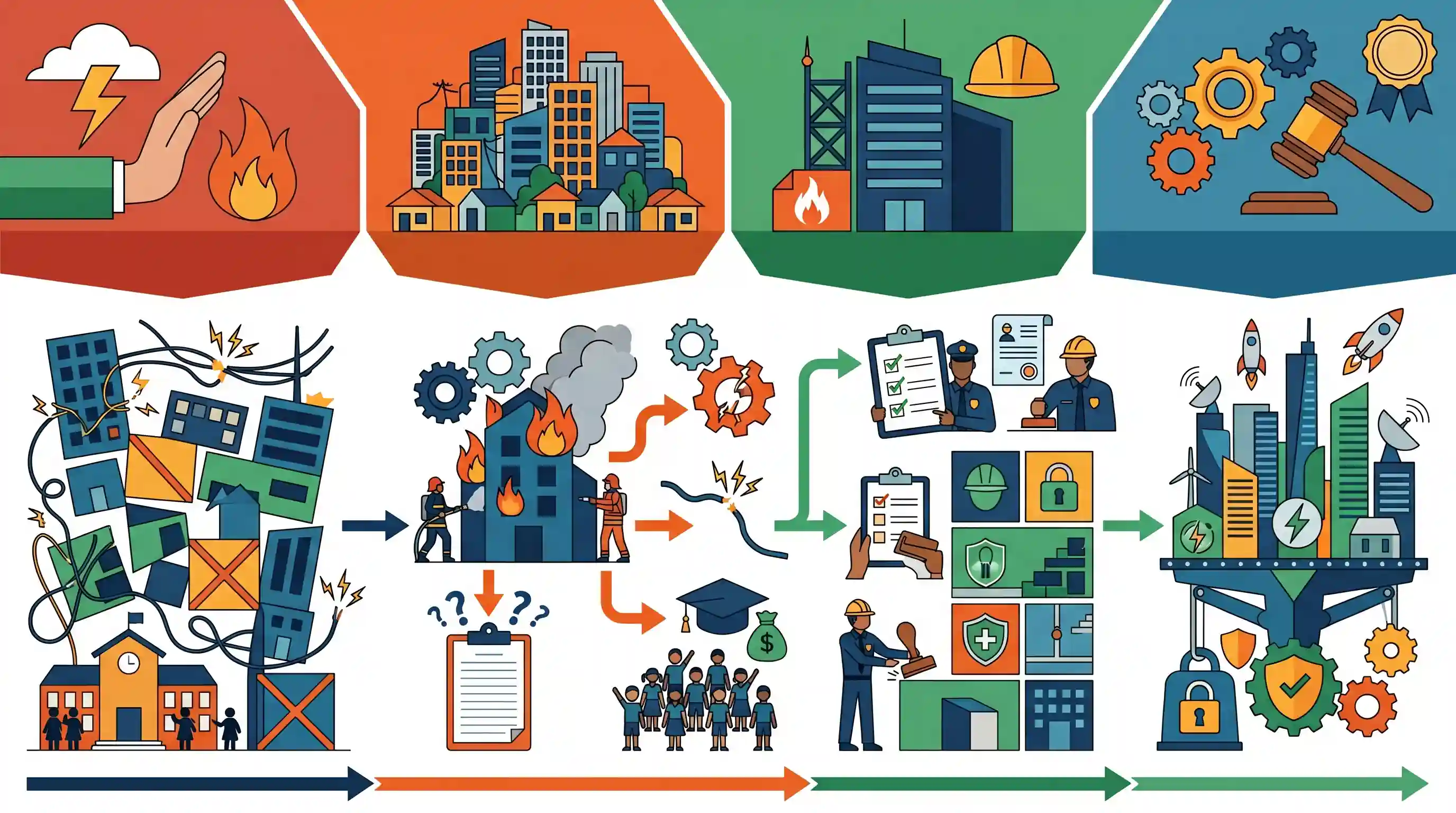
The Lucknow fire tragedy, which claimed 15 lives at a coaching centre, underscores the deadly consequences of regulatory apathy and unplanned urbanization. The incident reveals critical lapses in urban governance, where commercial activities flourish in unauthorized buildings devoid of fundamental fire safety measures. Beyond immediate negligence, the editorial points to deeper systemic issues, such as the mushrooming of unregulated educational institutes driven by demographic aspirations, and the lack of robust electrical safety and fire-forensic investigations. Achieving the vision of a 'Viksit Bharat' necessitates an uncompromising commitment to 'Surakshit Bharat' through stringent enforcement of building codes and nationwide safety audits.
Key Points
- A tragic fire at an unauthorized coaching centre in Lucknow claimed 15 lives, exposing severe regulatory failures in building and commercial zone compliance.
- The proliferation of unregulated coaching institutes is driven by youth aspirations and skill gaps in formal education, leading to safety compromises.
- The editorial highlights the systemic neglect of structural and electrical safety, noting that 'electrical short-circuits' are often symptomatic of overloaded circuits and absent safety devices like arc-fault circuit interrupters.
- There is a pressing need for dedicated fire-forensics experts and a culture of rigorous post-accident investigation to prevent recurrent summer fire disasters.
- The vision of a developed India ('Viksit Bharat') must inherently incorporate structural and public safety ('Surakshit Bharat') through nationwide building safety assessments.
Important Terms
Viksit Bharat @2047

A strategic vision to transform India into a developed nation by 2047, the centenary of independence, targeting a $30-40 trillion economy and high human development standards.
UPSC context
GS Paper III: Indian Economy and Growth; GS Paper II: Governance and long-term developmental vision.
Urban Local Bodies (ULBs)
Constitutional third tier of government (74th Amendment Act) responsible for urban governance, planning, and public safety across 18 functional subjects listed in the Twelfth Schedule.
UPSC context
GS Paper II: Devolution of powers and Decentralization; GS Paper III: Urbanization and Infrastructure.
National Building Code (NBC) of India
A national standard published by the Bureau of Indian Standards (BIS) providing guidelines for building construction and fire safety (specifically Part 4: Fire and Life Safety).
UPSC context
GS Paper III: Disaster Management and Infrastructure safety regulations in urban areas.
Fire Safety Audit
A systematic, periodic evaluation of a building’s fire prevention systems, equipment, and evacuation readiness to ensure compliance with the National Building Code and state laws.
UPSC context
GS Paper III: Disaster Management and Industrial safety; tests regulatory enforcement and risk mitigation.
Fire Services (State Subject)
Listed under the Twelfth Schedule (Article 243W), fire services are a state-governed function typically managed by Urban Local Bodies for prevention and emergency response.
UPSC context
GS Paper II: Seventh Schedule and Local Governance; GS Paper III: Disaster Management framework.
Surakshit Bharat
The prerequisite 'Safe India' vision emphasizing infrastructure safety, disaster resilience, and law enforcement as fundamental pillars necessary to achieve the 'Viksit Bharat' (Developed India) goals.
UPSC context
GS Paper III: Disaster Management and Internal Security; essential link between safety and economic growth.
Prelims Trap
"The National Building Code (NBC) 2016 is a mandatory, legally binding framework for all states."
The NBC is a recommendatory document published by the Bureau of Indian Standards (BIS). It becomes legally binding only when States or ULBs adopt it into their local building bye-laws.
Static Concepts Connected
Who has the constitutional mandate for fire services in India?
- State Subject: Fire services fall under the State List (Entry 33) of the Seventh Schedule of the Constitution.
- Municipal Function: Under Article 243W (12th Schedule), fire services are explicitly categorized as a municipal function for Urban Local Bodies (ULBs).
- NDMA's Role: The NDMA provides overarching guidelines on urban fires, but execution and safety audits remain strictly local administrative responsibilities.
What is the National Building Code (NBC) of India?
- Publisher: It is formulated by the Bureau of Indian Standards (BIS) as a comprehensive model code for construction.
- Nature: It is inherently a recommendatory document providing guidelines for structural, fire, health, and life safety.
- Implementation: Its enforcement relies entirely on its formal adoption into state and local municipal building bye-laws.
Cross-Topic Patterns
Demographic Dividend vs Urban Disasters
The unchecked proliferation of coaching centres exposes how formal education gaps and youth aspirations inadvertently drive hazardous, unplanned commercialization in residential urban zones.
Tech Integration in Disaster Mitigation
With 70% of urban fires caused by short-circuits, mandatory integration of modern infrastructure tech like Arc-Fault Circuit Interrupters (AFCIs) bridges GS-3 Science and Disaster Management.

Expect a 2026 Prelims question testing the recommendatory nature of NBC 2016 against ULB constitutional powers in the 12th Schedule.
Linked PYQs · 3
Linked PYQs · 3
- 2024MainsGS3
What is disaster resilience? How is it determined? Describe various elements of a resilience framework. Also mention the global targets of Sendai Framework for Disaster Risk Reduction (2015–2030).
- 2013MainsGS1
Discuss the various social problems which originated out of the speedy process of urbanization in India.
- 2024MainsGS2
Analyse the role of local bodies in providing good governance at local level and bring out the pros and cons merging the rural local bodies with the urban local bodies.
