Mission Aagaman and Private Sector Orbital Launch
Source:Indian Express ↗
Why It Matters
The launch of Vikram-1 marks a critical milestone in India's space sector reforms, showcasing the successful transition of private entities from experimental sub-orbital flights to functional, satellite-deploying orbital capabilities. This transition is essential for India to secure a competitive foothold in the lucrative global commercial satellite launch market.
Summary
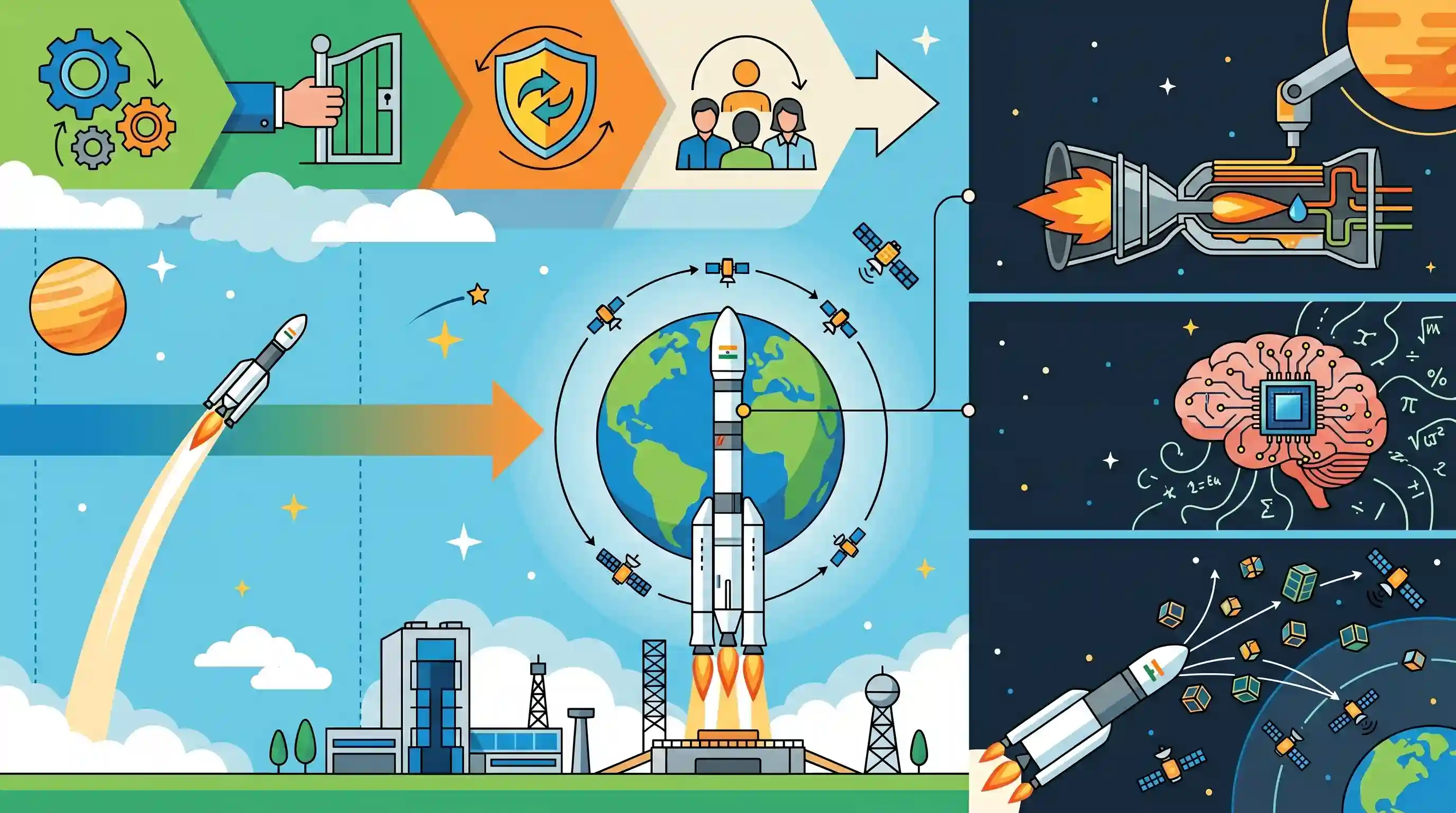
The article outlines the upcoming launch of Vikram-1, India's first privately developed orbital rocket, under 'Mission Aagaman' by Skyroot Aerospace. Expected to launch in mid-2026 from Sriharikota, Vikram-1 represents a major milestone in India's private space tech capabilities, moving beyond the sub-orbital threshold established by Vikram-S in 2022. The launch vehicle is designed for custom, rapid small satellite deployment using fully indigenous technology, including a 3D-printed liquid engine and the autonomous mission computer 'Ramanujan', supported by ISRO and the regulatory body IN-SPACe.
Key Points
- Vikram-1, developed by Hyderabad-based startup Skyroot Aerospace, is ready for its first test flight under 'Mission Aagaman' from Satish Dhawan Space Centre, Sriharikota.
- Unlike Vikram-S, which was a sub-orbital rocket under 'Mission Prarambh' (November 2022), Vikram-1 is an orbital launch vehicle designed to deploy satellites into orbit.
- Vikram-1 features an all-carbon composite structure, solid fuel boosters, a 3D-printed liquid engine, and is 100% manufactured in India.
- The rocket can carry payloads of up to 350 kg to Low Earth Orbit (LEO) at a 450 km altitude with a 60-degree inclination, and up to 260 kg to Sun-Synchronous Orbit (SSO).
- It features an autonomous guidance, navigation, and control system powered by an onboard mission computer named 'Ramanujan', eliminating the need for manual piloting or joysticks.
- The mission highlights the expanding role of non-governmental entities (NGEs) and private players in India's space ecosystem, actively facilitated and mentored by ISRO and IN-SPACe.
Important Terms
Mission Aagaman

The maiden test flight of Vikram-1, India's first privately developed orbital-class rocket, scheduled for mid-2026 by Skyroot Aerospace to deploy small satellites into Low Earth Orbit.
UPSC context
GS Paper III (Science and Technology); tests awareness of commercial space privatization, indigenization of technology, and satellite launch vehicles.
Mission Prarambh
The historic November 2022 launch of Vikram-S, India's first privately developed suborbital rocket, designed by Skyroot Aerospace and authorized by IN-SPACe, marking a milestone in private space technology.
UPSC context
GS Paper III (Science and Technology); crucial for understanding the evolution of private sector space missions and suborbital vs orbital capabilities.
Skyroot Aerospace
A Hyderabad-based private space-tech startup and unicorn founded by former ISRO scientists, famous for launching India’s first private suborbital rocket (Vikram-S) and developing the Vikram-1 orbital rocket.
UPSC context
GS Paper III (Science and Tech); tests understanding of startup-led technology indigenization and private participation in the space economy.
IN-SPACe (Indian National Space Promotion and Authorisation Centre)
An autonomous, single-window nodal agency under the Department of Space that promotes, facilitates, and regulates the space activities of non-governmental private entities in India.
UPSC context
GS Paper II (Governance) & GS III (Space Tech); tests knowledge of regulatory reforms enabling private participation in the space sector.
Indian Space Research Organisation (ISRO)
India's premier national space agency under the Department of Space, responsible for space exploration, satellite launching, and facilitating infrastructure sharing for private aerospace startups.
UPSC context
GS Paper III (Science and Tech); tests knowledge of state-led technological milestones and institutional reforms facilitating the commercial space ecosystem.
Prelims Trap
Vikram-S, launched under Mission Prarambh in 2022, was India's first private orbital rocket.
Vikram-S was a sub-orbital sounding rocket. Vikram-1, scheduled under Mission Aagaman, is the first private Indian launch vehicle designed to place payloads in stable orbits.
Static Concepts Connected
How do the mandates of IN-SPACe and NSIL differ in India's space ecosystem?
- IN-SPACe role: Functions as an autonomous, single-window regulatory and promotional body to facilitate and supervise private sector (NGE) space activities.
- NSIL role: Operates as ISRO's commercial arm, focusing on commercializing ISRO technologies, transferring tech to industry, and acquiring launch services.
What is the physical difference between sub-orbital and orbital trajectories?
- Velocity threshold: Sub-orbital flights lack the horizontal velocity (approximately 7.8 km/s) required to enter a stable, continuous orbit around Earth.
- Flight path: Sub-orbital missions follow a parabolic ballistic trajectory returning to Earth's surface, while orbital flights achieve stable continuous free-fall.
Cross-Topic Patterns
Space-tech commercialization and IPR dynamics
Private orbital launches raise critical questions about technology transfer, patent rights for indigenous 3D-printed engines, and technology licensing from ISRO.
LEO commercialization and debris mitigation
Rapid deployment of private small-satellite constellations in LEO increases orbital crowding, linking space commercialization to global space debris mitigation protocols.

IN-SPACe vs NSIL institutional mandates and private orbital flight capabilities are highly likely to feature in Prelims 2026.
Linked PYQs · 2
Linked PYQs · 2
- 2026PrelimsGS1
Consider the following statements with regard to involvement of private entities in India's space programme : 1. The Indian National Space Promotion and Authorisation Centre (IN-SPACe) is an autonomous agency formed to facilitate participation of private entities. 2. Agnikul Cosmos launched the world's first flight using 3D-printed rocket engine. 3. Skyroot Aerospace has developed liquid fuel for GSLV. Which of the statements given above is/are correct ?
- 2016MainsGS3
Discuss India's achievements in the field of Space Science and Technology. How the application of this technology has helped India in its socio-economic development?
