Vikram 1 Launch and Public Private Partnerships in Space
Source:The Hindu ↗
কেন এটি গুরুত্বপূর্ণ
The shift from a state-monopolized space program to a collaborative, private-sector-inclusive ecosystem is a major theme under GS3 Science and Technology. Startups like Skyroot Aerospace and regulatory facilitators like IN-SPACe are redefining India's commercial space capabilities, aligning with India's broader economic and technological goals (Viksit Bharat). Understanding these reforms is crucial for questions on privatization, space technology achievements, and joint ventures in high-tech sectors.
সারসংক্ষেপ
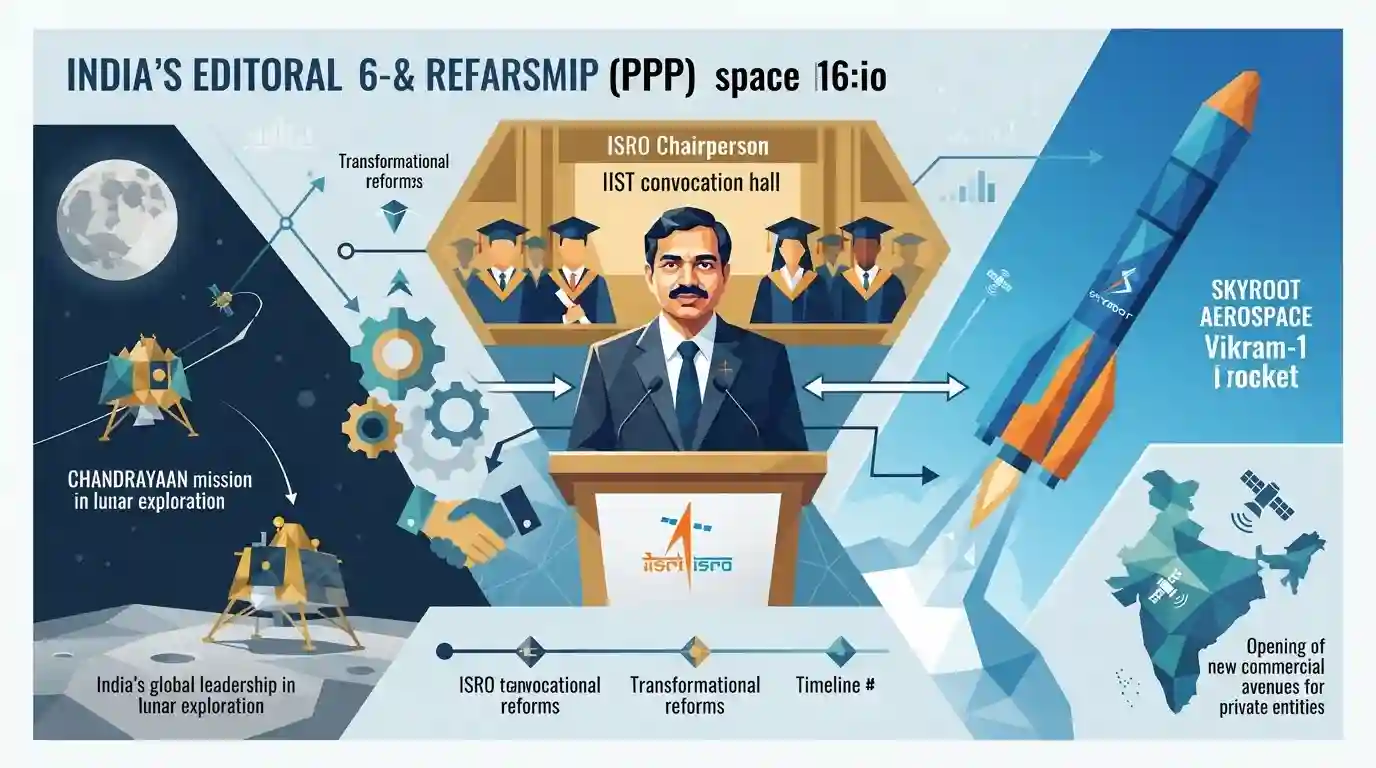
During the 14th convocation of the Indian Institute of Space Science and Technology (IIST), ISRO Chairperson V. Narayanan hailed the successful launch of Vikram-1 by Skyroot Aerospace as a prime example of successful public-private partnerships (PPP) in India's space sector. He described the recent space reforms as a transformational milestone that has unlocked new commercial avenues for private entities. Highlighting India's global leadership in lunar exploration through the Chandrayaan mission, the address emphasized the growing collaborative framework between ISRO and the private sector to build a robust space ecosystem.
মূল বিষয়
- ISRO Chairperson V. Narayanan highlighted that the successful launch of Vikram-1 by Skyroot Aerospace showcases the growing synergy of public-private partnerships (PPP) in India's space ecosystem.
- He characterized India's space sector reforms as a 'transformational milestone' that has democratized the sector, offering unprecedented opportunities for private space startups and commercial entities.
- The address was delivered during the 14th convocation of the Indian Institute of Space Science and Technology (IIST) in Valiamala, Thiruvananthapuram, where 332 degrees were conferred.
- India's leading space achievements, such as finding water-related evidence on the Moon and the historic soft landing near the lunar south pole via the Chandrayaan mission, were celebrated as global benchmarks of scientific excellence.
- Chief Guest Governor Rajendra Vishwanath Arlekar emphasized that India's rising capabilities across science, technology, and national security have shifted global perceptions, urging graduates to contribute to the 'Viksit Bharat' vision.
গুরুত্বপূর্ণ শব্দ
Vikram-1 launch

The successful maiden orbital flight of Vikram-1 on July 18, 2026, developed by Skyroot Aerospace, establishing India as the third country with demonstrated private orbital launch capability.
UPSC context
GS Paper III (Science & Tech); tests awareness of space startups, public-private partnerships, and commercial space achievements.
Indian Space Sector Reforms
Regulatory and policy shifts initiated in 2020 designed to open India’s space industry to non-government entities (NGEs) and promote private participation in end-to-end space activities through IN-SPACe.
UPSC context
GS Paper III (S&T and Economy); tests understanding of space policies, FDI rules, and commercializing the space ecosystem.
Skyroot Aerospace
A Hyderabad-based private aerospace startup that became the first Indian private company to independently develop and launch a rocket to orbit, following its successful Vikram-1 mission.
UPSC context
GS Paper III (Science & Tech); tests awareness of private aerospace pioneers and commercial launch services.
Indian Space Research Organisation (ISRO)
India's premier national space agency under the Department of Space, tasked with conducting space research, developing space technologies, and executing planetary exploration missions.
UPSC context
GS Paper III (Science & Tech); tests knowledge of foundational space institutions and landmark national space missions.
Indian Institute of Space Science and Technology (IIST)
A premier government-aided deemed university established in Thiruvananthapuram, Kerala, dedicated to teaching and researching space sciences and serving as a crucial talent pipeline for ISRO.
UPSC context
GS Paper III (S&T/Education); tests awareness of specialized capacity-building institutions supporting the space program.
Chandrayaan mission
ISRO's flagship lunar exploration program consisting of multiple missions aimed at lunar mapping, chemical characterization, and demonstrating soft-landing capabilities on the Moon's surface.
UPSC context
GS Paper III (Science & Tech); tests knowledge of key indigenous deep-space exploration and scientific achievements.
প্রিলিমস ফাঁদ
Vikram-1 was the first privately developed rocket launched into space from India.
Vikram-S (launched in Nov 2022) was a sub-orbital launch. Vikram-1 is the first private orbital launch. UPSC often swaps 'orbital' and 'sub-orbital' to test precision.
সংযুক্ত স্থির ধারণা
What are the distinct mandates of IN-SPACe and NSIL?
- IN-SPACe mandate: Single-window autonomous nodal agency under the Department of Space (DoS) to authorize, promote, and regulate private space activities.
- NSIL mandate: A Central Public Sector Enterprise (CPSE) acting as the commercial arm of ISRO, handling satellite launches and technology transfer.
- ISRO's new role: Reoriented to focus primarily on advanced research and development, deep-space exploration, and human spaceflight missions.
আন্তঃবিষয় প্যাটার্ন
FDI liberalization + Space startups
The 2024 amendment allowing up to 100% FDI in space-tech under automatic routes has directly fueled capital inflows for private orbital launch projects like Skyroot.
Space debris + Private launch expansion
Surging private launches in Low Earth Orbit (LEO) heighten collision risks, emphasizing the strategic importance of ISRO's Project NETRA for space situational awareness.

Prelims 2026 may test institutional roles of IN-SPACe vs NSIL alongside India's first private orbital launch capabilities.
সংযুক্ত PYQ · 3
সংযুক্ত PYQ · 3
- 2026PrelimsGS1
Consider the following statements with regard to involvement of private entities in India's space programme : 1. The Indian National Space Promotion and Authorisation Centre (IN-SPACe) is an autonomous agency formed to facilitate participation of private entities. 2. Agnikul Cosmos launched the world's first flight using 3D-printed rocket engine. 3. Skyroot Aerospace has developed liquid fuel for GSLV. Which of the statements given above is/are correct ?
- 2023MainsGS3
What is the main task of India's third moon mission which could not be achieved in its earlier mission? List the countries that have achieved this task. Introduce the subsystems in the spacecraft launched and explain the role of the Virtual Launch Control Centre' at the Vikram Sarabhai Space Centre which contributed to the successful launch from Sriharikota.
- 2016MainsGS3
Discuss India's achievements in the field of Space Science and Technology. How the application of this technology has helped India in its socio-economic development?
