NGLV Project and LOX Methane Propulsion for Next Gen ISRO Rockets
Source:The Hindu ↗
Why It Matters
Launch vehicle technology is a highly tested area in UPSC Prelims and Mains (GS3). Understanding ISRO's transition from traditional cryogenic engines to LOX-Methane propulsion and the specific payload capabilities of the upcoming NGLV is essential for space-related questions. Additionally, the new Rashtriya Vigyan Puraskar awards are important factual fodder for Prelims.
Summary
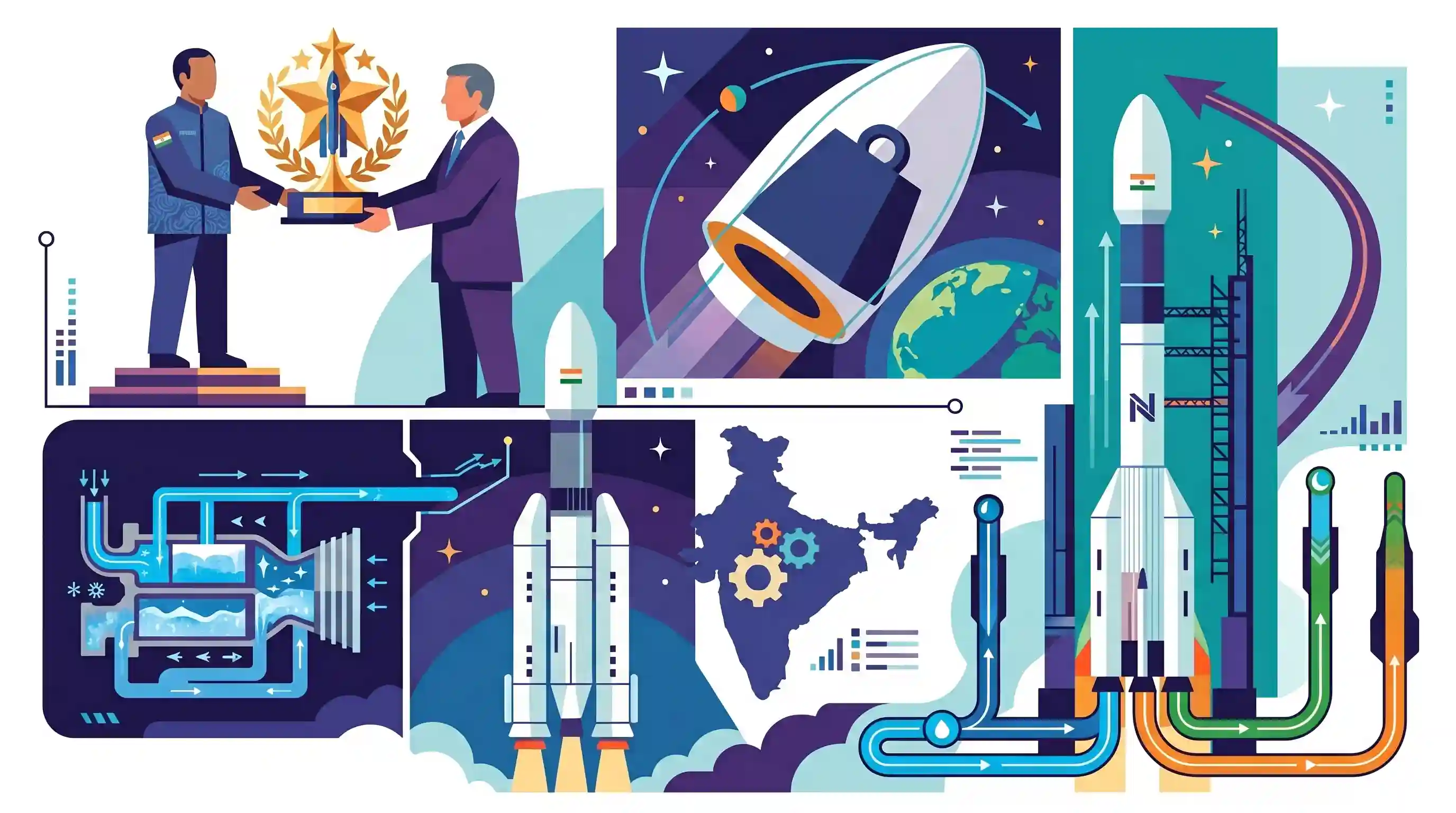
Jayan N., a prominent scientist at ISRO's Vikram Sarabhai Space Centre, has been honoured with the Vigyan Shri award in the Space Science and Technology category under the Rashtriya Vigyan Puraskar. The award recognizes his instrumental role in developing indigenous cryogenic engines for ISRO's heavy-lift launch vehicles, including the GSLV and LVM3. He is now leading the Next Generation Launch Vehicle (NGLV) project, which aims to build India's tallest rocket capable of carrying 30 tonnes to Low Earth Orbit, utilizing advanced Liquid Oxygen-Methane propulsion technology.
Key Points
- Senior ISRO scientist Jayan N. was awarded the Vigyan Shri (under Rashtriya Vigyan Puraskar) for his contributions to cryogenic engine development for GSLV and LVM3 rockets.
- He currently serves as the Project Director for the Next Generation Launch Vehicle (NGLV) at the Vikram Sarabhai Space Centre.
- The NGLV is designed to be India's tallest rocket (93 metres) and will have a payload capacity of 30 tonnes to Low Earth Orbit (LEO).
- A key feature of the NGLV will be the use of a new Liquid Oxygen-Methane (LOX-Methane) engine, marking a shift in ISRO's propulsion technology.
Important Terms
Rashtriya Vigyan Puraskar

India's highest national honors for science, technology, and innovation, established in 2024 to replace various individual ministry-level awards.
UPSC context
GS Paper III: Science & Technology; tests awareness of national honors and institutional reforms in the scientific ecosystem.
Vigyan Shri
One of four categories under the Rashtriya Vigyan Puraskar, recognizing 'distinguished contributions' in various scientific domains without an age limit.
UPSC context
GS Paper III: Achievements of Indians in S&T; identifying specific recognition levels for scientists.
Next Generation Launch Vehicle (NGLV)
ISRO's upcoming three-stage, partially reusable heavy-lift rocket designed to carry 30-tonne payloads to Low Earth Orbit, replacing the PSLV.
UPSC context
GS Paper III: Space Technology; crucial for understanding India's future lunar missions and space station plans.
Vikram Sarabhai Space Centre (VSSC)
ISRO's lead center in Thiruvananthapuram for launch vehicle design, responsible for the development of rockets like PSLV, GSLV, and NGLV.
UPSC context
GS Paper III: Space Technology; understanding the role of major national R&D institutions.
Cryogenic Technology
Rocket technology using liquid fuels (like hydrogen or methane) and oxidizers at extremely low temperatures to provide high thrust for heavy-lift vehicles.
UPSC context
GS Paper III: Science & Technology; tests knowledge of critical propulsion systems and India's indigenous capabilities.
LOX-Methane Propulsion
An advanced propulsion system using liquid oxygen and methane; it is cleaner, reusable, and potentially synthesizable on other planets like Mars.
UPSC context
GS Paper III: Space Technology; emerging trends in green propulsion and interplanetary mission sustainability.
Prelims Trap
"The Next Generation Launch Vehicle uses Liquid Hydrogen as fuel for its main cryogenic engines."
While India's current cryogenic engines (GSLV/LVM3) use Liquid Hydrogen, NGLV shifts to Liquid Methane. Methane prevents soot build-up (coking), making it ideal for reusable rockets.
Static Concepts Connected
What distinguishes traditional Cryogenic from new Methalox rocket engines?
- Traditional Cryogenic: Uses gases liquefied at extremely low temperatures, traditionally Liquid Hydrogen (fuel) and Liquid Oxygen (oxidizer). Highly efficient but complex to store.
- Methalox Engine: Uses Liquid Methane as fuel and Liquid Oxygen as oxidizer. It burns cleaner, resists coking (soot), and is easier to handle, making it ideal for reusable rockets.
What is the structure of the Rashtriya Vigyan Puraskar (RVP)?
- Unified System: It replaces 300+ science awards (including the Shanti Swarup Bhatnagar prize) to create a unified national recognition for scientific achievement.
- Four Categories: Comprises Vigyan Ratna (lifetime achievement), Vigyan Shri (distinguished contributions), Vigyan Yuva-SSB (young scientists under 45), and Vigyan Team.
- Eligibility: Persons of Indian Origin (PIOs) staying abroad are also eligible for the awards if their contributions have significantly benefited India.
Cross-Topic Patterns
Reusability and Space Sustainability
NGLV's partially reusable design and cleaner-burning methalox engines directly align with ISRO's broader sustainability goals, complementing initiatives like the Debris Free Space Missions by 2030.
NGLV as the backbone of BAS
NGLV's 30-tonne LEO payload capacity is a structural prerequisite for lifting heavy habitat modules to assemble the Bharatiya Antariksh Station (BAS) by 2035.

Expect a multi-statement Prelims question comparing LVM3 and NGLV capabilities, specifically highlighting the shift to LOX-Methane fuel.
Linked PYQs · 2
Linked PYQs · 2
- 2018PrelimsGS1
With reference to India's satellite launch vehicles, consider the following statements: 1. PSLVs launch the satellites useful for Earth resources monitoring whereas GSLVs are designed mainly to launch communication satellites. 2. Satellites launched by PSLV appear to remain permanently fixed in the same position in the sky, as viewed from a particular location on Earth. 3. GSLV Mk III is a four-staged launch vehicle with the first and third stages using solid rocket motors; and the second and fourth stages using liquid rocket engines. Which of the statements given above is/are correct?
- 2023MainsGS3
What is the main task of India's third moon mission which could not be achieved in its earlier mission? List the countries that have achieved this task. Introduce the subsystems in the spacecraft launched and explain the role of the Virtual Launch Control Centre' at the Vikram Sarabhai Space Centre which contributed to the successful launch from Sriharikota.
