Role of Judiciary and Civil Society in Advancing Gender Justice
Source:The Hindu ↗
Why It Matters
Highlights the crucial interplay between the judiciary and civil society in driving social reform and ensuring constitutional accountability. It provides important perspective for answers on the role of non-state actors in democracy, judicial functioning, and strategies for achieving substantive gender equality.
Summary
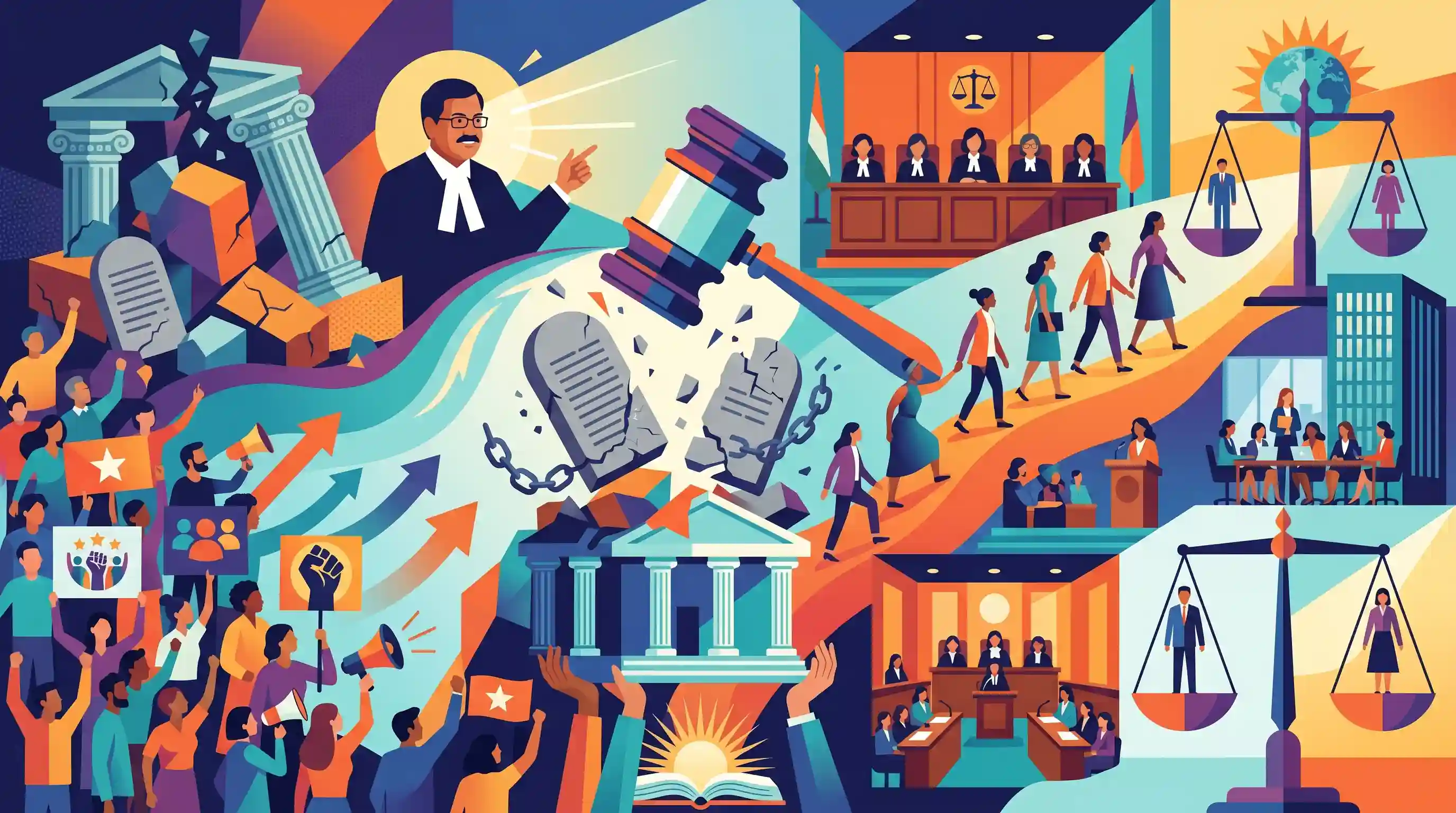
Chief Justice of India B.R. Gavai, delivering the 30th Justice Sunanda Bhandare Memorial Lecture, underscored the collaborative role of the judiciary, civil society, and women's movements in advancing gender justice in India. He noted that courts alone have not achieved this progress; rather, the vigilance of ordinary citizens has repeatedly challenged regressive legal precedents, leading to vital reforms and keeping the judiciary accountable to the Constitution. Gavai asserted that true gender equality transcends token representation, demanding the systemic integration of women into spaces of power, institutions, and decision-making.
Key Points
- CJI B.R. Gavai emphasized that progress in gender justice in India is a collaborative achievement of the courts, vigilant civil society, and women's movements.
- Public vigilance and the collective voice of citizens have been crucial in questioning and correcting regressive legal precedents through reform, reinterpretation, or legislative intervention.
- The dialogue between the judiciary and citizens acts as a vital source of democratic strength, keeping courts accountable to the constitutional promise of equality.
- Genuine gender equality goes beyond token representation; it requires women to have an equal share in spaces of power, decision-making, and opportunity.
Important Terms
Gender Justice

The principle of social, political, and economic equality for all genders, requiring the removal of systemic barriers and ensuring equal access to rights and opportunities.
UPSC context
GS Paper 1 (Social Issues) and GS Paper 2 (Social Justice); critical for analyzing women's empowerment and legal protections.
Civil Society
The 'third sector' of society, comprising NGOs, movements, and citizen groups that act independently of the state to advocate for public interests and accountability.
UPSC context
GS Paper 2 (Governance/NGOs); focuses on the collaborative role of non-state actors in policy-making and rights advocacy.
Supreme Court of India
The apex judicial body under the Indian Constitution, acting as the ultimate interpreter of laws and the protector of citizens' fundamental rights.
UPSC context
GS Paper 2 (Polity); central to questions on judicial activism, independence, and its role in social transformation.
Judicial Accountability
The requirement that the judiciary remains answerable to the Constitution and the public for its conduct, decisions, and institutional integrity.
UPSC context
GS Paper 2 (Governance); involves balancing judicial independence with transparency and corrective mechanisms for regressive precedents.
Constitutional Morality
The adherence to the core democratic values and spirit enshrined in the Constitution, guiding the state and judiciary beyond mere literal interpretations.
UPSC context
GS Paper 2 (Polity/Judiciary); often tested via landmark judgments that prioritize substantive equality over regressive social norms.
Transformative Constitutionalism
A judicial philosophy where the Constitution is used as a tool to bring about fundamental shifts in social structures toward equality and justice.
UPSC context
GS Paper 2 (Polity); explores the judiciary's proactive role in correcting historical injustices and promoting modern social values.
Prelims Trap
Fundamental Duties under Article 51A, like renouncing derogatory practices against women, are directly enforceable by the Supreme Court via writs.
Fundamental duties are inherently non-justiciable. While courts use them to interpret the constitutionality of statutes, they cannot issue writs to enforce them against citizens without a backing law.
Static Concepts Connected
What distinguishes Formal Equality from Substantive Equality under the Indian Constitution?
- Formal Equality: Mandated by Article 14, it ensures equal treatment before the law but often ignores historical and structural disadvantages faced by marginalized demographic groups.
- Substantive Equality: Enabled by Articles 15(3) and 16(4), it demands affirmative state action and systemic integration to achieve genuine, real-world equity for disadvantaged groups like women.
How does Public Interest Litigation (PIL) enable civil society to drive legal reform?
- Locus Standi Relaxation: Supreme Court rulings in the 1980s allowed any public-spirited citizen or NGO to file petitions on behalf of vulnerable groups unable to access courts themselves.
- Epistolary Jurisdiction: Courts began accepting letters and telegrams as formal writ petitions, democratizing the enforcement of fundamental rights and empowering women's movements to challenge regressive norms.
Cross-Topic Patterns
PILs filling legislative vacuums
The partnership of civil society and courts in the Bhanwari Devi case produced the Vishaka Guidelines, proving how judicial-civic collaboration forces the creation of laws like the POSH Act, 2013.
Tokenism in Panchayati Raj (Sarpanch Patis)
The CJI's critique of token representation mirrors the phenomenon of 'Sarpanch Patis', where proxy male leadership undermines the 73rd Amendment's goal of substantive political empowerment for women in local governance.

Expect a GS2 Mains question analyzing how 'substantive equality' for women requires civil society vigilance alongside judicial rulings.
Linked PYQs · 5
Linked PYQs · 5
- 2025MainsGS2
Civil Society Organizations are often perceived as being anti-State actors than non-State actors. Do you agree? Justify.
- 2024MainsGS1
Distinguish between gender equality, gender equity and women's empowerment. Why is it important to take gender concerns into account in programme design and implementation?
- 2023MainsGS2
Explain the constitutional perspectives of Gender Justice with the help of relevant Constitutional Provisions and case laws.
- 2021MainsGS2
Discuss the desirability of greater representation to women in the higher judiciary to ensure diversity, equity and inclusiveness.
- 2025MainsGS2
Women's social capital complements in advancing empowerment and gender equity. Explain.
