Uttarakhand Vigilance Court Notice in Disproportionate Assets Case
Source:bignewsnetwork ↗
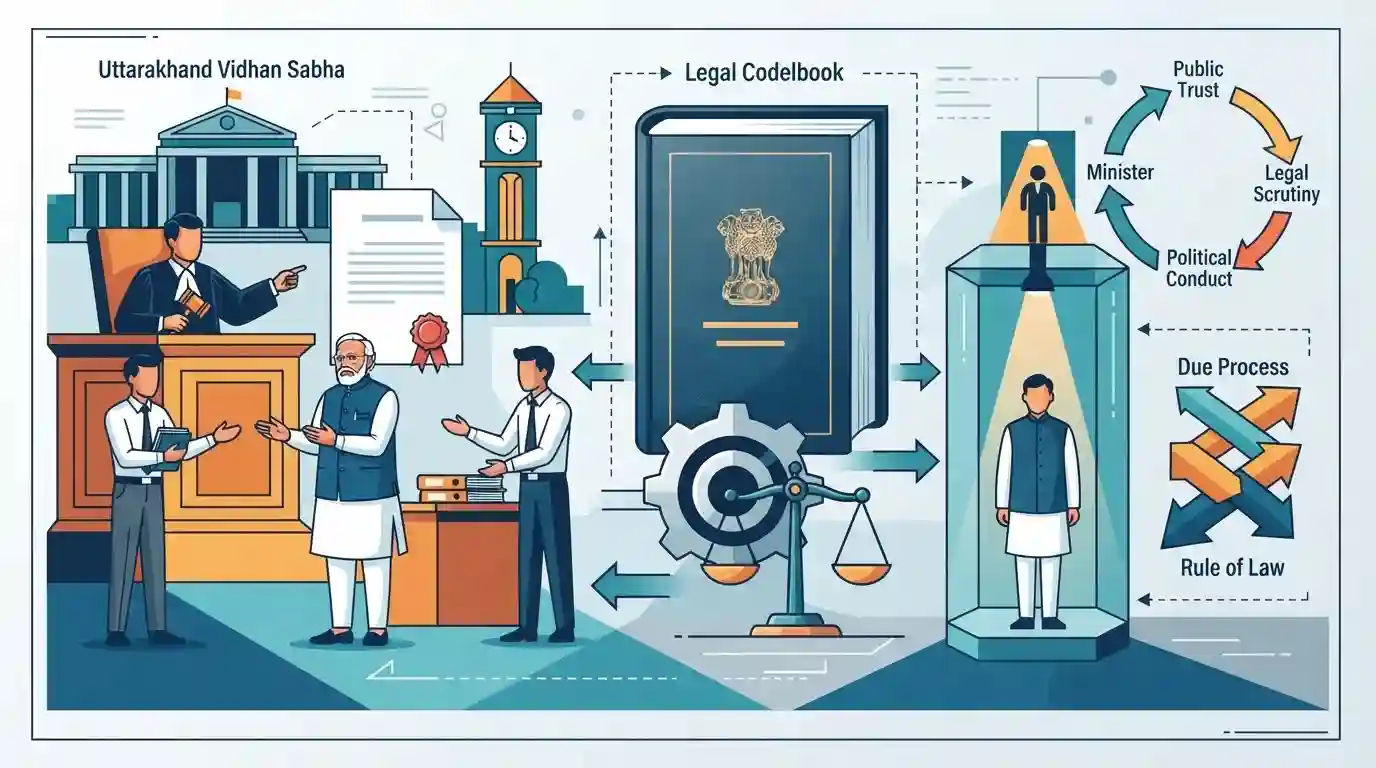
Why It Matters
Highlights the active role of state vigilance mechanisms and courts in holding public officials accountable, while offering a practical example of the new Bharatiya Nagarik Suraksha Sanhita (BNSS) in judicial proceedings. Relevant for Polity and Governance topics.
Summary
Uttarakhand Cabinet Minister Ganesh Joshi has been issued a notice by a Special Vigilance Court in Dehradun concerning a disproportionate assets case. Acting on a complaint filed by Pankaj Singh Kshetri, the court directed the minister to appear on September 3. The notice underscores the application of the newly enacted Bharatiya Nagarik Suraksha Sanhita (BNSS) within the state's anti-corruption proceedings, bringing political accountability and legal reform to the forefront.
Key Points
- A Special Vigilance Court in Dehradun issued a formal notice to Uttarakhand Cabinet Minister Ganesh Joshi over alleged disproportionate assets.
- The minister has been ordered to appear before the court on September 3, 2026.
- The legal notice was issued under the newly implemented Bharatiya Nagarik Suraksha Sanhita (BNSS).
- The complainant requested an open vigilance inquiry into the minister's assets, highlighting accountability of elected state representatives.
Important Terms
Bharatiya Nagarik Suraksha Sanhita (BNSS)

India's new criminal procedure code, effective July 2024, replacing the colonial-era CrPC. It modernizes the justice system by introducing e-FIRs, digital evidence integration, strict trial timelines, and mandatory forensic investigations for serious offenses.
UPSC context
High-priority for GS Paper 2 (Criminal Justice Reforms). Tests knowledge of procedural changes balancing state power and citizen rights.
Vigilance Court
Specialized trial courts presided over by a Special Judge to exclusively adjudicate corruption, bribery, and disproportionate assets cases against public servants, primarily under the Prevention of Corruption Act, 1988.
UPSC context
Relevant to GS Paper 2 (Governance & Accountability) and GS Paper 4 (Probity). Highlights the judicial infrastructure combating public corruption.
Vigilance Department
A dedicated state-level anti-corruption agency tasked with investigating allegations of bribery, misconduct, and the accumulation of disproportionate assets against government officials, public servants, and elected representatives.
UPSC context
Important for GS Paper 2 (State Governance) and GS Paper 4. Tests understanding of institutional mechanisms enforcing administrative accountability.
Prelims Trap
Any demand or acceptance of a bribe by a public servant is classified as 'criminal misconduct' under Section 13 of the Prevention of Corruption Act.
The 2018 amendment narrowed Section 13 'criminal misconduct' to only two categories: misappropriation of public property and disproportionate assets. Other bribery offenses are covered under different sections.
Static Concepts Connected
What constitutes 'criminal misconduct' under the amended Prevention of Corruption Act?
- Narrowed definition: The 2018 amendment restricted criminal misconduct to just two specific categories of offenses under Section 13.
- Property misappropriation: Dishonestly or fraudulently misappropriating or converting any public property entrusted to them for personal use.
- Illicit enrichment: Intentionally amassing pecuniary resources or property disproportionate to the public servant's known sources of income.
How does the BNSS address prosecution sanctions for public servants?
- Mandatory timeline: Under Section 218, the competent authority must decide on granting prosecution sanction within 120 days.
- Deemed approval: If the authority fails to decide within 120 days, the sanction is legally deemed to have been granted.
Cross-Topic Patterns
BNSS timelines + Cooperative Federalism
Uniform implementation of BNSS procedural rules like deemed sanctions binds state vigilance courts, altering how state governments shield high-ranking political executives from prosecution.
Anti-corruption + RPA disqualification
A conviction for disproportionate assets under the PC Act triggers automatic disqualification from legislative bodies under Section 8 of the Representation of the People Act, 1951.

The conflict between BNSS Sec 218 (deemed prosecution sanction) and PC Act Sec 17A (prior permission) is highly likely in GS-2 2026.
Linked PYQs · 1
Linked PYQs · 1
- 2025UKPSC_PRELIMSGS1
Consider the following statements regarding Lokpal and Lokayukta Act, 2013 : 1. The Selection Committee of Lokpal consists of Chairperson of Rajya Sabha. 2. It shall apply to Indian public servants both within and outside India. Which of the above statements is/are correct ?
