Himachal Jal Shakti Department begins para-workers recruitment drive
Source:babushahi ↗
Why It Matters
It highlights state-specific governance initiatives linking rural employment generation with the maintenance of vital public utilities like water and irrigation infrastructure, which is highly relevant for HPAS questions on state schemes and administration.
Summary
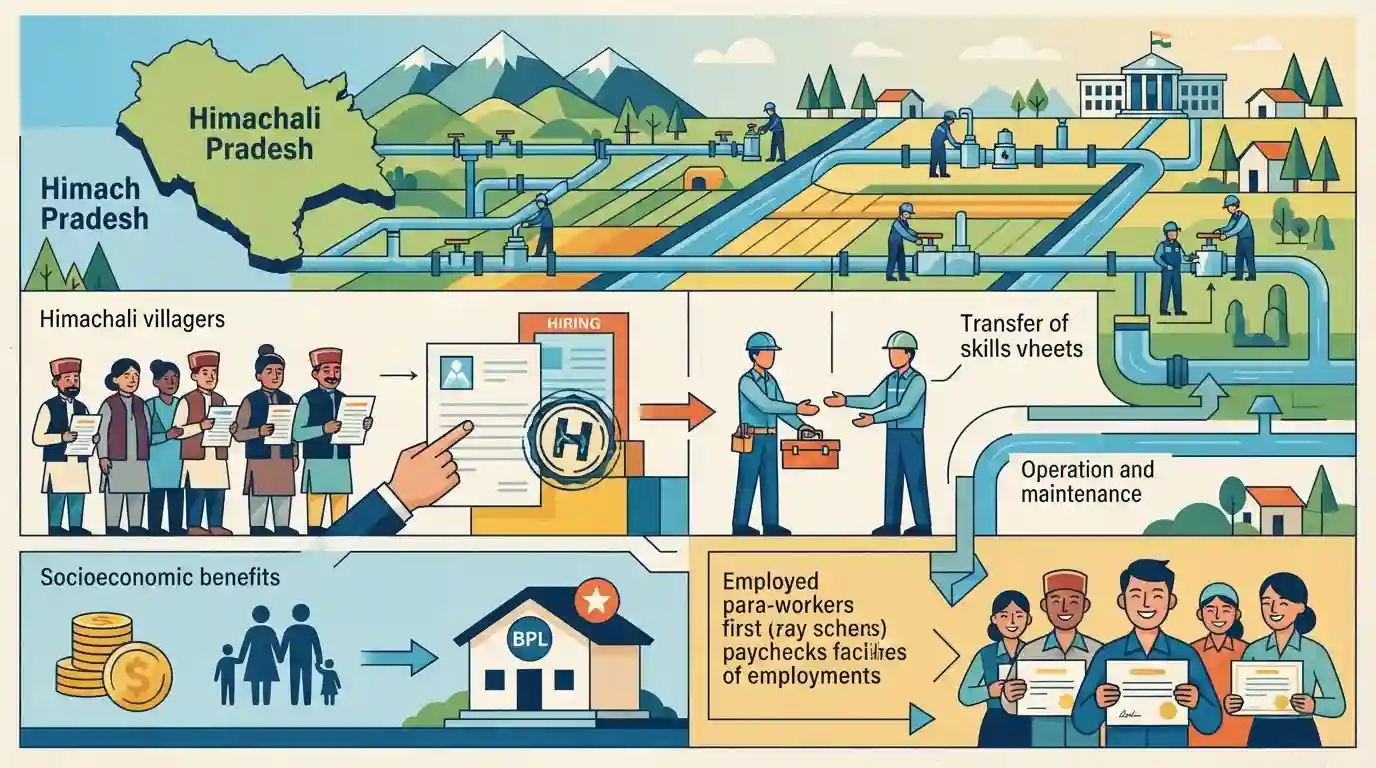
The Himachal Pradesh Jal Shakti Department has initiated a recruitment drive for para-workers to support the operation and maintenance of the state's drinking water and irrigation schemes. The drive focuses on local employment, requiring a Himachali bonafide certificate, and includes provisions favoring BPL families.
Key Points
- The Himachal Pradesh Jal Shakti Department is recruiting Para Pump Operators, Para Fitters, and Para Multi-Purpose Workers.
- The initiative aims to ensure the smooth operation and maintenance of drinking water and irrigation schemes in the state.
- Eligibility requires candidates to be aged 18 to 45 years and possess specific educational qualifications, including ITI certificates for technical roles.
- Selection is based on a 10-mark evaluation system that includes educational merit, BPL status (1 mark), relevant experience, and skill/physical tests.
- Selected technical workers will receive a monthly honorarium of Rs 7,100, while Multi-Purpose Workers will receive Rs 6,000.
Important Terms
Below Poverty Line (BPL)

An economic benchmark used by the Indian government to identify households in severe economic disadvantage. It determines eligibility for various welfare schemes and subsidies based on specific income thresholds and deprivation parameters.
UPSC context
Crucial for GS Paper 2 (Social Justice). Tests knowledge of poverty estimation methodologies, welfare targeting, and socio-economic inclusion.
Himachal Pradesh Jal Shakti Department
A state-level government agency responsible for developing, operating, and maintaining drinking water supply schemes, sewerage systems, flood protection works, and agricultural irrigation infrastructure across Himachal Pradesh.
UPSC context
Relevant to GS Paper 2 (Governance) and GS Paper 3 (Water Resources). Highlights state-led institutional frameworks for rural service delivery.
Para-workers
Contractual or honorarium-based staff hired locally by government departments to assist in operating, maintaining, and managing grassroots public infrastructure, such as rural drinking water and irrigation schemes.
UPSC context
Maps to GS Paper 2 (Governance) and GS Paper 3 (Employment). Tests understanding of local employment generation and decentralization.
Prelims Trap
"State legislatures have the constitutional power to mandate residence requirements for state public employment."
Under Article 16(3) of the Constitution, only Parliament—not State Legislatures—has the power to prescribe residence as a condition for public employment in a state/UT.
Static Concepts Connected
How does the Jal Jeevan Mission ensure decentralized Operation & Maintenance (O&M)?
- Pani Samitis: Village Water & Sanitation Committees (VWSCs) or 'Pani Samitis' are formed to plan, implement, and manage in-village water infrastructure.
- Community Ownership: Communities must contribute 5% (hilly/forested) or 10% (other areas) of the capital cost in cash, kind, or labor to instil ownership.
- Skill Integration: The mission integrates local capacity building, skilling rural youth as masons, plumbers, fitters, and electricians to maintain the piped systems locally.
What are the constitutional exceptions to equality of opportunity in public employment (Article 16)?
- Residence Requirements: Parliament (not states) can legally prescribe residence as a condition for certain state or UT government jobs under Article 16(3).
- Backward Classes: The State can reserve appointments or posts for any backward class of citizens not adequately represented in state services under Article 16(4).
- Religious Institutions: A law can provide that the incumbent of an office in connection with a religious institution must profess that particular religion.
Cross-Topic Patterns
Convergence of JJM and Skill India
Localized hiring of ITI-certified youth for scheme maintenance reflects a policy shift towards merging rural infrastructure creation (Jal Jeevan Mission) with vocational skill deployment (Skill India).
Son of the Soil Policies vs Article 16
The requirement for a "Himachali bonafide certificate" links to ongoing constitutional debates and judicial scrutiny over 'son of the soil' policies and state-level private/public domicile quotas (e.g., Haryana).

Expect a multi-statement question on Jal Jeevan Mission focusing on community ownership and decentralized O&M via VWSCs, not just targets.
Linked PYQs · 3
Linked PYQs · 3
- 2022HPAS_PRELIMSGS1
Which of the following statements about 'Jal-Jeevan-Mission' is not correct ? (i) In H.P. it is targeted to include every rural household in providing 'Functional Household Tap Connection (FHTC) to every family by June, 2022. (ii) Out of 17.28 lakh households, 15.80 lakh were provided FHTC upto December, 2021. (iii) In Himachal Pradesh 91% of the households have been provided with domestic connection against a national average of 45.50 percent. (iv) Himachal Pradesh places at 8th position in the country for providing FHTC.
- 2023HPAS_PRELIMSGS1
Match List I with List II : | List-I | List-II | |---|---| | (a) Himachal Pradesh Skill Development Project | (i) 2018 | | (b) Himachal Pradesh Kaushal Vikas Nigam | (ii) 2017 | | (c) Mukhya Mantri Yuva Ajivika Yojana | (iii) 2014 | | (d) Himachal Grhini Suvidha Yojana | (iv) 2019 | Choose the correct answer from the options given below : Code: (a) (b) (c) (d)
- 2025HPAS_PRELIMSGS1
Match List I with List II : | List-I (Scheme) | List-II (Launch Year) | |---|---| | (a) Mukhya Mantri Roshni Yojana | (i) 2015 | | (b) Himachal Pradesh Horticulture Development Project | (ii) 2019 | | (c) Mukhya Mantri Gram Path Yojana | (iii) 2009 | | (d) Swavalamban Yojana | (iv) 2020 | Choose the correct answer from the options given below : Code: (a) (b) (c) (d)
