Himachal Reduces Pass Fees for Vehicles on Shimla Sealed Roads
Source:babushahi ↗
Why It Matters
Understanding local urban policies, traffic management in difficult terrains, and state ordinances is crucial for HPAS Prelims, particularly in the context of Himachal Pradesh-specific governance and administration.
Summary
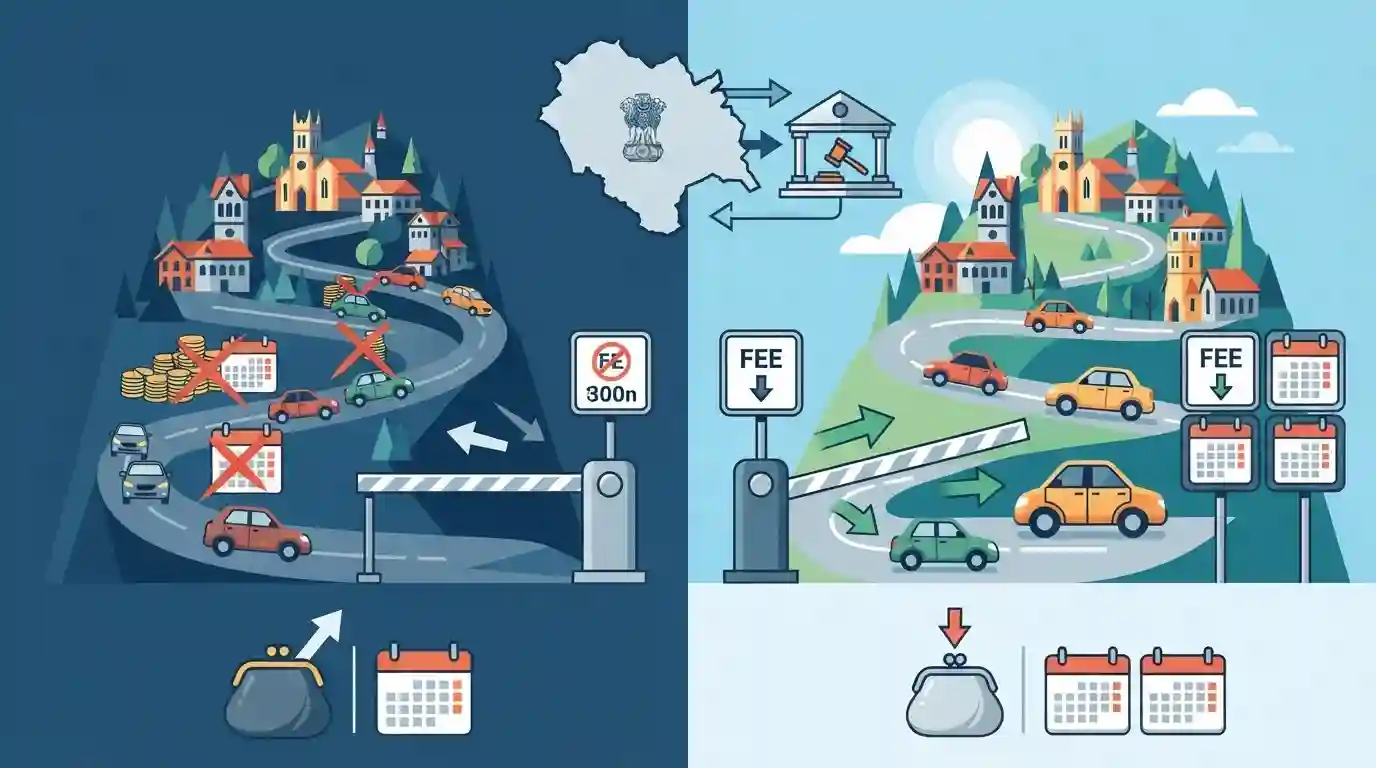
The Himachal Pradesh government has significantly reduced the pass fees for private vehicles on sealed and restricted roads in Shimla by amending the Shimla Road Users and Pedestrians Ordinance, 2026. The move aims to provide relief and convenience to private vehicle owners by lowering annual fees and introducing new six-month pass options.
Key Points
- The Himachal Pradesh government has promulgated the Shimla Road Users and Pedestrians (Public Safety and Convenience) Amendment Ordinance, 2026.
- The annual pass fee for private vehicles on sealed roads in Shimla has been reduced from ₹15,000 to ₹8,000.
- The annual fee for restricted roads has been lowered from ₹5,000 to ₹3,000 per vehicle.
- A new provision allows for the issuance of six-month passes, costing ₹4,500 for sealed roads and ₹2,000 for restricted roads.
Important Terms
Shimla Road Users and Pedestrians (Public Safety and Convenience) Amendment Ordinance, 2026

A state-promulgated decree that significantly reduced annual vehicle permit fees and introduced flexible six-month passes for private car owners using designated sealed and restricted roads in Shimla.
UPSC context
GS Paper II & III: Explores the dynamics of local urban governance, state legislation, and infrastructure management.
The Shimla Road Users and Pedestrians (Public Safety and Convenience) Act, 2007
The primary state law governing and regulating vehicular traffic in Shimla to preserve its historical heritage, minimize pedestrian accidents, and curb congestion in the core municipal areas.
UPSC context
GS Paper II: Covers state laws, public safety regulation, and urban municipal administration.
Sealed and Restricted Roads
Two legal classifications of roads in Shimla's heritage zone where private vehicular access is heavily restricted and requires specialized government-issued permits for passage.
UPSC context
GS Paper III: Pertains to urban mobility planning, ecological preservation of hill stations, and congestion.
Article 213 of the Indian Constitution
The constitutional article granting the Governor of an Indian state the legislative power to promulgate ordinances when the state legislature is in recess.
UPSC context
GS Paper II: Tests constitutional provisions, legislative powers of the Governor, and executive-legislative balance.
Prelims Trap
Shimla's core pedestrian heritage zones are governed and penalized strictly under the central Motor Vehicles Act.
Aspirants often assume all traffic bans fall under the central MV Act. Shimla's unique pedestrian zones are governed by a specific state legislation (Shimla Road Users Act).
Static Concepts Connected
What are the key constraints on a Governor’s ordinance-making power (Article 213)?
- Session requirement: Can only be promulgated when the state legislative assembly (or either house in a bicameral legislature) is not in session.
- Co-extensive power: The ordinance-making power is co-extensive with the legislative power of the state, limited to State and Concurrent list subjects.
- Presidential sanction: Cannot be issued without the President's instructions if a similar bill would have required prior Presidential sanction or reservation.
Cross-Topic Patterns
Hill station carrying capacity
Shimla's vehicle restriction model serves as a direct case study for GS-3 environmental impact and GS-1 urbanization challenges regarding the carrying capacity of fragile Himalayan hill stations.
Judicial nudges in governance
The tightening of Shimla's traffic permits originally stemmed from a High Court order, highlighting a recurring pattern of judicial intervention bridging gaps in municipal urban planning.

Mains 2026 GS-1/GS-3 is highly likely to test the 'carrying capacity of hill stations,' where Shimla's pedestrian zoning is a vital case study.
Linked PYQs · 3
Linked PYQs · 3
- 2025HPAS_PRELIMSGS1
Match List I with List II : | List-I (Code) | List-II (District) | |---|---| | (a) Highest Rainfall (2018 Data) | (i) Shimla | | (b) Second Most Incidents Reported (2024 Crime Data) | (ii) Mandi | | (c) Fourth Highest Population (2011 Census) | (iii) Kangra | | (d) Fourth Largest Area | (iv) Solan | Choose the correct answer from the options given below : Code: (a) (b) (c) (d)
- 2025HPAS_PRELIMSGS1
Match List I with List II : | List-I (Wildlife Sanctuary) | List-II (District) | |---|---| | (a) Kias | (i) Kullu | | (b) Tarla | (ii) Shimla | | (c) Tundah | (iii) Chamba | | (d) Bandli | (iv) Mandi | Choose the correct answer from the options given below : Code: (a) (b) (c) (d)
- 2024HPAS_PRELIMSGS1
Match List I with List II : | List I (Waterfall) | List II (District) | |---|---| | (a) Rahla | (i) Solan | | (b) Bhagsu | (ii) Kangra | | (c) Badri | (iii) Shimla | | (d) Chadwick | (iv) Kullu | Choose the correct answer from the options given below : Code: (a) (b) (c) (d)
