Urban Flooding and Climate Vulnerability in Central Vietnam
Source:The Hindu ↗
Why It Matters
Highlights the devastating impacts of extreme weather events and urban flooding on both communities and vital cultural heritage sites (like UNESCO World Heritage Sites), offering relevant case studies for disaster management, climate resilience, and geography.
Summary
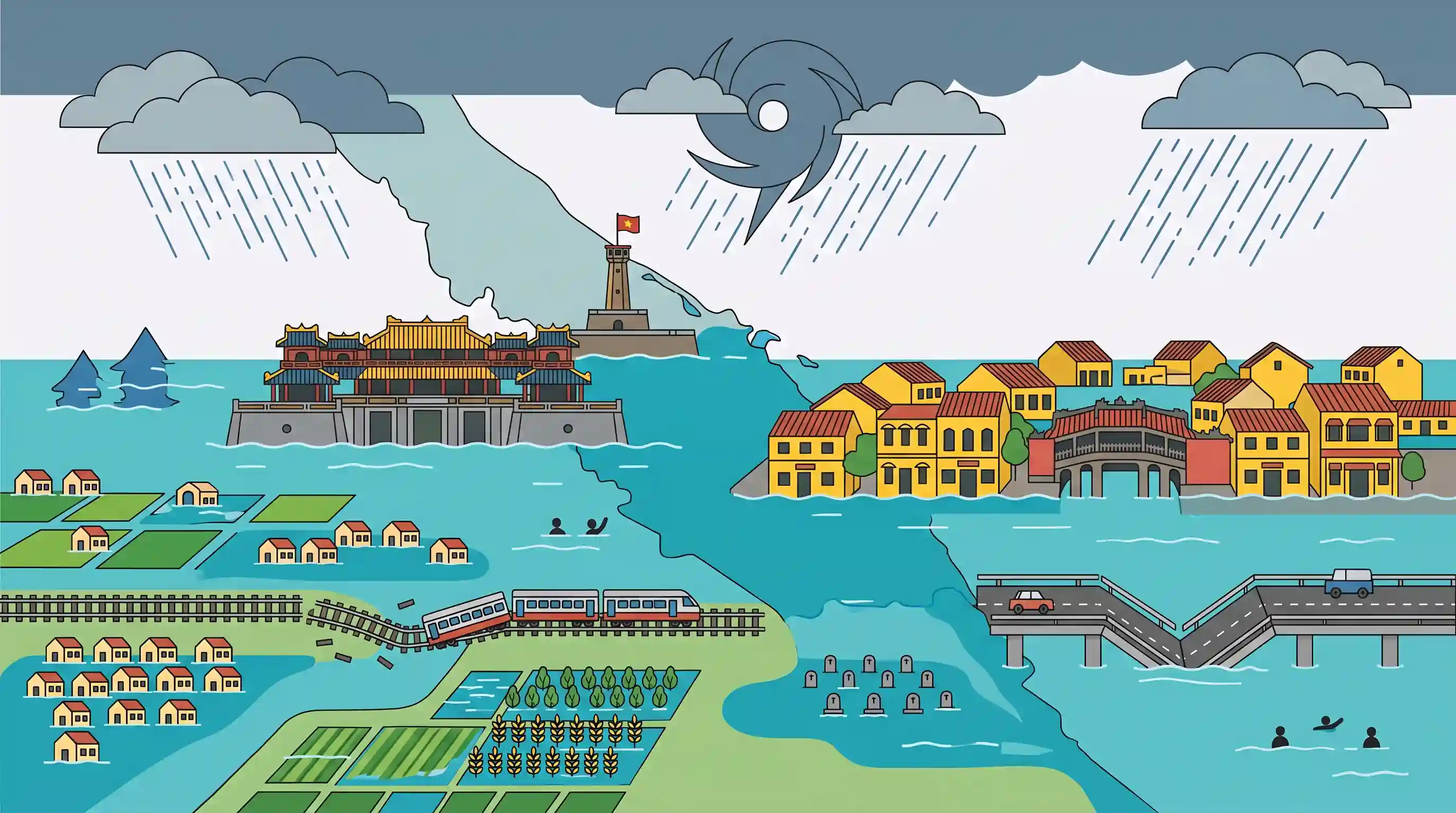
Heavy rainfall in central Vietnam has triggered severe flooding, causing 13 deaths and leaving 11 missing. The floods have inundated UNESCO-listed sites like the former imperial capital Hue and the ancient town of Hoi An, alongside over 116,000 houses and 5,000 hectares of crops. Infrastructure, including roads and railways, has been heavily damaged, highlighting Vietnam's vulnerability to extreme weather during its annual storm season.
Key Points
- Record rainfall in central Vietnam has led to severe flooding, resulting in 13 deaths and 11 missing persons.
- UNESCO-recognized heritage sites, the former imperial capital Hue and the ancient town of Hoi An, have been heavily inundated.
- The disaster has impacted over 116,000 homes, damaged 5,000 hectares of crops, and disrupted transportation and power networks.
- Vietnam experiences a distinct storm season from June to October, making it highly susceptible to catastrophic storms and flooding.
Important Terms
UNESCO World Heritage Sites

Landmarks or areas legally protected by an international convention for their outstanding cultural, historical, or natural value to humanity. Examples include Vietnam's Hue and Hoi An.
UPSC context
GS Paper 1 (Culture) and GS Paper 3 (Disaster Management for heritage sites). Tests knowledge of international conservation treaties.
Urban Flooding
The inundation of property in a built environment, caused by rainfall overwhelming drainage capacity. It is worsened by unplanned urbanization, encroachment on water bodies, and climate change.
UPSC context
GS Paper 3 (Disaster Management). A recurring theme testing understanding of urban planning and climate-induced hazards.
Sendai Framework for Disaster Risk Reduction
A 15-year (2015-2030) international voluntary agreement to reduce disaster risk, mortality, and economic losses. It emphasizes proactive risk governance and the principle of "Build Back Better."
UPSC context
GS Paper 3 (Disaster Management). The primary global framework for DRR; essential for international policy analysis.
Disaster Management Cycle
A systematic process consisting of mitigation, preparedness, response, and recovery. It aims to reduce the impact of hazards like Vietnam's seasonal floods on lives and infrastructure.
UPSC context
GS Paper 3 (Disaster Management). Tests foundational concepts of how states handle natural and man-made catastrophes.
Climate Change Vulnerability
The susceptibility of a region or community to the adverse effects of climate change. Vietnam is considered highly vulnerable due to its low-lying coastline and extreme weather events.
UPSC context
GS Paper 3 (Environment/Geography). Relevant for discussing adaptation strategies and the disproportionate impact of global warming on developing nations.
Heritage Conservation
The professional practice of preserving historical sites from threats like flooding. It involves technical measures to protect the physical integrity and authenticity of cultural monuments.
UPSC context
GS Paper 1 (Art and Culture). Tests awareness of challenges in maintaining world history amidst increasing natural disasters.
Prelims Trap
"The Global Climate Risk Index is published annually by the United Nations Environment Programme (UNEP)."
The index is actually published by Germanwatch, an independent environmental and development NGO based in Germany, not by any UN agency.
Static Concepts Connected
What are the key features of the Global Climate Risk Index?
- Publisher (Germanwatch): An independent environmental and development NGO that analyzes extreme weather impacts.
- Core Purpose: It quantifies the impacts of weather-related loss events (storms, floods, heatwaves) on countries and territories.
- Measurement Metrics: It factors in both human impacts (fatalities) and direct economic losses to rank vulnerability.
How does coastal topography exacerbate flash floods in regions like central Vietnam?
- Mountain Proximity: Mountain ranges (like the Annamite Range) sit very close to the coastline, limiting the coastal plain's width.
- Steep River Gradients: This geography creates short, steep river systems that lack the physical distance to dissipate large volumes of water.
- Rapid Funnel Effect: Heavy typhoon rainfall is rapidly funnelled down these steep gradients directly into low-lying urban areas, overwhelming drainage.
Cross-Topic Patterns
Sendai Framework + Heritage Protection
The Sendai Framework (2015-2030) uniquely mandates the protection of cultural assets, linking disaster risk reduction directly with UNESCO conservation—a highly testable intersection for Mains.
Western Ghats vs. Annamite Range Topography
Vietnam's short, steep rivers flowing from the Annamite Mountains create flash flood vulnerabilities identical to India's fast-flowing western rivers originating from the steep Western Ghats.

Sendai Framework's mandate to protect cultural assets from climate disasters is a prime target for a Disaster Management Mains question.
Linked PYQs · 5
Linked PYQs · 5
- 2024MainsGS3
Flooding in urban areas is an emerging climate-induced disaster. Discuss the causes of this disaster. Mention the features of two such major floods in the last two decades in India. Describe the policies and frameworks in India that aim at tackling such floods.
- 2019MainsGS3
Disaster preparedness is the first step in any disaster management process. Explain how hazard zonation mapping will help disaster mitigation in the case of landslides.
- 2014PrelimsGS1
What is the correct sequence of occurrence of the following cities in South-East Asia as one proceeds from south to north? 1. Bangkok 2. Hanoi 3. Jakarta 4. Singapore Select the correct answer using the code given below.
- 2004PrelimsGS1
The great Asian river Mekong does run through:
- 2021MainsGS3
Describe the various causes and the effects of landslides. Mention the important components of the National Landslide Risk Management Strategy.
