Vietnam and European Union elevate diplomatic ties for supply security
Source:The Hindu ↗
Why It Matters
Understanding Vietnam's 'bamboo diplomacy' is crucial for questions on Indo-Pacific geopolitics and middle-power balancing acts. The specific focus on critical minerals, semiconductors, and the EU's parallel trade engagements with both Vietnam and India highlight the growing strategic intersection of economic security and foreign policy, highly relevant for GS2 (IR) and GS3 (Economy/Technology).
Summary
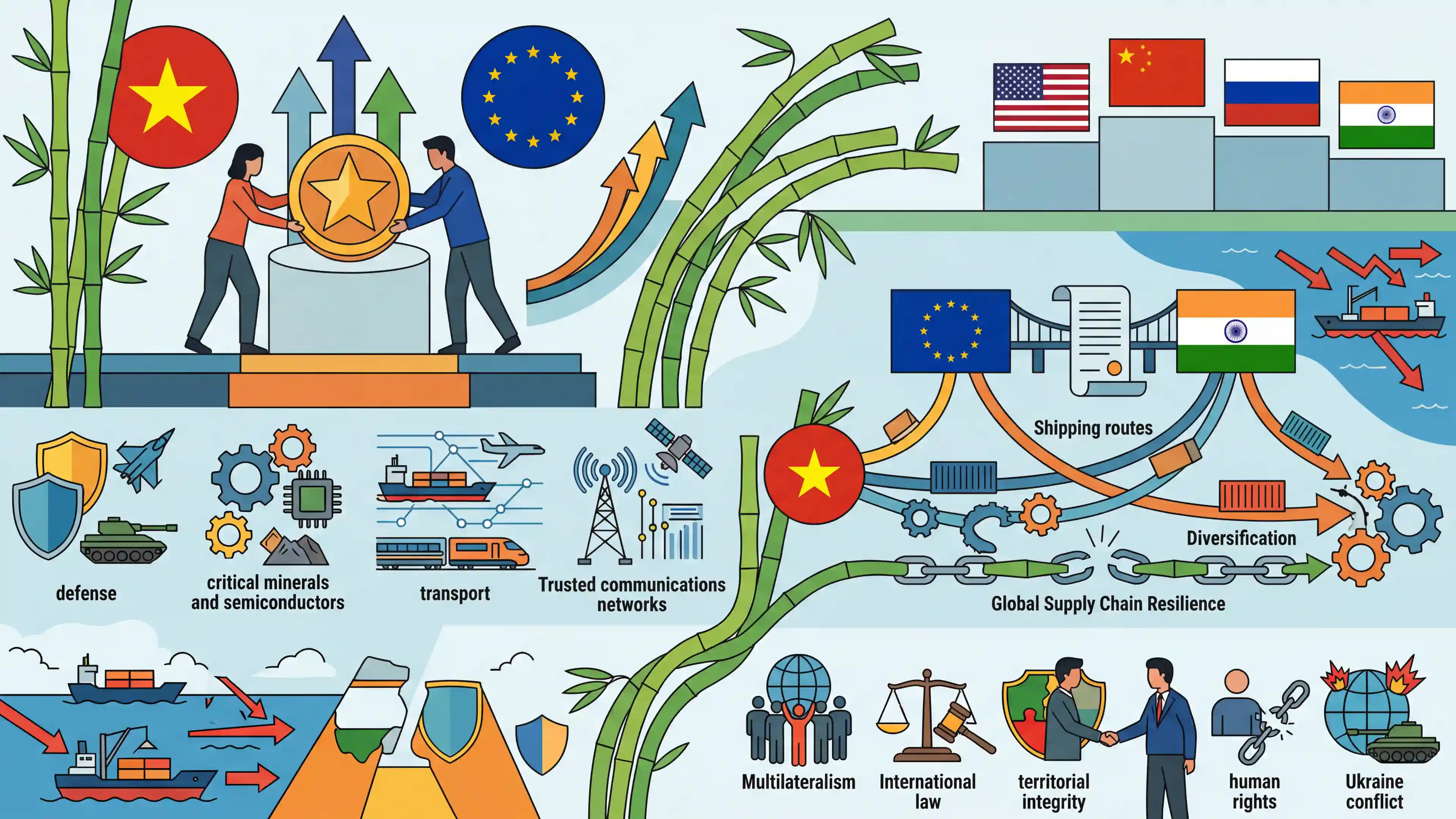
Vietnam and the European Union have officially elevated their diplomatic ties to a comprehensive strategic partnership during a visit by European Council President Antonio Costa to Hanoi. This upgrade places the EU on par with Vietnam’s top-tier partners, including the U.S., China, Russia, and India, reflecting Vietnam's nuanced 'bamboo diplomacy'. Against the backdrop of anticipated disruptions in global trade and higher export tariffs, the two partners aim to bolster cooperation in defense, critical minerals, semiconductor supply chains, transport, and trusted communications networks. Notably, this move coincides with the EU's recent major trade agreement with India, highlighting Europe's systematic approach to diversifying and securing Indo-Pacific supply chains. While acknowledging disagreements on issues like human rights and the Ukraine conflict, the leaders affirmed their mutual commitment to multilateralism, international law, and territorial integrity.
Key Points
- Vietnam and the European Union elevated their diplomatic relations, marking the EU's inclusion in Vietnam's top tier of bilateral partnerships.
- The strategic upgrade focuses heavily on supply chain resilience, encompassing critical minerals, semiconductors, and trusted communications infrastructure.
- The collaboration builds on the EU-Vietnam Free Trade Agreement (2020) and occurs against a backdrop of potential global trade disruptions and higher U.S. tariffs.
- The EU recently struck a major trade deal with India, signaling Europe's broader push to secure economic partnerships and diverse supply chains in the Indo-Pacific.
- Despite differences over the war in Ukraine and human rights concerns, both sides emphasized shared commitments to multilateralism, territorial integrity, and the UN Charter.
Important Terms
Bamboo Diplomacy

A Vietnamese foreign policy strategy characterized by "strong roots, sturdy trunk, and flexible branches." It emphasizes independence and resilience, allowing Vietnam to maintain balanced relations with global powers like the US and China without taking sides.
UPSC context
Relevant for GS Paper II (International Relations) regarding regional diplomacy and "Hedging" strategies in the Indo-Pacific.
Comprehensive Strategic Partnership
The highest level of bilateral engagement in Vietnam's diplomatic hierarchy. It signifies a long-term, multi-dimensional commitment covering trade, defense, and technology, placing the partner on par with Vietnam’s most significant global allies.
UPSC context
Important for GS Paper II. Tests understanding of diplomatic tiers and global powers' strategic outreach in Southeast Asia.
EU-Vietnam Free Trade Agreement (EVFTA)
A landmark 2020 "new generation" trade deal aimed at eliminating 99% of tariffs between the EU and Vietnam. It serves as a template for EU's economic engagement with developing nations and Indo-Pacific supply chain diversification.
UPSC context
GS Paper II (Bilateral Agreements) and GS Paper III (Economy). Highlights regional trade dynamics and competition with India's trade interests.
Critical Minerals
Metallic or non-metallic elements (like lithium, cobalt, rare earths) vital for high-tech industries and green energy. They are termed "critical" due to high economic importance and vulnerability to supply disruptions or geopolitical monopolies.
UPSC context
GS Paper I (Geography) and III (Economy/Security). Key to energy transition, semiconductor manufacturing, and global supply chain resilience.
European Union (EU)
A unique political and economic union of 27 member states. In the Indo-Pacific, it promotes a rules-based order, multilateralism, and trade diversification to counter regional instability and secure strategic supply chains.
UPSC context
GS Paper II (Global Groupings). Essential for understanding the EU's pivot to Asia and its strategic impact on India's interests.
Prelims Trap
Vietnam's 'Bamboo Diplomacy' precludes signing comprehensive strategic partnerships with Western powers to maintain neutrality.
False. Bamboo Diplomacy involves proactive multi-alignment. Vietnam actively signs top-tier Comprehensive Strategic Partnerships with Western entities, including the US, France, Australia, and the EU.
Static Concepts Connected
What are the core tenets of Vietnam's 'Bamboo Diplomacy'?
- Strong roots: An unyielding commitment to national independence, sovereignty, territorial integrity, and core national interests.
- Flexible branches: A pragmatic, highly adaptable foreign policy that forges ties with rival global powers simultaneously without ideological rigidity.
- Four Noes doctrine: Guided by the defense policy of no military alliances, no foreign bases, no siding with one against another, and no using force.
What are the key pillars of the India-Vietnam Comprehensive Strategic Partnership?
- Strategic alignment: India elevated ties to a CSP in 2016 (matching Vietnam's highest tier), anchoring the relationship on Indo-Pacific maritime security and ASEAN centrality.
- Energy exploration: ONGC Videsh Limited (OVL) maintains active joint oil and gas exploration blocks in Vietnamese sectors of the disputed South China Sea.
- Defense diplomacy: India provides lines of credit for defense manufacturing and actively transfers assets, such as the gifting of the missile corvette INS Kirpan.
Cross-Topic Patterns
De-risking & China Plus One
The EU's parallel strategic upgrades with India and Vietnam highlight the Western 'de-risking' strategy to diversify semiconductor and critical mineral supply chains away from China.
Multi-alignment policy parallels
Vietnam's balancing of the US, China, Russia, and the EU closely mirrors India's 'Strategic Autonomy' doctrine, making it a natural comparative framework for international relations.

Expect a 2026 GS-2 mains question comparing India's 'Multi-alignment' with Vietnam's 'Bamboo Diplomacy' in navigating the Indo-Pacific.
Linked PYQs · 5
Linked PYQs · 5
- 2022PrelimsGS1
Consider the following statements : 1. Vietnam has been one of the fastest growing economies in the world in the recent years. 2. Vietnam is led by a multi-party political system. 3. Vietnam's economic growth is linked to its integration with global supply chains and focus on exports. 4. For a long time Vietnam's low labour costs and stable exchange rates have attracted global manufacturers. 5. Vietnam has the most productive e-service sector in the Indo-Pacific region. Which of the statements given above are correct?
- 2018PrelimsGS1
Consider the following countries: 1. Australia 2. Canada 3. China 4. India 5. Japan 6. USA Which of the above are among the 'free-trade partners' of ASEAN?
- 2012PrelimsGS1
Recently, there has been a concern over the short supply of a group of elements called 'rare earth metals'. Why? 1. China, which is the largest producer of these elements, has imposed some restrictions on their export. 2. Other than China, Australia, Canada and Chile, these elements are not found in any country. 3. Rare earth metals are essential for the manufacture of various kinds of electronic items and there is a growing demand for these elements. Which of the statements given above is/are correct?
- 2025PrelimsGS1
Consider the following statements : I. India has joined the Minerals Security Partnership as a member. II. India is a resource-rich country in all the 30 critical minerals that it has identified. III. The Parliament in 2023 has amended the Mines and Minerals (Development and Regulation) Act, 1957 empowering the Central Government to exclusively auction mining lease and composite license for certain critical minerals. Which of the statements given above are correct?
- 2014MainsGS2
The aim of Information Technology Agreements (ITAs) is to lower all taxes and tariffs on information technology products by signatories to zero. What impact would such agreements have on India's interests?
