Supreme Court Ruling on Vidarbha Zudpi Scrub Lands
Source:Indian Express ↗
Why It Matters
It sets a crucial legal precedent on the definition of forests in India post the 2023 Forest Conservation Amendment, directly impacting how unnotified 'deemed forests' and scrublands are handled in environmental impact assessments, developmental clearances, and conservation strategies.
Summary
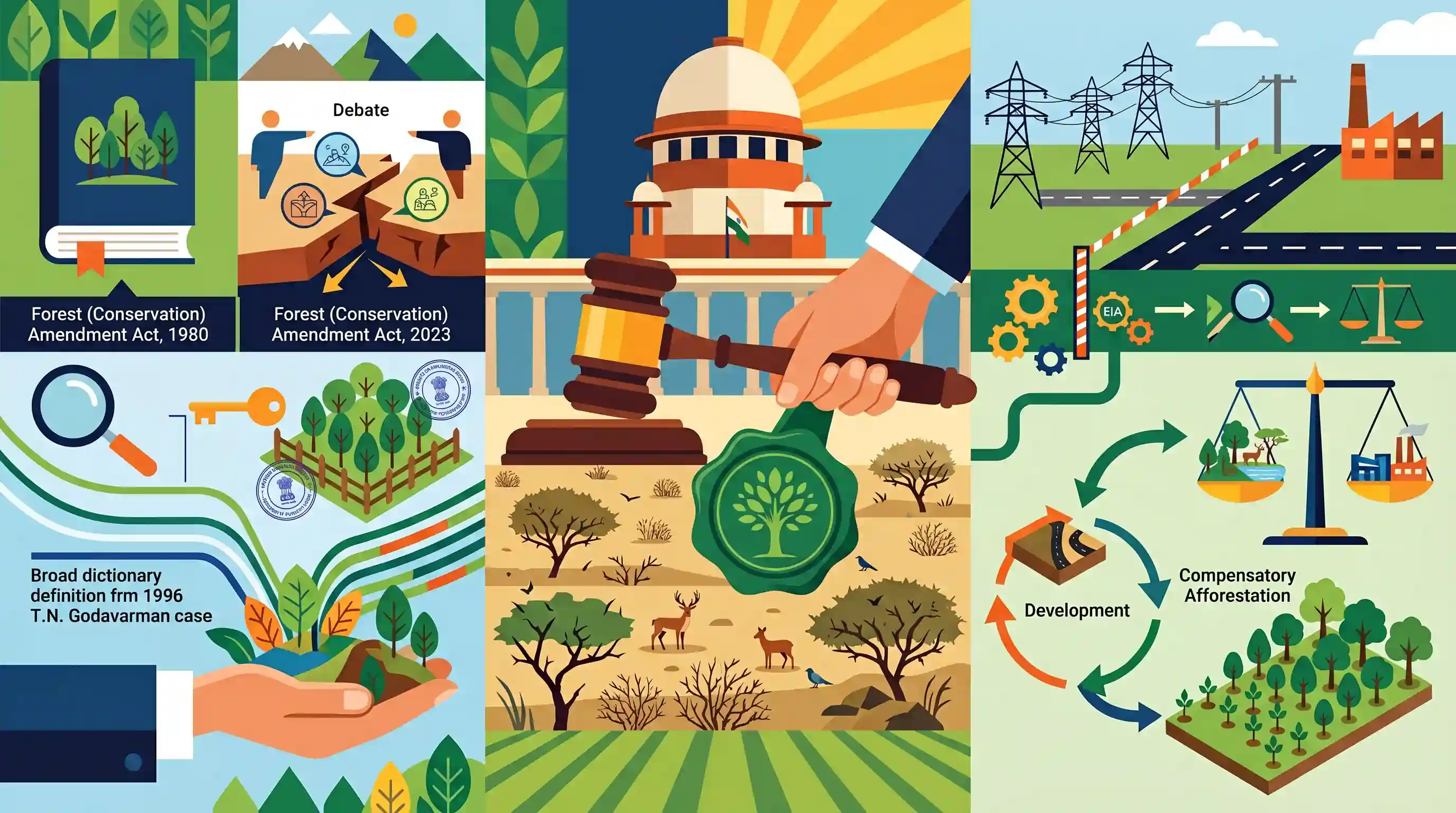
The Supreme Court of India recently classified the 'Zudpi' scrub lands of Maharashtra's Vidarbha region as 'forest' lands under the Forest (Conservation) Act, 1980. This ruling is significant for interpreting the definition of forests in the wake of the controversial Forest (Conservation) Amendment Act, 2023, which sought to restrict the Act's protective applicability primarily to officially notified forests. The judgment underscores the continuing legal relevance of the broad dictionary definition of forests as established in the 1996 T.N. Godavarman case. By mandating that any diversion of these scrub lands for non-forest purposes requires prior environmental clearance and compensatory afforestation, the Supreme Court aims to strike a pragmatic balance between allowing necessary developmental projects and preserving critical local ecosystems.
Key Points
- The Supreme Court ruled that the 'Zudpi' scrub lands of the Vidarbha region in Maharashtra qualify as 'forest' lands under the Forest (Conservation) Act, 1980.
- This decision reaffirms the broader dictionary definition of forests established in the landmark 1996 T.N. Godavarman Thirumulpad judgment, despite recent amendments to the FCA in 2023 that sought to narrow the definition to officially notified forests.
- Any diversion of Zudpi scrub lands for developmental or non-forest purposes will now require mandatory prior environmental clearance and compensatory afforestation.
- The ruling is seen as a judicial effort to balance necessary infrastructure and economic development in the Vidarbha region with robust environmental protection and the conservation of scrubland ecosystems.
Important Terms
Zudpi Jungle

Refers to scrub forests in Maharashtra's Vidarbha region, characterized by bushy vegetation on 'murmadi' soil. The term 'Zudpi' means bushes or shrubs in Marathi.
UPSC context
Relevant for GS Paper III (Environment) regarding land classification, local ecosystems, and specific regional conservation disputes in Maharashtra.
Forest (Conservation) Act, 1980
A landmark legislation requiring prior Central Government approval for diverting forest land for non-forest purposes like mining or infrastructure, aimed at curbing rapid deforestation.
UPSC context
Core environmental law for GS Paper II (Polity/Governance) and III (Environment); tests knowledge of federal environmental oversight.
Forest (Conservation) Amendment Act, 2023
Legislation that sought to limit the 1980 Act's scope primarily to officially notified forests, potentially exempting vast areas of 'deemed' forests from mandatory central clearances.
UPSC context
Crucial for GS Paper III; tests understanding of current legislative shifts and the debate between development and conservation.
T.N. Godavarman Case (1996)
A seminal Supreme Court ruling that expanded the legal definition of 'forest' to include all areas matching the 'dictionary meaning,' regardless of official notification or ownership.
UPSC context
High-priority legal precedent for GS Paper II and III; fundamental to India's 'deemed forest' jurisprudence and judicial activism.
Ministry of Environment, Forest and Climate Change (MoEFCC)
The nodal agency for planning and overseeing India's environmental and forestry policies, including granting clearances for forest land diversion under the FCA.
UPSC context
Standard executive body for GS Paper II; central to environmental governance and administrative procedures in India.
Compensatory Afforestation
The process of planting trees on non-forest or degraded land to offset forest loss due to developmental projects, funded by the project proponents.
UPSC context
GS Paper III topic regarding mitigation strategies and the controversial CAMPA (Compensatory Afforestation Fund Management and Planning Authority).
Net Present Value (NPV)
A mandatory fee paid by project proponents for diverting forest land, representing the estimated value of ecological services lost over a 50-year period.
UPSC context
GS Paper III economic-environmental concept; tests understanding of natural capital accounting and project costs in forest diversion.
Prelims Trap
The 2023 FCA Amendment completely restricts forest protection only to officially notified forests, overriding Godavarman.
SC interim orders mandate using the Godavarman 'dictionary meaning' until states finalize expert committee reports on deemed forests. The 2023 amendment hasn't permanently overridden this yet.
Static Concepts Connected
What was the key precedent set by the 1996 T.N. Godavarman judgment?
- Dictionary Meaning: Ruled that 'forest' must be understood according to its dictionary meaning, regardless of ownership, classification, or government records.
- Deemed Forests: Extended FCA 1980 protection to unrecorded and undocumented forests, formalizing the concept of "deemed forests" in Indian environmental jurisprudence.
- Non-Forest Use: Banned non-forest activities (like commercial mining or sawmills) in any forest area without prior Central Government approval.
What is the legal framework for Compensatory Afforestation in India?
- Statutory Backing: Governed by the Compensatory Afforestation Fund (CAF) Act, 2016, which established national and state-level CAMPA authorities.
- Fund Distribution: Funds collected from user agencies diverting forest land are shared between the State Fund (90%) and the National Fund (10%).
- Core Objective: Mandates planting trees on non-forest land (or degraded forest land) to compensate for the loss of ecosystem services diverted for development.
Cross-Topic Patterns
Scrubland ecology + Vidarbha geography
Links environmental law with physical geography. Recognizing Zudpi lands on Murmadi (gravelly) soil highlights the ecological value of arid "wastelands" previously ignored by narrow forest definitions.
Judicial Review + Environmental Law
Demonstrates the ongoing tussle between legislative intent (2023 FCA Amendment easing land diversion) and judicial oversight (SC upholding ecological security via dictionary definitions).

Expect a multi-statement Prelims 2026 question contrasting 'deemed forests' under the Godavarman ruling vs. the 2023 FCA Amendment criteria.
Linked PYQs · 4
Linked PYQs · 4
- 2019PrelimsGS1
Consider the following statements: 1. As per recent amendment to the Indian Forest Act, 1927, forest dwellers have the right to fell the bamboos grown on forest areas. 2. As per the Scheduled Tribes and Other Traditional Forest Dwellers (Recognition of Forest Rights) Act, 2006, bamboo is a minor forest produce. 3. The Scheduled Tribes and Other Traditional Forest Dwellers (Recognition of Forest Rights) Act, 2006 allows ownership of minor forest produce to forest dwellers. Which of the statements given above is/are correct?
- 2023PrelimsGS1
Consider the following statements: Once the Central Government notifies an area as a 'Community Reserve' 1. the Chief Wildlife Warden of the State becomes the governing authority of such forest 2. hunting is not allowed in such area 3. people of such area are allowed to collect non-timber forest produce 4. people of such area are allowed traditional agricultural practices How many of the above statements are correct?
- 2024MainsGS3
What role do environmental NGOs and activists play in influencing Environmental Impact Assessment (EIA) outcomes for major projects in India? Cite four examples with all important details.
- 2019MainsGS3
Define the concept of carrying capacity of an ecosystem as relevant to an environment. Explain how understanding this concept is vital while planning for sustainable development of a region.
