India Sri Lanka Energy Cooperation and Diaspora Policy
Source:The Hindu ↗
Why It Matters
This visit marks a consolidation of India-Sri Lanka ties with tangible progress on strategic energy infrastructure (Trincomalee oil tanks) and a major policy update for the Indian diaspora (OCI for 6th generation Tamils), both recurrent themes in GS-II (International Relations).
Summary
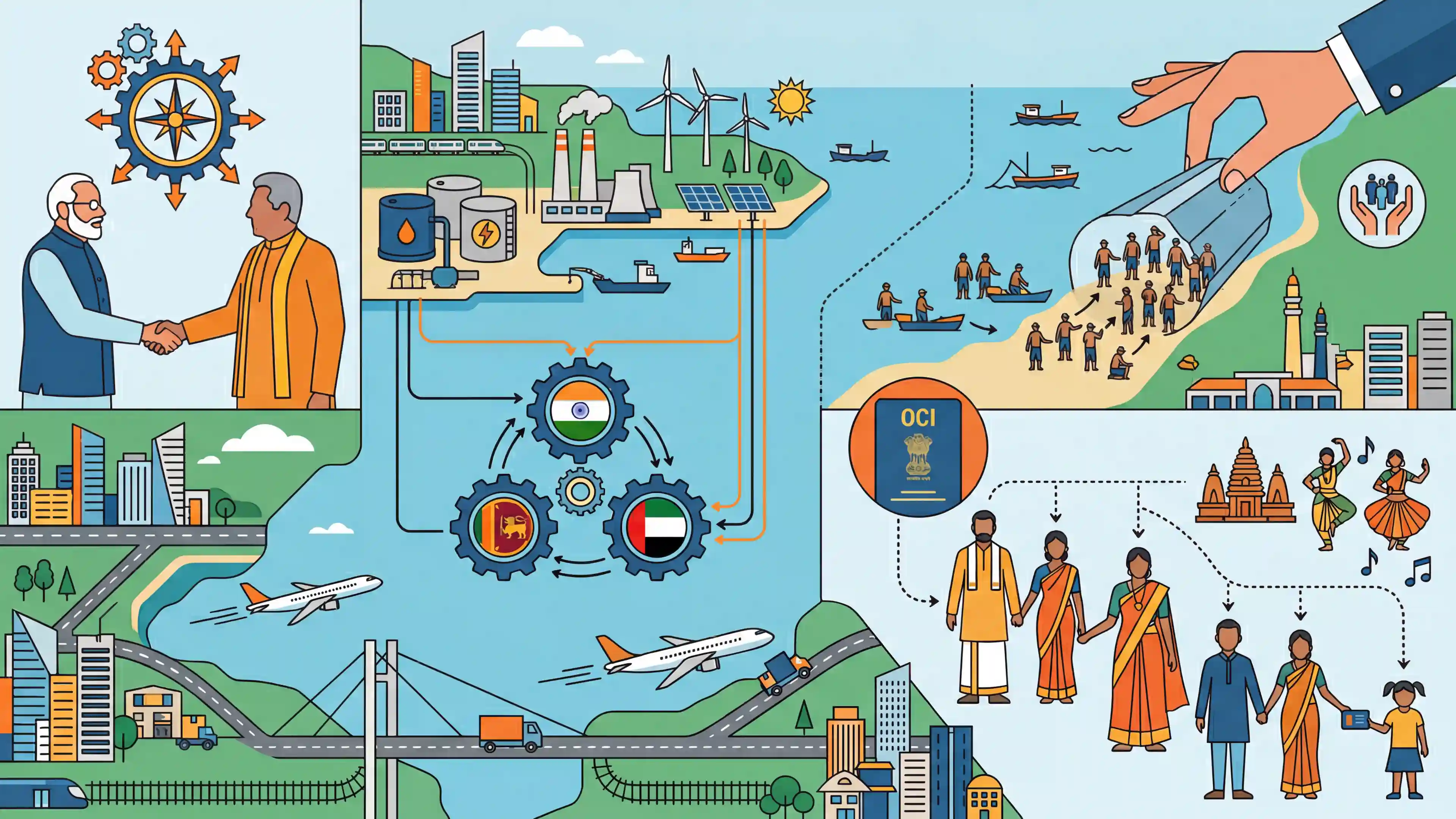
Vice-President C.P. Radhakrishnan's visit to Sri Lanka underscored India's 'Neighbourhood First' policy through high-level engagements with Sri Lankan President Anura Kumara Dissanayake. The discussions highlighted strategic energy cooperation, particularly the prompt development of Trincomalee as a regional energy hub supported by an India-Sri Lanka-UAE tripartite MoU. The visit also addressed the prolonged fishermen dispute with a renewed call for humanitarian handling, coinciding with the release of 47 Indian fishermen. Furthermore, an important diaspora policy shift was announced to extend Overseas Citizenship of India (OCI) cards to the sixth generation of Indian-origin Tamils, reinforcing cultural and historical bonds.
Key Points
- Vice-President C.P. Radhakrishnan visited Sri Lanka and met with President Anura Kumara Dissanayake, reviewing wide-ranging bilateral cooperation.
- A key focus was the development of Trincomalee into an 'energy hub', including the WWII-era oil tank farms, backed by an India-Sri Lanka-UAE tripartite MoU.
- India announced the extension of the Overseas Citizenship of India (OCI) card to the sixth generation of Indian-origin Sri Lankans (Malaiyaha Tamils), easing ties with the diaspora.
- The two sides addressed the recurrent fishermen dispute, with Sri Lanka recently releasing 47 Indian fishermen, and stressed the need for a 'humanitarian' approach.
- India reaffirmed its commitment to providing humanitarian assistance for cyclone recovery and completing ongoing India-funded housing projects in Sri Lanka.
Important Terms
Overseas Citizenship of India (OCI) scheme

A status granting foreign citizens of Indian origin lifelong residency and travel privileges. In 2026, eligibility was extended to sixth-generation Sri Lankan Tamils to deepen diaspora connections.
UPSC context
GS Paper II: International Relations/Diaspora. Tests understanding of citizenship laws and Indian diaspora engagement policies.
India-Sri Lanka-UAE Tripartite MoU
A strategic 2025 agreement to develop Trincomalee as a regional energy hub. It involves refurbishing oil tank farms and building pipelines, leveraging UAE capital and Indian expertise.
UPSC context
GS Paper II: International Relations. Tests knowledge of trilateral diplomacy and strategic infrastructure development.
Trincomalee Energy Hub
A strategic project to transform Trincomalee's natural harbor into a logistics and energy center. It includes oil tank refurbishment and a subsea fuel pipeline connecting India and Sri Lanka.
UPSC context
GS Paper II: Bilateral Relations. Important for analyzing regional energy security and India's maritime presence in the Indian Ocean.
Neighbourhood First Policy
India's diplomatic priority emphasizing proactive engagement, economic integration, and development aid with immediate neighbors to ensure regional stability and counter extra-regional strategic influence.
UPSC context
GS Paper II: India and its Neighborhood. Core concept for questions on regional foreign policy and security architecture.
Malaiyaha Tamils
Descendants of Indian laborers brought to Sri Lanka for plantation work. They are the primary beneficiaries of India's housing projects and the 2026 OCI eligibility extension.
UPSC context
GS Paper II: International Relations. Relevant for historical migration impacts and cultural diplomacy in bilateral relations.
Palk Strait Fishermen Dispute
A long-standing conflict involving the arrest of Indian fishermen for crossing the maritime boundary. Both nations emphasize a humanitarian approach to balance livelihoods and law enforcement.
UPSC context
GS Paper II: Bilateral Relations. Key for studying maritime boundary disputes and humanitarian concerns.
Prelims Trap
The OCI card scheme universally extends eligibility up to the sixth generation for the entire Indian diaspora.
OCI eligibility is generally limited to the 4th generation. The extension to the 6th generation is a specific diplomatic carve-out for Indian-origin Sri Lankans (Malaiyaha Tamils), not a global universal rule.
Static Concepts Connected
What are the key privileges and limitations of the Overseas Citizen of India (OCI) status?
- Lifelong visa: Grants a multiple-entry, multi-purpose, lifelong visa to visit India.
- Parity with NRIs: Equal treatment with NRIs in economic, financial, and educational fields, except for acquiring agricultural or plantation properties.
- No political rights: Cardholders cannot vote, hold constitutional posts, or seek public employment in India.
Where is Kachchatheevu located and what is its historical context in Indo-Sri Lankan relations?
- Geographic Location: An uninhabited islet in the Palk Strait situated between Rameswaram (India) and Neduntheevu (Sri Lanka).
- 1974 Cession: Ceded to Sri Lanka by India under the 1974 Indo-Sri Lankan Maritime Boundary Agreement.
- Traditional rights: The 1974 pact allowed Indian fishermen to rest and dry nets, but subsequent agreements restricted active fishing in Sri Lankan waters.
Cross-Topic Patterns
UAE's strategic footprint in Indian Ocean
The India-Sri Lanka-UAE tripartite MoU for Trincomalee demonstrates how India is increasingly leveraging Gulf capital to build strategic infrastructure in South Asia, effectively countering China's Belt and Road Initiative footprint.
Bottom Trawling and Marine Ecology
The Palk Bay fishermen dispute bridges IR and Environment; India's mechanized bottom trawling severely degrades benthic ecosystems, prompting strict Sri Lankan maritime legislation and regular arrests.

Expect a multi-statement Prelims question combining OCI generation exceptions, Kachchatheevu's geography, and Trincomalee's tripartite MoU.
Linked PYQs · 3
Linked PYQs · 3
- 2022MainsGS2
India is an age-old friend of Sri Lanka.’ Discuss India's role in the recent crisis in Sri Lanka in the light of the preceding statement.
- 2017MainsGS2
Indian diaspora has an important role to play in South-East Asian countries' economy and society. Appraise the role of Indian diaspora in South-East Asia in this context.
- 2025MainsGS2
"Energy security constitutes the dominant kingpin of India's foreign policy, and is linked with India's overarching influence in Middle Eastern countries.” How would you integrate energy security with India's foreign policy trajectories in the coming years?
