Vice President Urges Commitment to Equality and Social Justice
Source:The Hindu ↗
Why It Matters
Basaveshwara's Sharana philosophy and the Anubhava Mantapa are highly relevant for GS-1 Art & Culture (Bhakti/reform movements) and Essay topics. Furthermore, it touches upon essential themes of social justice, anti-caste efforts, and heritage preservation which frequently feature in both Prelims and Mains.
Summary
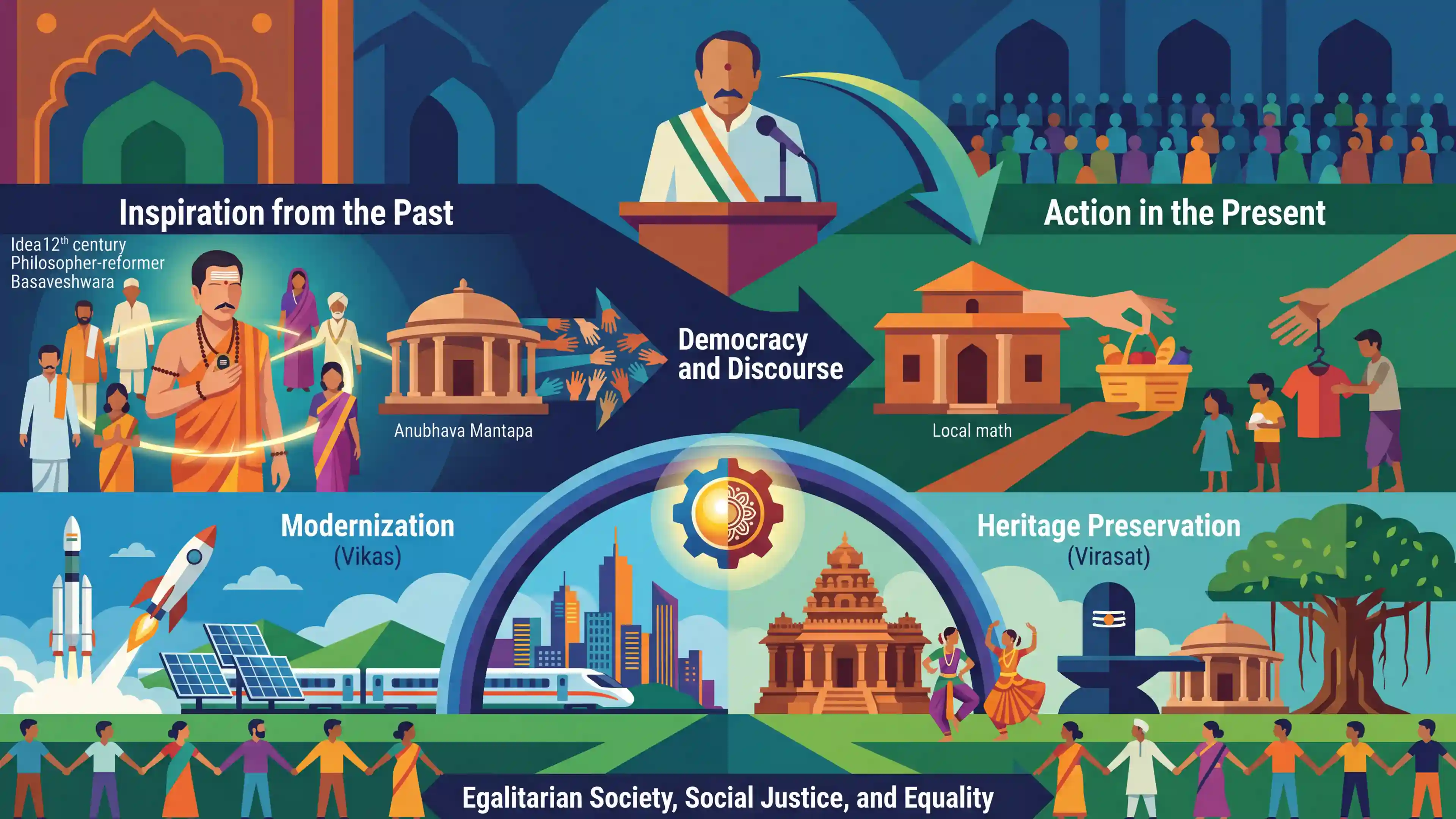
Vice-President C.P. Radhakrishnan stressed the importance of an egalitarian society built on social justice and equality, drawing inspiration from the 12th-century philosopher-reformer Basaveshwara and the Sharana movement. Speaking at the 75th birth anniversary of seer Basavalinga Pattadevaru in Bidar, he praised the historic Anubhava Mantapa as an early democratic forum for socio-spiritual discourse. Commending the local math's welfare initiatives for the underprivileged, he reiterated the need to harmonize rapid national modernization with the preservation of cultural heritage, invoking the vision of "Vikas Bhi, Virasat Bhi".
Key Points
- Vice-President C.P. Radhakrishnan invoked the 12th-century social reformer Basaveshwara to champion a society rooted in equality and social justice.
- He highlighted the Anubhava Mantapa at Basavakalyan as one of the world's earliest platforms for democratic, spiritual, and social dialogue.
- The event celebrated the 75th birth anniversary of Basavalinga Pattadevaru, noting his contributions to providing food (Anna Dasoha), education (Akshara Dasoha), and health (Arogya Dasoha) to orphaned and underprivileged children.
- The VP underscored the "Vikas Bhi, Virasat Bhi" philosophy, advocating for balanced progress where development goes hand-in-hand with preserving cultural heritage.
Important Terms
Anubhava Mantapa

A 12th-century democratic forum established by Basaveshwara in Basavakalyan. Termed the 'world’s first parliament,' it allowed seekers (Sharanas) of all castes and genders to debate spiritual and social issues.
UPSC context
GS Paper 1 (Art & Culture); tests knowledge of Bhakti movement reforms and the historical roots of Indian democratic thought.
Anna Dasoha
The Lingayat spiritual practice of selfless service through free food distribution. Rooted in the principle of 'Dasoha' (sharing), it rejects caste-based food hierarchies and ensures community food security.
UPSC context
GS Paper 1 (Society/Culture); relevant for social welfare traditions and the egalitarian values of the Sharana movement.
Naari Shakti
The 12th-century recognition of women’s spiritual and social equality within the Sharana movement. It empowered female saints like Akka Mahadevi to participate in intellectual discourses and challenge patriarchal norms.
UPSC context
GS Paper 1 & 2 (Society/Social Justice); focuses on historical gender reforms and women's agency in Indian religious history.
Akshara Dasoha
A form of selfless service (Dasoha) dedicated to education. It involves providing free schooling and knowledge to the underprivileged, viewing education as a community-driven spiritual duty.
UPSC context
GS Paper 2 (Social Justice/Education); relevant for community-led educational initiatives and the historical foundations of social empowerment.
Arogya Dasoha
The practice of selfless service in healthcare, providing medical aid and wellness support to the needy. It integrates the spiritual concept of 'Dasoha' with public health welfare.
UPSC context
GS Paper 2 (Social Justice/Health); illustrates the role of socio-religious institutions in addressing community health needs.
Hiremath Samsthan
A prominent Veerashaiva/Lingayat monastic institution (Matha) in Bhalki, Bidar. It continues Basaveshwara’s legacy through extensive humanitarian work, including schools and orphanages for the underprivileged.
UPSC context
GS Paper 1 (Culture); provides a case study of contemporary monastic institutions preserving cultural heritage through social service.
Prelims Trap
Basaveshwara championed temple construction and Vedic rituals to promote social equality.
Basaveshwara actively rejected rigid temple worship (Sthavara) and Brahminical rituals, advocating instead for the 'Ishtalinga' worn on the body and personal spirituality.
Static Concepts Connected
What are the core philosophical tenets of Basaveshwara's Lingayat movement?
- Ishtalinga Worship: Rejected stationary temple worship (Sthavara) in favor of wearing a personal Linga (Jangama) on the body.
- Kayaka and Dasoha: Emphasized the dignity of labor (Kayaka) and the selfless sharing of accumulated surplus wealth with the community (Dasoha).
- Social Reform: Strictly opposed caste hierarchies, gender discrimination, and orthodox rituals, democratizing spiritual access.
What was the socio-political significance of the Anubhava Mantapa?
- Early Parliament: Acted as a 12th-century democratic forum in Basavakalyan for socio-spiritual discourse, often compared to an early parliament.
- Absolute Inclusivity: Welcomed 'Sharanas' (followers) across all castes, classes, and genders, including notable women saints like Akka Mahadevi.
- Vachana Sahitya: Served as the epicenter for composing Vachanas—rhythmic, accessible Kannada prose-poetry used to critique social evils.
Cross-Topic Patterns
Ancient roots of Indian democracy
UPSC increasingly tests medieval institutions like the Anubhava Mantapa or Chola Uthiramerur inscriptions as historical evidence of India's early democratic and parliamentary ethos.
"Vikas Bhi, Virasat Bhi" in Mains
This governance catchphrase acts as a powerful GS1/GS2 bridge for Mains, linking cultural heritage preservation directly with modern inclusive economic development policies.

Match-the-pair questions linking Bhakti reformers to their specific socio-democratic institutions (like Anubhava Mantapa) are probable.
Linked PYQs · 5
Linked PYQs · 5
- 2022PrelimsGS1
The world's second tallest statue in sitting pose of Ramanuja was inaugurated by the Prime Minister of India at Hyderabad recently. Which one of the following statements correctly represents the teachings of Ramanuja?
- 2018MainsGS1
The Bhakti movement received a remarkable re-orientation with the advent of Sri Chaitanya Mahaprabhu. Discuss.
- 2024MainsGS1
Despite comprehensive policies for equity and social justice, underprivileged sections are not yet getting the full benefits of affirmative action envisaged by the Constitution. Comment.
- 2016PrelimsGS1
Satya Shodhak Samaj organized
- 2018MainsGS1
Safeguarding the Indian art heritage is the need of the moment. Discuss.
