बिरसा मुंडा उलगुलान और जनजातीय भूमि अधिकार
स्रोत:इंडियन एक्सप्रेस ↗
क्यों मायने रखता है
Tribal uprisings, specifically Birsa Munda's Ulgulan, are highly tested areas in both UPSC Prelims and Mains. Understanding the historical context of tribal exploitation and legislative responses (like the Chotanagpur Tenancy Act) is essential for GS1, while current initiatives celebrated on Janjatiya Gaurav Divas are relevant for GS2 social justice topics.
सारांश
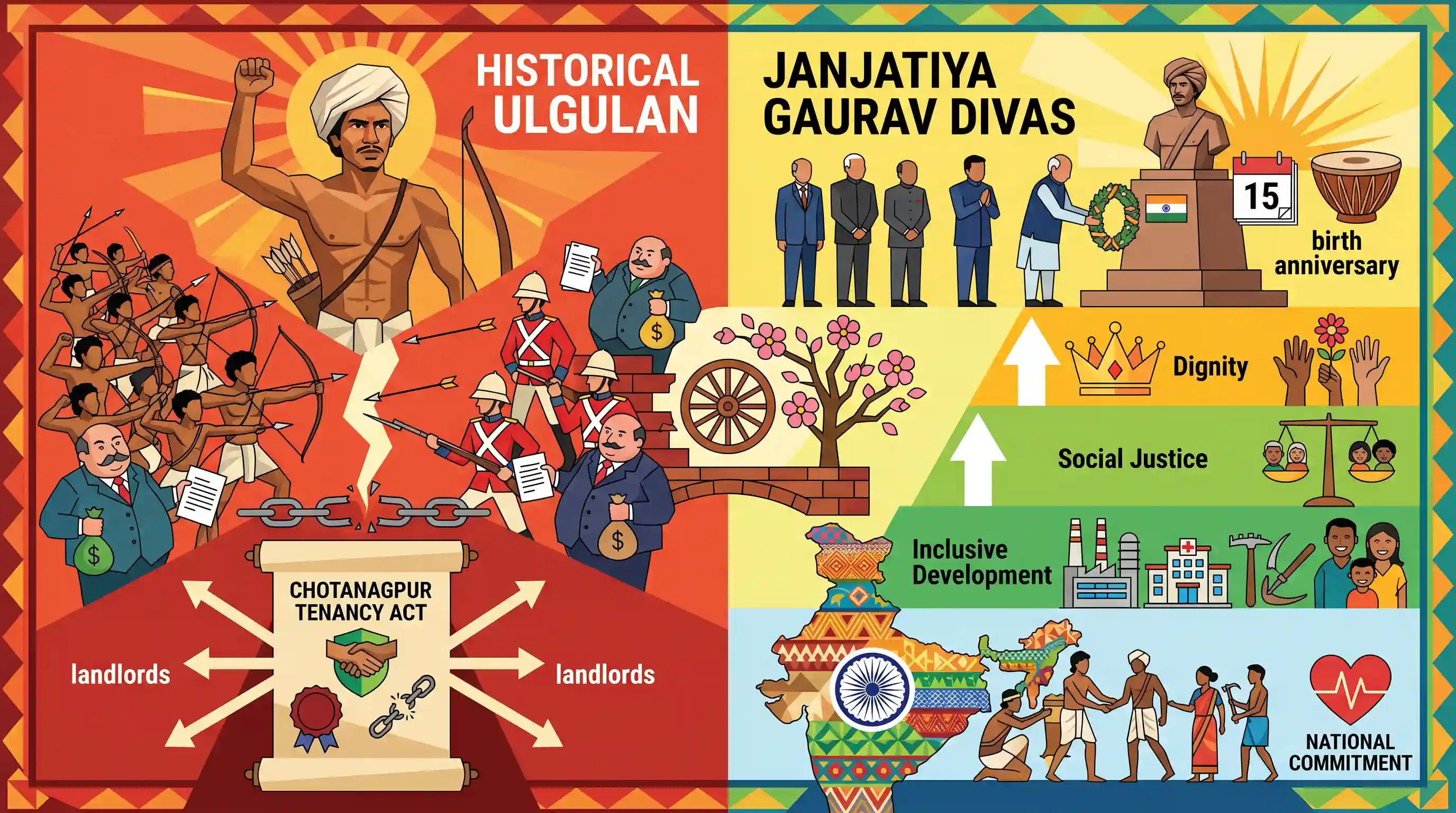
Vice-President C P Radhakrishnan commemorates the birth anniversary of the legendary tribal freedom fighter Birsa Munda, observed nationally as Janjatiya Gaurav Divas. The article reflects on Birsa Munda's 'Ulgulan' (Great Tumult) against British colonial forces and exploitative landlords to protect tribal land rights, which ultimately led to the protective Chotanagpur Tenancy Act. Beyond historical remembrance, the piece emphasizes the ongoing national commitment to ensuring dignity, social justice, and inclusive development for India's tribal communities.
मुख्य बिंदु
- 15 नवंबर, बिरसा मुंडा की जयंती को, भारत के स्वतंत्रता संग्राम में जनजातीय समुदायों की भूमिका को सम्मान देने के लिए जनजातीय गौरव दिवस के रूप में मनाया जाता है।
- Birsa Munda spearheaded the 'Ulgulan' (Great Tumult) in the Chotanagpur region against British colonialism and 'dikus' (outsiders) who were exploiting tribal populations and alienating them from their lands.
- The uprising compelled the British to introduce the Chotanagpur Tenancy Act (1908), a landmark legislation that restricted the transfer of tribal land to non-tribals.
- The article bridges this historical legacy with contemporary tribal empowerment, emphasizing dignity, cultural preservation, and inclusive development for India's indigenous communities.
महत्वपूर्ण शब्द
Birsa Munda

A 19th-century charismatic tribal leader and freedom fighter from the Munda tribe who led a powerful movement against British land policies and for tribal autonomy.
UPSC context
GS Paper I (Modern History); tests knowledge of key tribal uprisings and influential freedom fighters.
Ulgulan
Meaning 'Great Tumult,' it refers to the Munda Rebellion (1899–1900) led by Birsa Munda against British exploitation and the erosion of traditional tribal land rights.
UPSC context
GS Paper I (Tribal Revolts); frequently tested in Prelims regarding 19th-century resistance movements.
Chotanagpur Tenancy Act (1908)
A landmark colonial law passed after the Munda Rebellion to protect tribal land by restricting its transfer to non-tribals in the Chotanagpur region.
UPSC context
GS Paper I & II (Governance); highlights legislative outcomes of tribal struggles for land rights.
Janjatiya Gaurav Divas
Observed annually on November 15 since 2021 to honor Birsa Munda’s birth anniversary and recognize the contributions of India’s tribal communities to the freedom struggle.
UPSC context
Current Affairs (GS II - Social Justice); reflects government initiatives for tribal heritage and inclusive development.
Khuntkatti System
The traditional Munda system of joint landholding by the entire lineage, the replacement of which by individualistic British land settlements sparked the Ulgulan.
UPSC context
GS पेपर I (आधुनिक इतिहास); जनजातीय भूमि कार्यकाल और अशांति को समझने के लिए प्रमुख सामाजिक-आर्थिक अवधारणा।
Dikus
A derogatory term used by tribal groups like the Mundas for 'outsiders,' specifically exploitative moneylenders, landlords, and British colonial officials.
UPSC context
GS Paper I; central term for analyzing the targets and causes of tribal resistance movements.
प्रारंभिक ट्रैप
"The Ulgulan led by Birsa Munda resulted in the creation of the Damin-i-Koh territory to protect tribal land."
Damin-i-Koh is associated with the Santhal settlement and the subsequent Santhal Hul (1855). The Munda Ulgulan (1899) led to the Chotanagpur Tenancy Act (1908).
संबंधित अवधारणाएँ
What was the 'Khuntkatti' system and how did it trigger the Ulgulan?
- Communal Ownership: A traditional customary system where forest land was cleared and owned jointly by tribal lineages (Mundas) rather than individuals.
- Subversion by Dikus: British land revenue policies introduced a Zamindari framework, allowing outsiders (dikus) to usurp these lands and exact exorbitant rents.
- Beth Begari: The destruction of the Khuntkatti system and the imposition of 'beth begari' (forced unpaid labor) became the primary economic grievances driving the rebellion.
How did Birsa Munda reform tribal society beyond the political rebellion?
- Monotheism: Founded the 'Birsait' sect, urging followers to abandon animistic practices and worship a single supreme deity, 'Singhbonga'.
- Social Purification: Campaigned aggressively against internal social evils, including alcoholism, belief in witchcraft, and animal sacrifice, promoting a puritanical lifestyle.
अंतर-विषय पैटर्न
Historical revolts + Modern PESA Act
The Munda struggle against land alienation underpins the rationale for modern protections like the PESA Act (1996) and Forest Rights Act, linking GS1 Modern History to GS2 Social Justice/Polity.
Tribal deities and cultural syncretism
Birsa's promotion of 'Singhbonga' (monotheism) and social purification reflects religious reform themes that UPSC often compares with mainstream 19th-century socio-religious movements.

Expect a 2026 Prelims question matching specific tribal rebellions (Ulgulan, Hul) with their unique land tenure outcomes (Khuntkatti vs Damin-i-Koh).
संबद्ध PYQ · 2
संबद्ध PYQ · 2
- 2020PrelimsGS1
With reference to the history of India, "Ulgulan" or the Great Tumult is the description of which of the following events?
- 2023MainsGS1
How did the colonial rule affect the tribals in India and what was the tribal response to the colonial oppression?
