Vibrant Villages Programme Phase Two for Border Infrastructure
Source:Indian Express ↗
Why It Matters
Border management and infrastructure development are critical themes in UPSC GS3. The Vibrant Villages Programme reflects a strategic shift from viewing border areas as neglected peripheries to actively developing them to counter adversarial infrastructure buildup (such as China's border villages) and enhance national security.
Summary
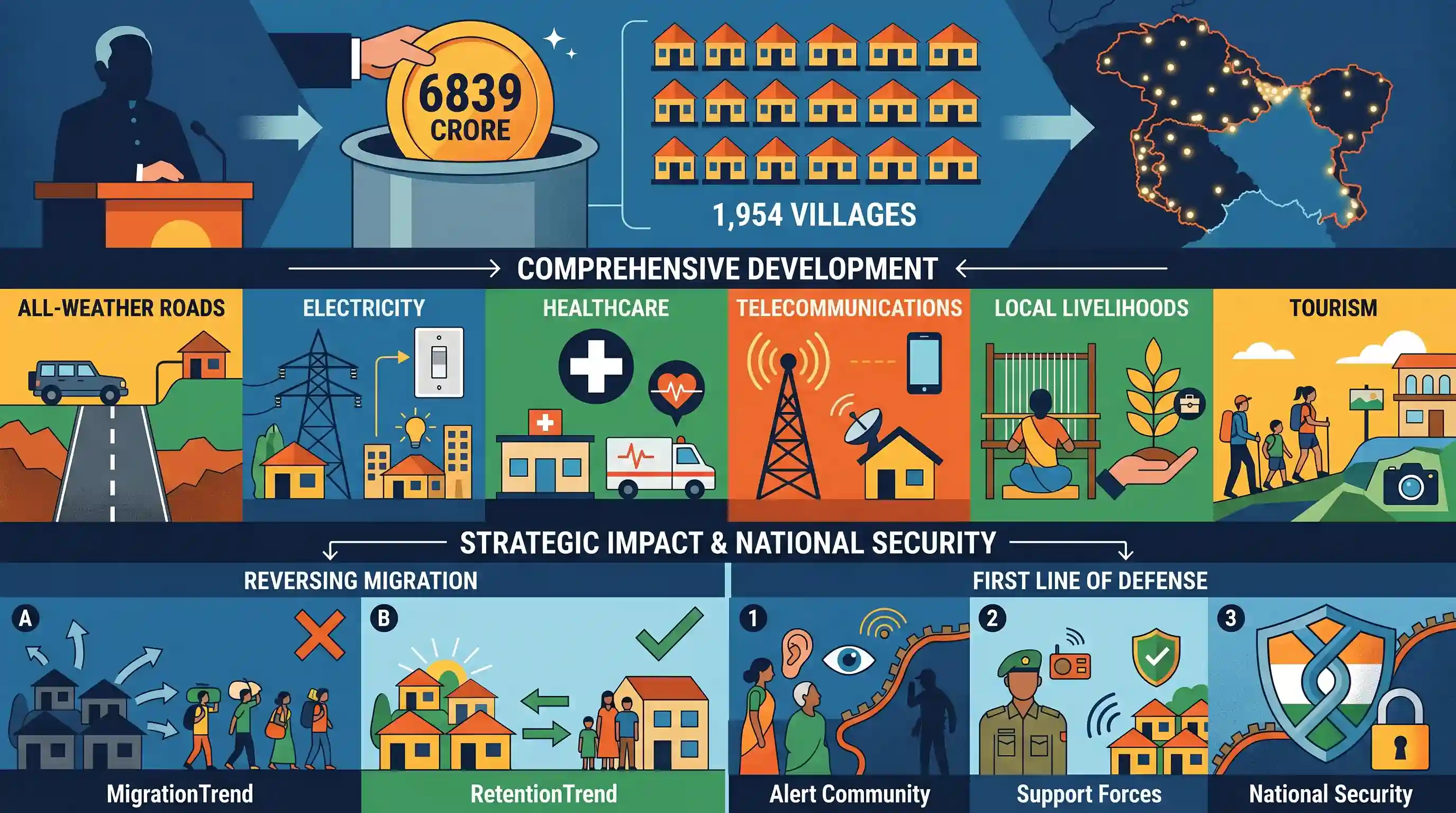
Union Home Minister Amit Shah announced the second phase of the Vibrant Villages Programme (VVP) in Assam, with an allocation of Rs 6,839 crore aimed at upgrading 1,954 border villages. The initiative focuses on the comprehensive development of these remote settlements by providing essential infrastructure such as all-weather roads, electricity, healthcare, and telecommunications. A key strategic goal of VVP is to reverse the trend of out-migration by improving local livelihoods, thereby ensuring that these villages remain populated. Retaining civilian populations in border regions is considered crucial for national security, as these communities act as an effective 'first line of defense' and support border guarding forces.
Key Points
- Union Home Minister Amit Shah announced the launch of Vibrant Villages Programme Phase 2 in Assam, allocating Rs 6,839 crore.
- The funds will be utilized to comprehensively upgrade infrastructure and amenities in 1,954 border villages.
- The strategic objective of the scheme is to arrest out-migration from remote border areas by improving the quality of life and creating economic opportunities.
- Populated border villages are envisioned as India's 'first line of defense' to enhance intelligence gathering and border security along challenging terrains.
- This push complements existing border infrastructure management initiatives, acting as a counter to infrastructural developments by adversaries across the frontier.
Important Terms
Vibrant Villages Programme (VVP)

A central initiative for the holistic development of villages along India's international borders, focusing on infrastructure, livelihoods, and reversing out-migration to strengthen national security.
UPSC context
GS Paper II (Govt. Policies) & III (Security). Tests understanding of strategic rural development and border-management convergence.
First Line of Defence
A strategic concept where border residents serve as the 'eyes and ears' for security forces, providing vital ground-level intelligence and situational awareness in remote frontier regions.
UPSC context
GS Paper III (Internal Security). Focuses on the civilian role in national security and deterring territorial incursions.
Out-migration
The socio-economic trend of residents leaving remote border areas for urban centers, which creates a 'security vacuum' and demographic shifts that can be exploited by adversaries.
UPSC context
GS Paper III (Internal Security). Tests analysis of how socio-economic deficits lead to security vulnerabilities in border regions.
Border Management
A comprehensive security function aimed at securing frontiers, regulating the movement of goods and people, and addressing socio-economic gaps to prevent infiltration, smuggling, and insurgency.
UPSC context
GS Paper III (Internal Security). A core syllabus topic examining challenges and institutional frameworks for protecting international borders.
Border Area Development Programme (BADP)
A long-standing scheme (launched 1986-87) to fill infrastructure gaps in border blocks. VVP is more targeted, focusing on the specific intensive development of strategic villages.
UPSC context
GS Paper II & III. Useful for comparative analysis of legacy vs. modern targeted developmental schemes in border areas.
Central Sector Scheme
Schemes 100% funded by the Union Government and implemented by central agencies. VVP Phase II follows this model, ensuring direct central control and financial backing.
UPSC context
GS Paper II (Governance). Differentiates between funding mechanisms (Central Sector vs. Centrally Sponsored) in administrative governance.
Prelims Trap
Vibrant Villages Programme is a Centrally Sponsored Scheme restricted only to villages along the Indo-China border.
VVP is actually a Central Sector Scheme (100% central funding). Furthermore, while Phase I was limited to the Northern border, Phase II covers all international land borders.
Static Concepts Connected
How does VVP differ from the older Border Area Development Programme (BADP)?
- Funding Pattern: BADP is Centrally Sponsored (60:40 or 90:10 ratio), whereas VVP is a Central Sector Scheme with 100% funding from the Union Government.
- Targeted Scope: BADP covers block-level infrastructure broadly. VVP identifies specific remote strategic villages for comprehensive 'saturation-level' development.
- Strategic Objective: VVP explicitly targets the reversal of out-migration by promoting local economic drivers like border tourism and heritage promotion, unlike BADP's pure infrastructure focus.
Why are civilian populations critical for border security strategy?
- Eyes and Ears: Local residents act as the primary intelligence gatherers against illegal incursions, smuggling, and militant infiltration in difficult terrains.
- Sovereignty Markers: Civilian settlements solidify a nation's territorial claims, creating a natural defense against adversarial 'salami-slicing' border tactics.
- Logistical Backbone: Familiarity with extreme terrain allows locals to provide invaluable logistical support, guidance, and porter services to border guarding forces.
Cross-Topic Patterns
The 'Model Village' Geopolitical Race
India’s VVP directly mirrors and counters China's dual-use 'Xiaokang' (prosperous) border villages in Tibet, elevating civilian border settlements from a welfare issue to a hard-power geopolitical tool.
Infrastructure Convergence at Borders
VVP abandons isolated implementation by converging with schemes like PMGSY-IV for all-weather roads, seamlessly linking rural governance with strategic military mobility requirements.

VVP-II's expansion to all land borders and 100% central funding makes it a high-probability multi-statement prelims question in 2026.
Linked PYQs · 3
Linked PYQs · 3
- 2024MainsGS3
India has a long and troubled border with China and Pakistan fraught with contentious issues. Examine the conflicting issues and security challenges along the border. Also give out the development being undertaken in these areas under the Border Area Development Programme (BADP) and Border Infrastructure and Management (BIM) Scheme.
- 2020MainsGS3
For effective border area management, discuss the steps required to be taken to deny local support to militants and also suggest ways to manage favourable perception among locals.
- 2016MainsGS3
Border management is a complex task due to difficult terrain and hostile relations with some countries. Elucidate the challenges and strategies for effective border management.
