Vetlapalem firecracker blast and informal sector safety violations
Source:The Hindu ↗
Why It Matters
This incident serves as a crucial case study for UPSC aspirants on industrial safety compliance, the occupational hazards faced by unorganized sector workers, and the shift required from reactive to proactive disaster management. It demonstrates the real-world detriments of unregulated informalization in manufacturing.
Summary
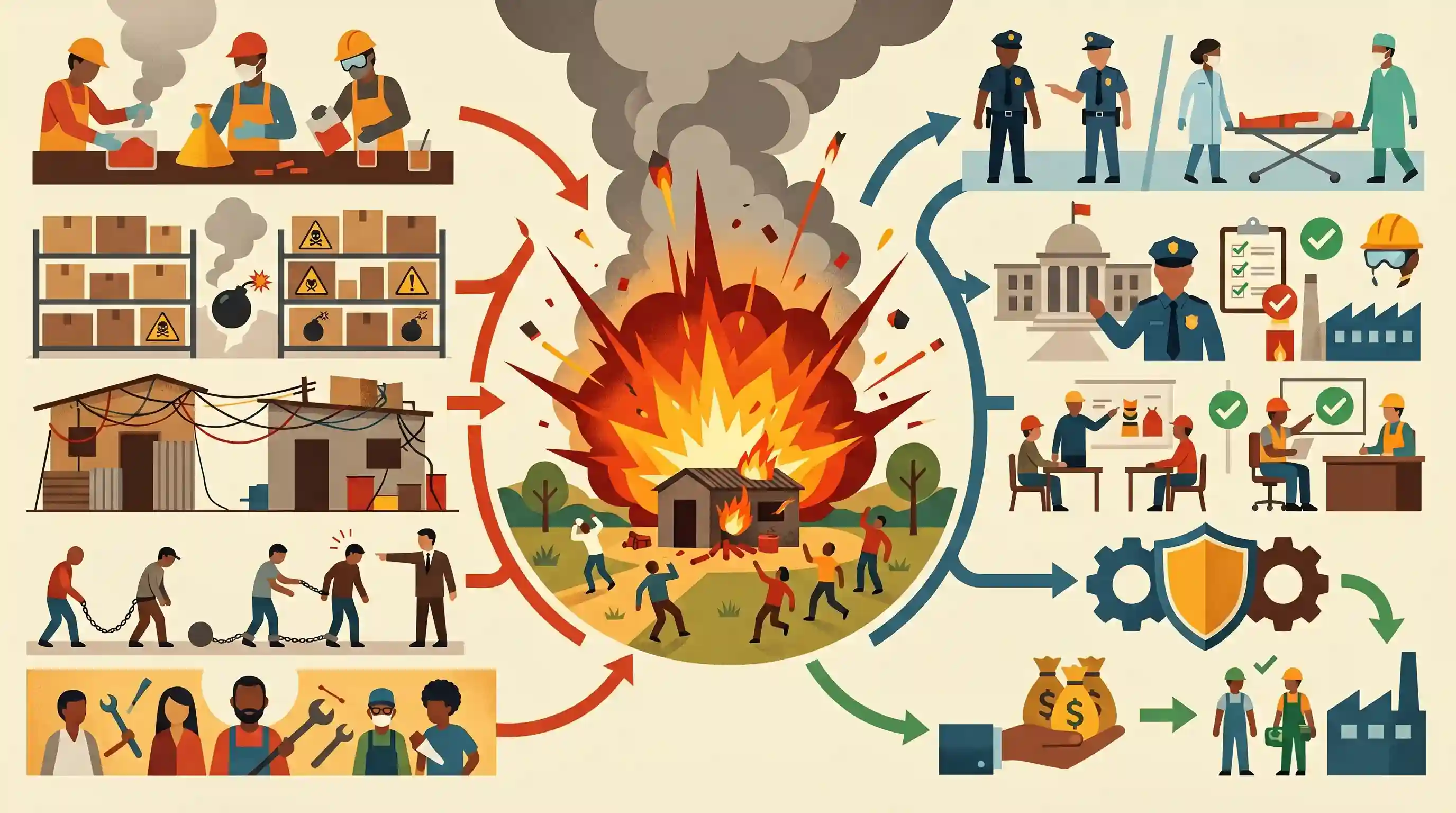
The explosion at a firecracker unit in Vetlapalem, Andhra Pradesh, which killed at least 20 workers, underscores systemic failures in industrial safety and occupational hazard management within the unorganized sector. The tragedy reveals severe non-compliance with safety protocols, improper storage of explosives, and the employment of unskilled, vulnerable workers in highly hazardous conditions without adequate protections. Such recurrent industrial accidents highlight the urgent need for a proactive regulatory framework and strict enforcement of occupational health and safety standards in the informal economy, moving beyond reactive compensation models.
Key Points
- An explosion at a firecracker manufacturing unit in Vetlapalem, Andhra Pradesh claimed 20 lives, exposing severe regulatory lapses in industrial safety.
- The incident highlights chronic industry issues such as the non-adherence to safety protocols, improper storage of explosives, and hazardous working conditions within unscientifically designed thatched sheds.
- It underscores the extreme vulnerability of unorganized sector workers, mostly local women, who undertake high-risk jobs for low wages (₹500-₹1000/day) with minimal training and no social security.
- The state's response—an ex-gratia payment of ₹20 lakh and suspension of officials—reiterates the ongoing reliance on reactive disaster management rather than proactive enforcement of occupational safety standards.
Prelims Trap
PESO is a statutory body under the Ministry of Home Affairs or Labour.
PESO is a subordinate office under DPIIT (Ministry of Commerce and Industry), not MHA or Labour, and it administers the Explosives Act 1884.
Static Concepts Connected
What is the mandate of PESO?
- Administrative Control: It is a subordinate office under the DPIIT, Ministry of Commerce and Industry.
- Statutory Role: Administers the Explosives Act 1884 and Petroleum Act 1934 to regulate manufacturing, storage, and transport of hazardous substances.
How does the OSH Code 2020 treat hazardous micro-units?
- General Applicability: Generally, the Code consolidates labour laws and applies to establishments with 10 or more workers.
- Hazardous Exception: The government can mandate safety provisions for hazardous manufacturing units regardless of the number of workers.
Cross-Topic Patterns
Feminisation of hazardous informal work
Explosions in Vetlapalem and Sivakasi consistently reveal the exploitation of vulnerable rural women in piece-rate, highly hazardous MSME roles lacking social security.
Reactive vs Proactive DRM
State reliance on ex-gratia compensation rather than proactive NDMA-mandated hazard zonation highlights systemic implementation failures in industrial disaster mitigation.

PESO's administrative ministry (DPIIT) and the OSH Code's exception for hazardous micro-units are high-probability targets for Prelims 2026.
Linked PYQs · 4
Linked PYQs · 4
- 2019MainsGS3
Vulnerability is an essential element for defining disaster impacts and its threat to people. How and in what ways can vulnerability to disasters be characterized? Discuss different types of vulnerability with reference to disasters.
- 2020MainsGS3
Discuss the recent measures initiated in disaster management by the Government of India departing from the earlier reactive approach.
- 2016MainsGS3
How globalization has led to the reduction of employment in the formal sector of the Indian economy? Is increased informalization detrimental to the development of the country?
- 2023MainsGS3
Faster economic growth requires increased share of the manufacturing sector in GDP, particularly of MSMEs. Comment on the present policies of the Government in this regard.
