Gaganyaan mission and India's human spaceflight program milestones
Source:The Hindu ↗
Why It Matters
India's transition towards a manned space mission is a highly anticipated milestone. This aligns directly with GS-3 Science and Technology syllabus regarding indigenization of technology and awareness in the field of Space. Understanding the integration of international experience (from the ISS) into India's indigenous program (Gaganyaan) is critical for Mains and Prelims.
Summary
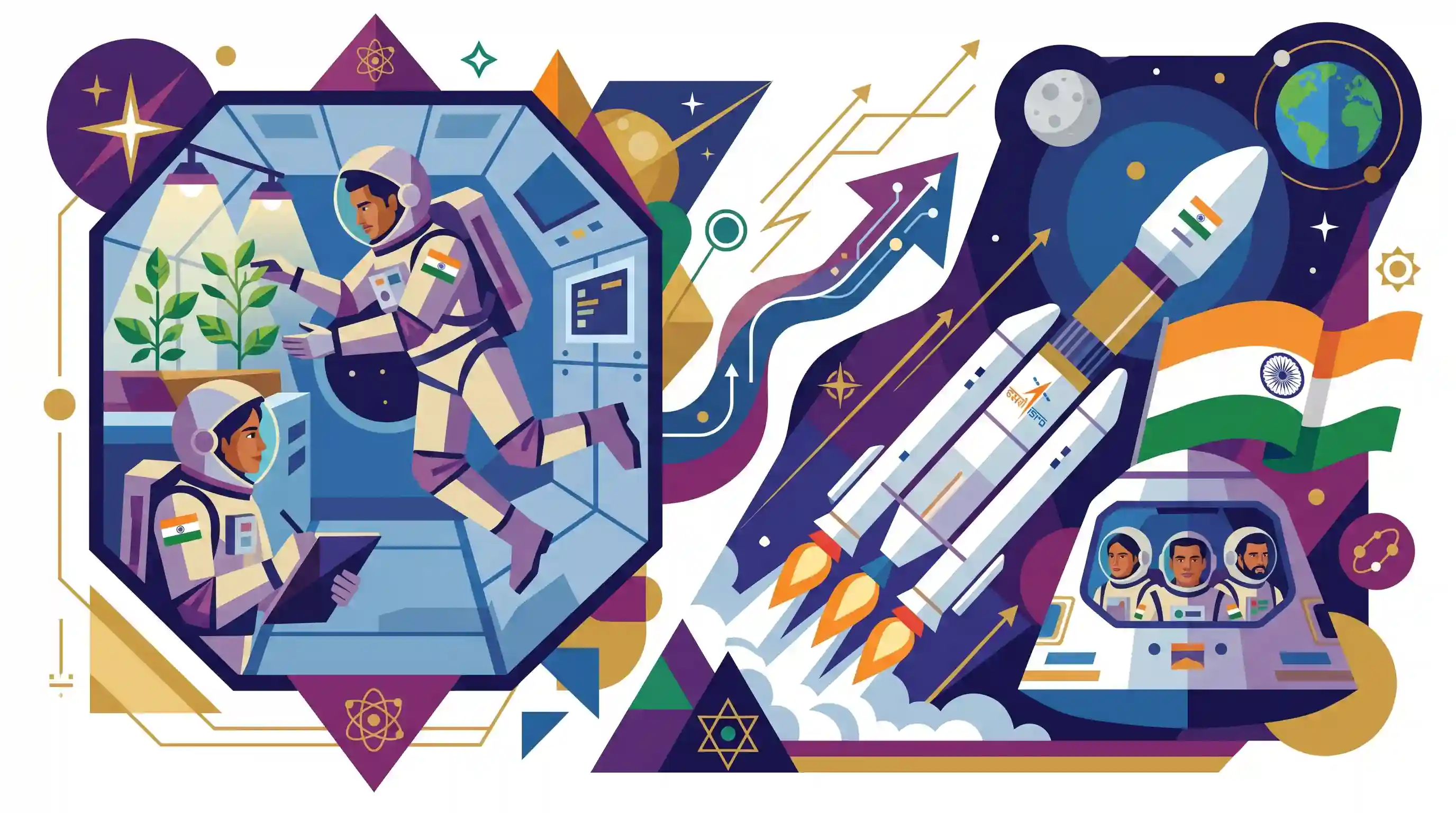
Captain Shubhanshu Shukla, the first Indian to travel to the International Space Station (ISS), has stated that the operational experience and knowledge gained from his mission will be invaluable for ISRO’s upcoming Gaganyaan project. Accompanied by his backup, Group Captain Prashant Balakrishnan Nair, Shukla highlighted their involvement in microgravity experiments on the ISS, such as studying plant adaptation. Shukla expressed confidence that ISRO is close to finalizing the technical milestones needed to launch an Indian into space using an indigenous rocket, a critical leap for India’s human spaceflight capabilities.
Key Points
- Captain Shubhanshu Shukla became the first Indian astronaut to travel to the International Space Station (ISS).
- The data and operational insights gained from this ISS mission will directly benefit ISRO's upcoming Gaganyaan human spaceflight mission.
- Shukla and Group Captain Prashant Balakrishnan Nair discussed their experiences in Houston, emphasizing lessons learned from both Russian and U.S. space agencies.
- During the ISS mission, astronauts conducted critical microgravity experiments, including studying plant adaptation in space.
- ISRO is on the verge of completing all technical aspects of the Gaganyaan mission, which aims to send an Indian to space on an indigenous rocket by mid-2027.
Important Terms
Gaganyaan Mission

India’s first crewed spaceflight program aiming to send a three-member team into a 400-km orbit for three days and return them safely to Earth.
UPSC context
GS Paper III (Science & Tech); tests knowledge of indigenous technology, orbital mechanics, and India’s space milestones.
International Space Station (ISS)
A habitable artificial satellite in low Earth orbit acting as a microgravity laboratory; a collaborative effort between NASA, Roscosmos, JAXA, ESA, and CSA.
UPSC context
GS Paper III (Science & Tech); highlights international cooperation, low Earth orbit (LEO) research, and space-based diplomacy.
Axiom-4 Mission
A 2025 commercial spaceflight to the ISS where Group Captain Shubhanshu Shukla served as pilot, providing India with operational experience for its indigenous human spaceflight.
UPSC context
GS Paper III (Science & Tech); signifies the role of private missions in astronaut training and international knowledge transfer.
Microgravity
The state of appearing weightless in space; used for experiments in medicine and material science that are impossible to conduct under Earth's gravity.
UPSC context
GS Paper III (Science); relates to advancements in biotechnology and material science conducted in space environments.
LVM3 (Launch Vehicle Mark 3)
ISRO’s most powerful rocket (formerly GSLV Mk III), specifically "human-rated" with enhanced safety systems to transport astronauts for the Gaganyaan mission.
UPSC context
GS Paper III (Science & Tech); tests understanding of heavy-lift launch vehicles and the human-rating process for crew safety.
ISRO
The primary national space agency of India, responsible for space research, satellite communication, and developing indigenous human spaceflight capabilities.
UPSC context
GS Paper III (Science & Tech); core agency for questions on space missions, institutional mandates, and technological self-reliance.
Prelims Trap
Shubhanshu Shukla became the first Indian in space by flying on ISRO's indigenous Gaganyaan mission.
He is the first Indian to visit the ISS (via the Axiom-4 mission), but Rakesh Sharma was the first Indian in space (1984). The indigenous Gaganyaan mission has not launched yet.
Static Concepts Connected
What is the technical architecture of ISRO's Gaganyaan mission?
- Launch Vehicle: A modified Launch Vehicle Mark-3 (LVM3) reconfigured as HLVM3 to meet stringent human-rating requirements for safety.
- Orbit Profile: Designed to carry a crew of up to three members to a 400 km Low Earth Orbit (LEO) for a 3-day mission.
- Crew Module & CES: Features a state-of-the-art double-walled Crew Module (CM) and a rapid-response Crew Escape System (CES) for launch aborts.
How does microgravity impact biological systems in space?
- Plant Adaptation: Without gravity, plants rely heavily on other environmental cues like light (phototropism) and moisture to direct root and shoot growth.
- Human Physiology: Prolonged exposure causes muscle atrophy, loss of bone density, fluid shifts towards the upper body, and vision changes.
- Genetic Changes: Provides a unique environment to study altered gene expression and stress responses, impossible to replicate perfectly on Earth.
Cross-Topic Patterns
Private-Public Space Collaborations
The Ax-4 mission exemplifies ISRO's strategic shift to leverage foreign private space entities (Axiom/SpaceX) for rapid crew training, complementing India's broader space commercialization push under IN-SPACe.
Astrobiology & Space Agriculture
Microgravity experiments on plant adaptation (green gram/fenugreek) link space exploration to biotechnology, exploring stress-resistant crop genetics for future space habitats and extreme climate conditions on Earth.

Expect multi-statement Qs contrasting Rakesh Sharma's 1984 Salyut-7 flight with Shukla's Ax-4 ISS mission and the upcoming Gaganyaan.
Linked PYQs · 2
Linked PYQs · 2
- 2017MainsGS3
India has achieved remarkable successes in unmanned space missions including the Chandrayaan and Mars Orbitter Mission, but has not ventured into manned space missions. What are the main obstacles to launching a manned space mission, both in terms of technology and logistics? Examine critically.
- 2025PrelimsGS1
Consider the following space missions : I. Axiom-4 II. SpaDeX III. Gaganyaan How many of the space missions given above encourage and support micro-gravity research?
