Judicial due process and discharge ruling in excise policy case
Source:Indian Express ↗
Why It Matters
It provides a contemporary case study on the friction between central investigating agencies (CBI, ED) and state governments/political opposition, relevant for GS-2 topics on federalism and statutory bodies. Furthermore, it reinforces the GS-2 themes of judicial independence, constitutional morality, and the fundamental rights of undertrials (due process vs. procedure established by law).
Summary
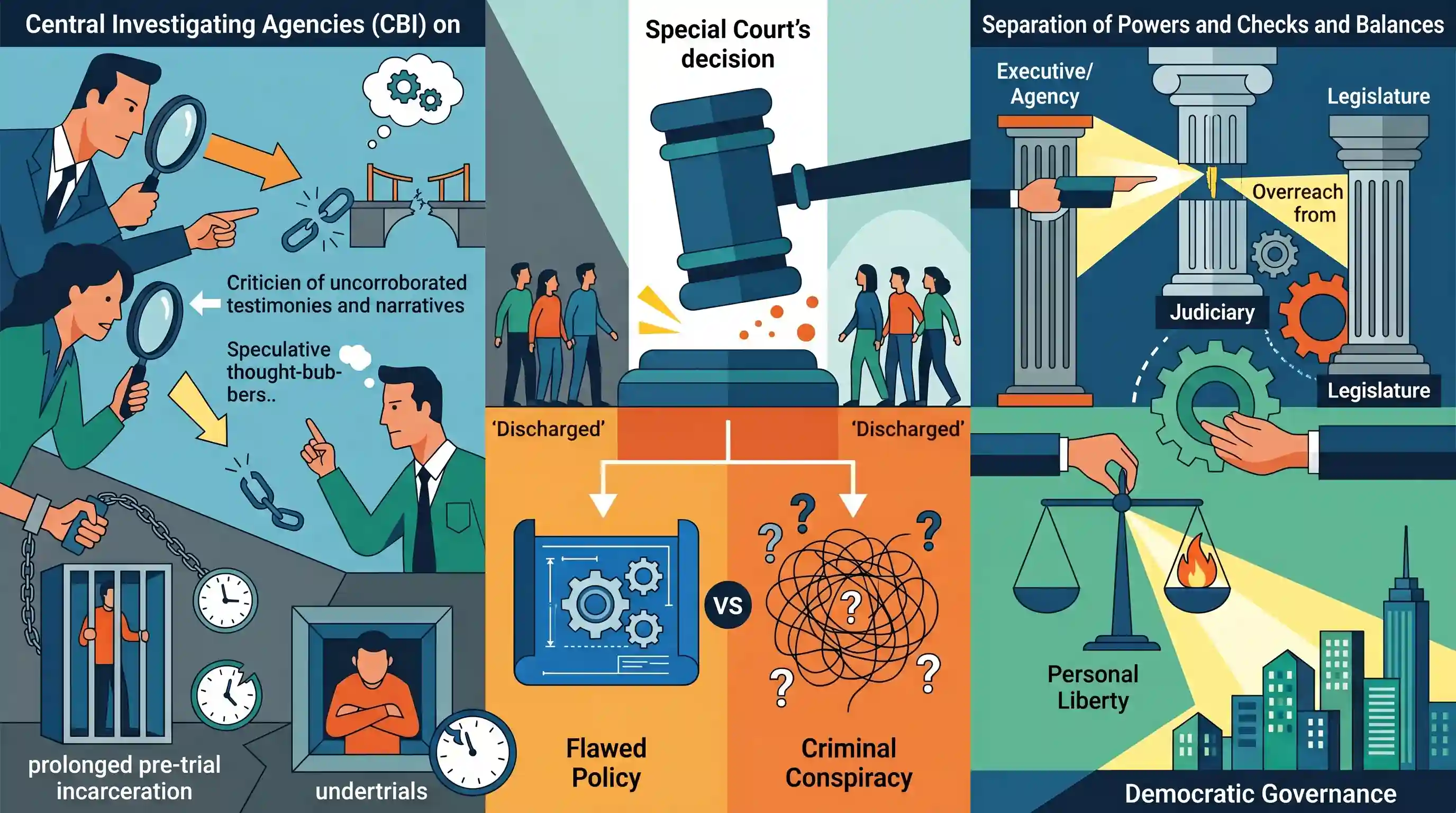
The article analyzes a special court's decision to discharge Arvind Kejriwal, Manish Sisodia, and 21 others in the CBI's Delhi excise policy case. The ruling reinforces the sanctity of due process, clarifying that a flawed policy is not synonymous with a criminal conspiracy. The court strongly criticized the CBI's methodology, particularly its reliance on uncorroborated approver testimonies and speculative narratives. The verdict serves as a critical commentary on the weaponization of central agencies against political opponents and the dangers of prolonged pre-trial incarceration. It ultimately underscores the indispensability of judicial independence and constitutional checks and balances in safeguarding personal liberty and democratic governance.
Key Points
- A special court discharged Delhi CM Arvind Kejriwal, Manish Sisodia, and others in the CBI's Delhi excise policy case, affirming that a failed policy does not inherently prove a criminal conspiracy.
- The court criticized the CBI's reliance on approver statements without independent corroboration and rejected speculative arguments like "region-based labelling" (e.g., the 'South Group').
- The verdict highlights the constitutional danger of weaponizing central investigating agencies to target political opponents and criminalize governance decisions.
- The case underscores the fundamental principle of due process, warning that prolonged pre-trial incarceration on untested allegations becomes punitive.
- The ruling serves as a vital example of judicial independence and the trial court's role in upholding democratic checks and balances against executive overreach.
Important Terms
Delhi Excise Policy 2021-22

A 2021-22 policy aimed at privatizing Delhi's liquor trade, later scrapped after allegations of corruption and procedural violations led to central agency probes.
UPSC context
GS Paper II (Executive/Governance); examines policy-making vs. criminal conspiracy and administrative accountability.
Central Bureau of Investigation (CBI)
India's premier federal investigating agency, tasked with probing high-profile corruption, economic offenses, and complex crimes under the Delhi Special Police Establishment Act.
UPSC context
GS Paper II (Statutory/Regulatory Bodies); tests knowledge of agency autonomy and its role in federal investigations.
Enforcement Directorate (ED)
A financial investigation agency under the Ministry of Finance responsible for enforcing the Prevention of Money Laundering Act (PMLA) and foreign exchange laws.
UPSC context
GS Paper III (Internal Security); tests understanding of money laundering and the powers of specialized agencies.
Due Process of Law
A constitutional doctrine requiring that laws and legal proceedings be fair, just, and non-arbitrary, interpreted into Article 21 following the Maneka Gandhi case.
UPSC context
GS Paper II (Constitution); essential for topics on fundamental rights and the protection of personal liberty.
Rouse Avenue Court
A specialized court complex in New Delhi designated to handle high-profile corruption cases and criminal proceedings involving Members of Parliament (MPs) and MLAs.
UPSC context
GS Paper II (Judiciary); relevant for judicial specialization and the "speedy trial" mandate for elected representatives.
Approver
An accomplice granted a judicial pardon under the criminal code (Section 306 CrPC/BNSS) in exchange for a full disclosure to secure convictions against others.
UPSC context
GS Paper II (Criminal Justice); tests understanding of evidence law and the reliability of state-witness testimony.
Discharge
A judicial order releasing an accused before the trial begins, based on the finding that the evidence is insufficient to even frame formal charges.
UPSC context
GS Paper II (Criminal Justice Reform); differentiates pre-trial relief from post-trial acquittal in the Indian legal system.
Prelims Trap
Pardoning an accomplice to make them an approver is an exercise of the President's constitutional pardoning power.
An approver's pardon is a statutory judicial function under the BNSS (formerly CrPC) granted by a magistrate, distinct from the President's executive clemency under Article 72.
Static Concepts Connected
What is the legal validity of an 'approver's' testimony in Indian law?
- Competent witness: An accomplice is legally competent to testify, but evidentiary rules require corroboration in material particulars to prevent convictions based solely on untested statements.
- Statutory pardon: A magistrate grants a pardon during inquiry or trial to secure vital evidence, a procedure now governed under the BNSS (formerly Section 306 CrPC).
How does the CBI derive its legal authority and jurisdiction?
- DSPE Act 1946: The CBI is not a statutory body; it draws its investigating powers from the Delhi Special Police Establishment (DSPE) Act, 1946.
- State consent: Under Section 6 of the DSPE Act, the CBI requires either general or specific consent from state governments to operate within their territorial jurisdiction.
Cross-Topic Patterns
Bail jurisprudence and Article 21
The judiciary repeatedly ties prolonged undertrial detention to Article 21 violations, using constitutional guarantees to override restrictive statutory bail conditions in exceptional cases.
Central Agencies and Federal Friction
Alleged weaponization of central agencies frequently prompts states to withdraw 'general consent', converting criminal administrative investigations into a core center-state federalism dispute.

Expect a Mains question linking prolonged pre-trial incarceration under special laws to Article 21 and the necessity of judicial checks.
Linked PYQs · 4
Linked PYQs · 4
- 2023PrelimsGS1
In essence, what does 'Due Process of Law' mean?
- 2021MainsGS2
The jurisdiction of the Central Bureau of Investigation (CBI) regarding lodging an FIR and conducting probe within a particular State is being questioned by various States. However, the power of the States to withhold consent to the CBI is not absolute. Explain with special reference to the federal character of India.
- 2019MainsGS2
Do you think that Constitution of India does not accept principle of strict separation of powers rather it is based on the principle of 'checks and balance'? Explain.
- 2023MainsGS2
“Constitutionally guaranteed judicial independence is a prerequisite of democracy.” Comment.
