India and Venezuela bilateral ties and energy security cooperation
Source:The Hindu ↗
Why It Matters
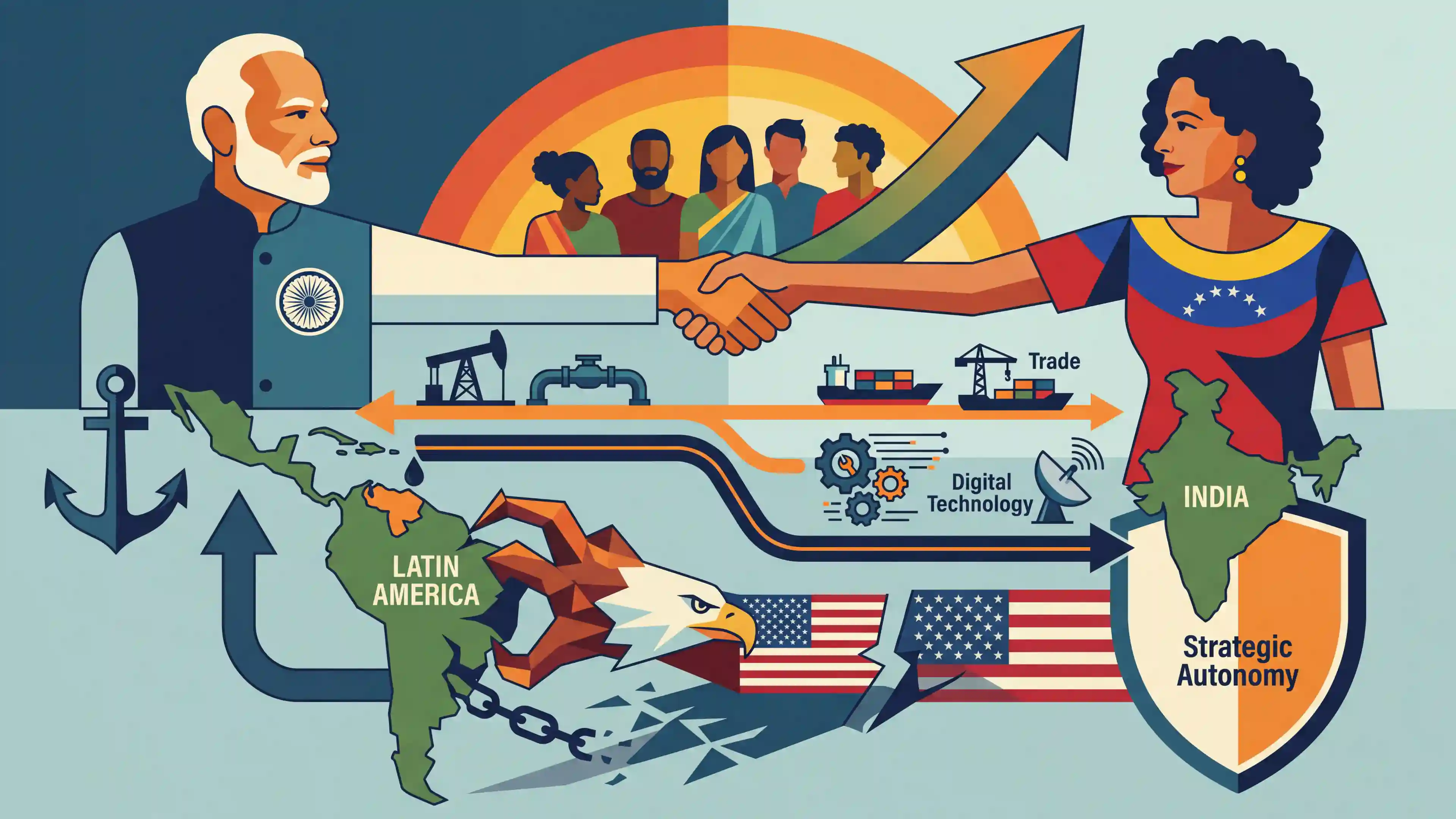
This development is highly relevant for GS2 (International Relations) as it demonstrates India's pragmatic foreign policy and strategic autonomy. Engaging with Venezuela's interim leadership amidst a controversial US intervention allows India to pursue its energy security needs—given Venezuela's massive oil reserves—while solidifying its position as an independent leader of the Global South.
Summary
The article details a significant diplomatic engagement between Indian Prime Minister Narendra Modi and Venezuela's acting President Delcy Rodriguez. The leaders committed to deepening their bilateral partnership across multiple sectors, including energy, trade, and digital technology, while reaffirming their dedication to advancing the interests of the Global South. This conversation marks India's first high-level communication with Venezuela since US forces captured President Nicolas Maduro in early January 2026. By engaging with Rodriguez—who recently introduced reforms to liberalize Venezuela's oil industry—India highlights its independent foreign policy, aiming to secure vital energy resources while maintaining strategic autonomy amidst aggressive US geopolitical maneuvers in Latin America.
Key Points
- PM Narendra Modi held a telephonic conversation with Venezuela's acting President Delcy Rodriguez to enhance India-Venezuela bilateral relations.
- The leaders agreed to strengthen ties in trade, investment, energy, digital technology, health, and agriculture, while emphasizing mutual cooperation for the Global South.
- The engagement assumes geopolitical significance as it follows the controversial capture of Venezuelan President Nicolas Maduro by US forces in early January 2026.
- Following Maduro's capture, Delcy Rodriguez assumed the interim presidency and has initiated reforms in Venezuela's oil sector to reduce state control and attract foreign investments.
- India's continued engagement reflects its pursuit of strategic autonomy, balancing its ties with the US while securing crucial energy interests in Latin America.
Prelims Trap
Venezuela is currently the world's largest producer and exporter of crude oil.
Venezuela holds the world's largest proven reserves, but due to sanctions and underinvestment, it is far from being the largest producer or exporter.
Static Concepts Connected
What is 'Equity Oil' and how does it aid India's energy security?
- Equity Oil: The share of oil produced from international geographic blocks where Indian state-owned or private companies hold a direct ownership stake.
- Implementing Agency: ONGC Videsh Limited (OVL) is the primary nodal agency for acquiring overseas upstream energy assets, helping buffer India against global supply shocks.
- Sanctions Impact: Investments in nations like Venezuela often face repatriation hurdles due to US sanctions. Local sector reforms allow India to unlock these stranded assets.
What defines the doctrine of 'Strategic Autonomy' in India's Foreign Policy?
- Independent Decision-Making: Retaining the sovereign right to pursue partnerships based strictly on national interest, rejecting bloc politics or external dictates (e.g., balancing US ties with Venezuela).
- Multi-Alignment: Moving away from rigid Non-Alignment towards multi-alignment, maximizing geopolitical leverage and securing resources without being constrained by formal military alliances.
Cross-Topic Patterns
Energy Security & Rupee Trade
Engaging sanctioned oil-rich regimes historically forces India to innovate alternative payment mechanisms, linking directly to the RBI's push for Rupee-based trade settlements and bypassing SWIFT.
US Hegemony vs Global South
The US intervention in Venezuela highlights unilateralism, validating India's push to act as the primary voice for equitable, multipolar governance and strategic autonomy via the Global South framework.

Expect a 2026 Prelims question contrasting top oil reserves (Venezuela) vs top producers, alongside ONGC Videsh's equity oil investments.
Linked PYQs · 3
Linked PYQs · 3
- 2017MainsGS2
The question of India's Energy Security constitutes the most important part of India's economic progress. Analyze India's energy policy cooperation with West Asian countries.
- 2025MainsGS2
"Energy security constitutes the dominant kingpin of India's foreign policy, and is linked with India's overarching influence in Middle Eastern countries.” How would you integrate energy security with India's foreign policy trajectories in the coming years?
- 2025MainsGS2
"With the waning of globalization, post-Cold War world is becoming a site of sovereign nationalism.” Elucidate.
