US Monroe Doctrine Shift Impacts Global Energy Security
Source:Indian Express ↗
Why It Matters
Understanding shifts in US foreign policy, especially regarding resource-rich nations like Venezuela, is critical for grasping global geopolitical dynamics. For UPSC aspirants, this highlights the intersection of international relations and energy security, illustrating how US sanctions can test India's strategic autonomy and energy supply chains.
Summary
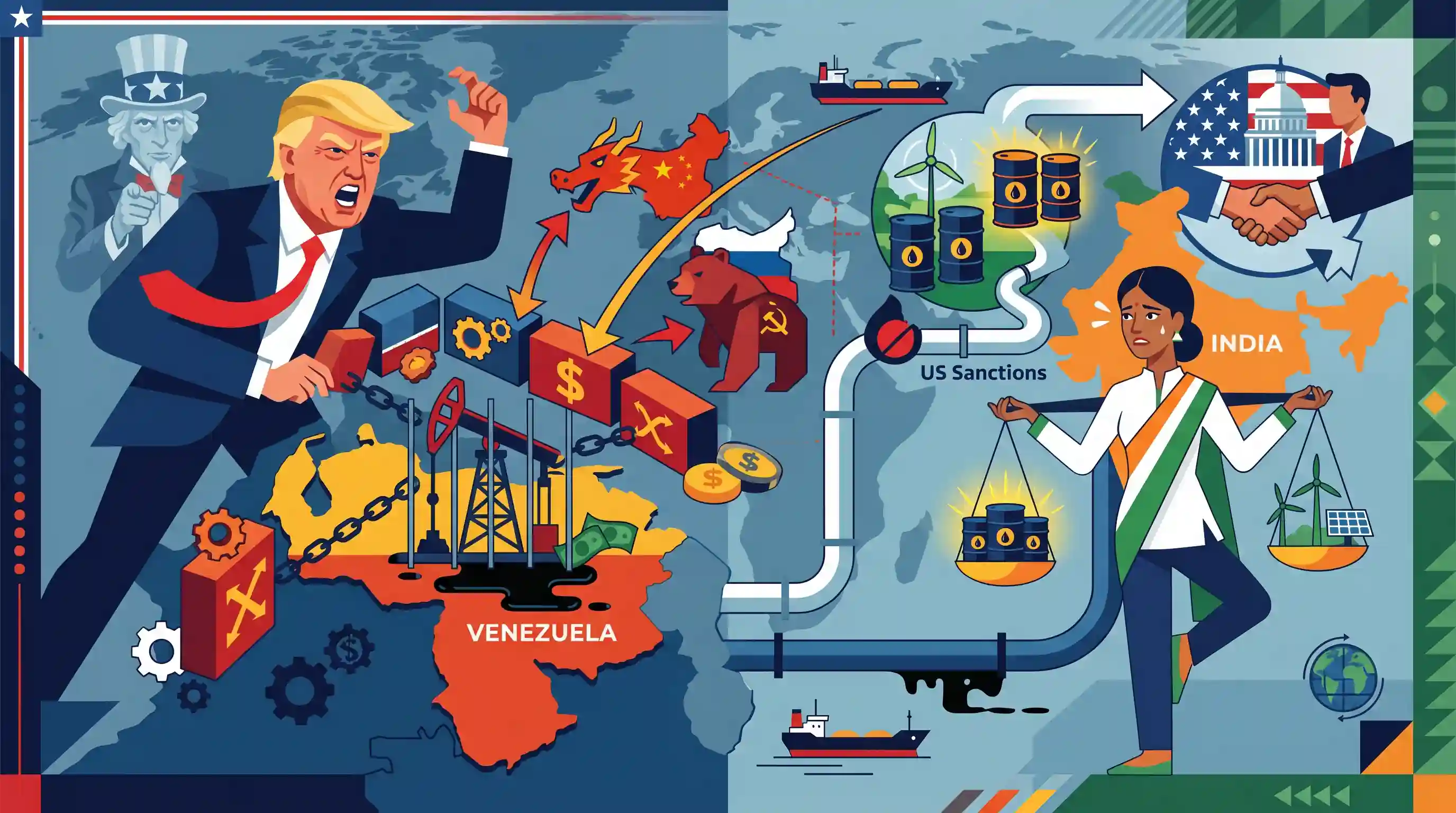
The article analyzes the evolution of the United States' strategy towards Venezuela, contrasting the traditional Monroe Doctrine with Donald Trump's transactional and aggressive 'Donroe' approach aimed at Nicolas Maduro's regime. It highlights the geopolitical consequences of this policy, particularly the use of stringent economic sanctions to isolate Venezuela and counter the influence of rival powers like China and Russia in Latin America. For India, these developments are of vital strategic interest, as US sanctions on Venezuelan oil directly impact India's energy security and complicate its foreign policy balancing act between maintaining strong ties with Washington and securing affordable energy imports.
Key Points
- The article explores the shift in US policy towards Latin America, specifically Venezuela, characterizing the transition from the historical Monroe Doctrine to a personalized 'Donroe' strategy under Donald Trump.
- Trump's approach towards Venezuelan President Nicolas Maduro heavily relies on economic sanctions and transactional diplomacy to curtail external influence (like that of Russia and China) in the Western Hemisphere.
- US sanctions on Venezuela's oil sector have significant repercussions for global energy markets, affecting major oil importers.
- For India, the US-Venezuela dynamic is crucial due to its implications for energy security; past US sanctions forced India to halt its import of heavy Venezuelan crude, necessitating a delicate diplomatic balancing act.
Important Terms
Monroe Doctrine

A 1823 US policy asserting that any intervention by external powers in the politics of the Americas is a potentially hostile act. It established the Western Hemisphere as a US sphere of influence.
UPSC context
GS-2: International Relations. Explains historical roots of US interventionism and its evolution into modern doctrines like the 'Donroe' strategy.
Organization of the Petroleum Exporting Countries (OPEC)
An intergovernmental organization of 12 oil-exporting nations that coordinates petroleum policies to stabilize markets. Founding members include Iran, Iraq, Kuwait, Saudi Arabia, and Venezuela.
UPSC context
GS-2: IR/GS-3: Economy. Essential for understanding global oil pricing, energy markets, and India's significant import dependencies.
Energy Security
The uninterrupted availability of energy sources at an affordable price. For India, it involves diversifying suppliers, building strategic reserves, and managing geopolitical risks like US sanctions on major oil producers.
UPSC context
GS-3: Economy/Energy. Analyzes how global conflicts and sanctions impact India's fiscal deficit, inflation, and development goals.
Donroe Doctrine
A 21st-century interpretation of the Monroe Doctrine attributed to Donald Trump, characterized by aggressive unilateralism, military interventionism, and a 'take the oil' transactional approach to reasserting US dominance.
UPSC context
GS-2: International Relations. Represents a contemporary shift in US foreign policy toward hard power and its challenges to international norms.
Economic Sanctions
Commercial and financial penalties applied against a state or group to influence behavior. US sanctions on Venezuela include oil export bans and asset freezes, impacting third-party investors like India.
UPSC context
GS-2: International Relations. Tests understanding of non-military coercion tools and their 'secondary' impacts on India’s strategic autonomy.
Prelims Trap
"Venezuela is the world's largest producer and exporter of crude oil."
Venezuela holds the world's largest *proven reserves* of crude oil, but its actual *production* is low due to US sanctions and domestic infrastructure collapse.
Static Concepts Connected
Why do Indian refineries prefer Venezuelan heavy crude oil?
- High complexity: Indian private refineries (like those in Jamnagar) possess very high Nelson Complexity Indices, allowing them to effectively process cheap, heavy, and sour crude.
- Higher margins: Processing heavily discounted, low-grade crude into high-value distillates (like diesel and aviation fuel) yields superior Gross Refining Margins (GRMs).
- Energy diversification: Sourcing heavy crude from Latin America helps India reduce its over-reliance on Middle Eastern oil, balancing geopolitical supply risks.
What is the Monroe Doctrine (1823)?
- US Hegemony: A foundational US policy asserting the Western Hemisphere (the Americas) as the United States' exclusive sphere of influence.
- Anti-Interventionist: It originally warned European colonial powers against further colonization or political intervention in Latin America.
- Modern relevance: Today, it is implicitly invoked by Washington to counter the growing strategic footprint of rival powers like China and Russia in South America.
Cross-Topic Patterns
Extraterritorial sanctions vs. Strategic Autonomy
India's past compliance with US sanctions on Venezuelan/Iranian oil contrasts sharply with its current defiance regarding Russian oil, illustrating the evolution of India's strategic autonomy in securing energy imports.
Geopolitics of the Orinoco Belt to Jamnagar
Links physical geography to industrial location: Venezuela’s heavy, sour crude from the Orinoco Belt perfectly matches the capital-intensive, high-complexity infrastructure of India’s private west-coast refineries.

Expect a 2026 Prelims pair-matching Q on global oil regions (Orinoco, Permian) and a Mains Q on India's energy diplomacy under sanctions.
Linked PYQs · 4
Linked PYQs · 4
- 2019MainsGS2
‘What introduces friction into the ties between India and the United States is that Washington is still unable to find for India a position in its global strategy, which would satisfy India's national self-esteem and ambitions.’ Explain with suitable examples.
- 2012MainsGS2
How have the US sanctions against Iran affected India's bilateral relations with Iran?
- 2025MainsGS2
"Energy security constitutes the dominant kingpin of India's foreign policy, and is linked with India's overarching influence in Middle Eastern countries.” How would you integrate energy security with India's foreign policy trajectories in the coming years?
- 2025PrelimsGS1
Consider the following countries : I. Bolivia II. Brazil III. Colombia IV. Ecuador V. Paraguay VI. Venezuela Andes mountains pass through how many of the above countries?
