Venezuela Political Prisoners Release Amidst Geopolitical Transitions
Source:The Hindu ↗
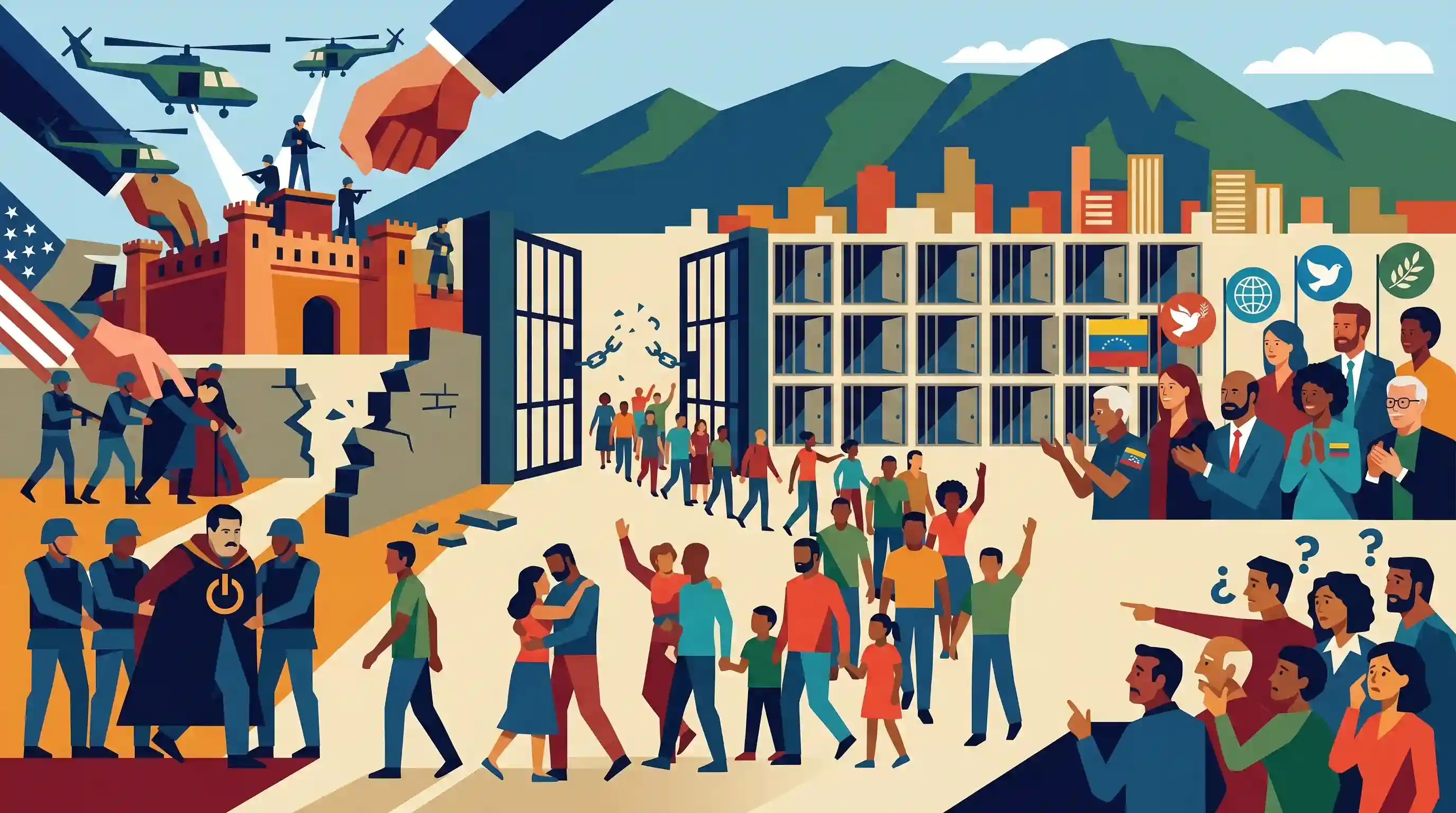
Why It Matters
The unprecedented U.S. raid resulting in the seizure of a foreign head of state highlights drastic contemporary methods of regime change and challenges fundamental principles of state sovereignty in international law. Furthermore, the mass release of political prisoners underlines the critical role of human rights frameworks and civil liberties amidst geopolitical transitions in Latin America.
Summary
Venezuela's government announced the release of 116 political prisoners who were incarcerated under former President Nicolas Maduro. This development follows a dramatic raid on Caracas by U.S. forces, which resulted in the seizure of Maduro. The government cited that the released detainees had been previously imprisoned for acts related to disrupting the constitutional order. The move answers longstanding demands from international bodies and human rights organizations, although some opposition groups dispute the official number of those actually freed.
Key Points
- The Venezuelan government announced the release of 116 political prisoners jailed during the administration of Nicolas Maduro.
- The mass release comes in the aftermath of U.S. forces raiding Caracas and seizing Nicolas Maduro.
- The Ministry of the Penitentiary Service noted the freed individuals had been held for allegedly disrupting constitutional order and undermining state stability.
- While human rights groups and opposition leaders have long demanded these releases, they claim the actual number of freed prisoners is lower than the official figure of 116.
Important Terms
Political Prisoners

Individuals detained for their political beliefs, activism, or dissent rather than for standard criminal offenses, often without due process or fair trials.
UPSC context
GS Paper II: Central to human rights, civil liberties, and international monitoring of democratic health in sovereign states.
Ministry of the Penitentiary Service
A Venezuelan executive body (MPPSP) responsible for the administration of prisons, inmate welfare, and the execution of judicial or executive release orders.
UPSC context
GS Paper II: Relevant for understanding foreign administrative structures and their role in human rights and judicial governance.
Constitutional Order
The legal and institutional framework established by a nation's constitution; its disruption is often used as a legal justification for detaining dissidents.
UPSC context
GS Paper II: Fundamental to Indian and global polity; relates to constitutionalism, the rule of law, and state security.
State Sovereignty
The principle that a state has supreme authority over its internal affairs and territory, free from external interference or military intervention.
UPSC context
GS Paper II: Crucial for International Relations, particularly regarding unilateral foreign interventions and the UN Charter's non-interference mandate.
U.S. Forces (Military Intervention)
The deployment of U.S. military assets to conduct operations in foreign territories, ranging from raids to regime-change actions, often impacting global geopolitics.
UPSC context
GS Paper II: Important for Geopolitics and IR; tests knowledge of unilateralism, international law, and regional stability.
Foro Penal
A non-governmental organization in Venezuela that monitors detentions and advocates for the rights of those imprisoned for political reasons.
UPSC context
GS Paper II: Significant for the role of Civil Society and NGOs in upholding human rights against state authoritarianism.
Prelims Trap
The UN Charter allows unilateral military intervention by a state to protect human rights or restore democracy.
Article 2(4) of the UN Charter prohibits unilateral use of force. Humanitarian intervention (like R2P) requires UN Security Council authorization; unilateral regime change violates international law.
Static Concepts Connected
What is the Monroe Doctrine and its corollaries?
- 1823 Origin: An 1823 US policy opposing European colonialism in the Americas, declaring the Western Hemisphere effectively closed to further European colonization.
- Roosevelt Corollary: A 1904 assertion (by Theodore Roosevelt) that the US could intervene in Latin American nations as an international police power to stabilize their economic or political affairs.
- Modern Application: Unilateral US military and political interventions in Latin America are often viewed by analysts as modern extensions of this doctrine, treating the region as an exclusive sphere of influence.
How does the UN balance state sovereignty and intervention?
- Article 2(4): The UN Charter strictly prohibits the unilateral use of force against the territorial integrity or political independence of any sovereign state, ensuring non-intervention.
- R2P Doctrine: The Responsibility to Protect (2005) allows intervention for severe human rights violations, but it strictly requires explicit authorization from the UN Security Council to be legal.
Cross-Topic Patterns
Energy security and regime change
Venezuela holds the world's largest proven oil reserves. Unilateral interventions disrupt global crude markets, directly impacting import-dependent economies like India and reshaping OPEC+ geopolitical dynamics.
Unilateralism vs. Multilateralism in IR
Bypassing the UN Security Council for direct military action reflects a growing geopolitical trend of major powers disregarding established international law and multilateral frameworks in favor of unilateralism.

Prelims 2026 may test map locations around Venezuela (Orinoco, Lake Maracaibo) or doctrines of unilateral intervention vs. UN Charter.
Linked PYQs · 2
Linked PYQs · 2
- 2011MainsGS2
The causes and implications of the Jasmine Revolution and its spread are as much economic in nature as they are political." Critically evaluate.
- 2025MainsGS2
"The reform process in the United Nations remains unresolved, because of the delicate imbalance of East and West and entanglement of the USA vs. Russo-Chinese alliance.” Examine and critically evaluate the East-West policy confrontations in this regard.
