Venezuela Releases Political Prisoners Ahead of Amnesty Law
Source:The Hindu ↗
Why It Matters
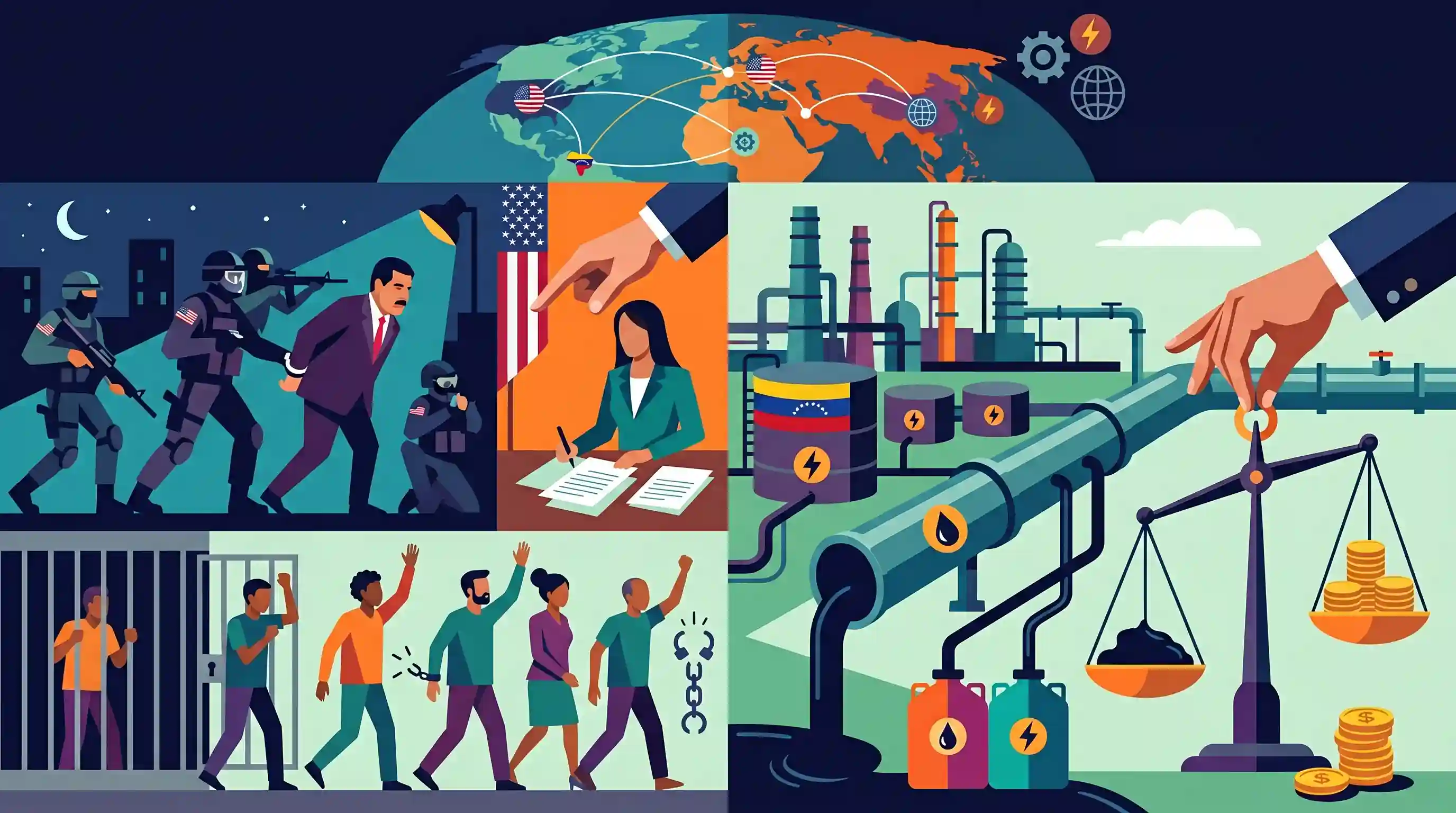
The Venezuelan crisis is a textbook case study of international intervention, regime change, and national sovereignty. The capture of a head of state by foreign forces and subsequent foreign control over domestic oil revenues raise critical questions about international law and geopolitics. For India, which relies heavily on imported oil, shifts in the control of Venezuela's vast oil reserves by the US can directly impact global crude prices and energy security strategies.
Summary
Following a dramatic US special forces raid in January that resulted in the capture of President Nicolas Maduro, Venezuela's political landscape is undergoing significant shifts. Acting President Delcy Rodriguez, operating under strict US directives, has freed 17 political prisoners ahead of a broad amnesty law aimed at clearing dissidents who opposed the Maduro and Chavez regimes over the past 27 years. Concurrently, the United States has assumed control over Venezuela's oil sales, with President Donald Trump demanding a share of the revenue. This scenario highlights profound themes of foreign intervention, human rights, and the geopolitics of global energy security.
Key Points
- Venezuela released 17 political prisoners as a precursor to a planned amnesty law for dissidents.
- The amnesty law aims to clear charges against those who opposed the socialist governments of Nicolas Maduro and Hugo Chavez over the past 27 years.
- Political dissidents in Venezuela were frequently targeted with severe charges like treason, terrorism, conspiracy, and incitement to hate.
- The political transition follows a January 3 raid in Caracas by US special forces that resulted in the capture of former President Nicolas Maduro.
- Acting President Delcy Rodriguez has been permitted to remain in power by US President Donald Trump, provided she complies with US directives.
- The United States has seized control of Venezuela's oil sales, with President Trump asserting that Washington will take a share of the revenue, significantly altering global energy dynamics.
Important Terms
OPEC

An intergovernmental organization of oil-exporting nations that coordinates petroleum policies to ensure market stability. Venezuela is a founding member, holding the world's largest proven oil reserves.
UPSC context
GS Paper II (International Relations) and GS Paper III (Energy Security); tests understanding of global resource cartels.
Monroe Doctrine
A 19th-century US policy opposing external intervention in the Americas, recently invoked to justify unilateral actions (like "Operation Absolute Resolve") to counter rival influence in Venezuela.
UPSC context
GS Paper II (International Relations); relevant for analyzing shifts in global power dynamics and foreign policy doctrines.
Foro Penal
A prominent Venezuelan NGO providing pro bono legal assistance to victims of arbitrary detention and political persecution, tracking "political prisoners" to facilitate international human rights monitoring.
UPSC context
GS Paper II (Governance/Human Rights); highlights the role of civil society in documenting state repression.
Strategic Autonomy
India's foreign policy approach of making independent decisions based on national interest, balancing relationships with major powers (like the US) while securing energy needs from diverse sources.
UPSC context
GS Paper II (India’s Foreign Policy); critical for understanding India's stance on non-interventionism versus pragmatic energy needs.
Amnesty Law
Legal provision granting a general pardon to a group of people for past political offenses, often used during transitions to reconcile with dissidents and restore civil order.
UPSC context
GS Paper II (Polity/Human Rights); tests knowledge of legal instruments used in political reconciliation and transitional justice.
PDVSA
The state-owned oil and natural gas company of Venezuela. It is the primary vehicle for the country's economy and the focus of international sanctions and geopolitical control.
UPSC context
GS Paper III (Economy/Energy); central to the study of state-led resource management and global energy trade.
Energy Security
The continuous and affordable availability of energy sources. In this context, it involves the geopolitical battle over Venezuelan crude and its impact on global supply chains.
UPSC context
GS Paper III (Infrastructure/Energy); crucial for analyzing India’s dependence on crude imports and vulnerability to global shocks.
Prelims Trap
Venezuela is the largest producer and exporter of crude oil in the world.
Aspirants confuse reserves with production. Venezuela holds the world's largest proven reserves, but its actual production has plummeted due to years of sanctions, mismanagement, and infrastructure decay.
Static Concepts Connected
What is the 'Resource Curse' and the associated 'Dutch Disease'?
- Resource Curse: A paradox where countries with abundant natural resources (like oil) experience lower economic growth, higher corruption, and worse development outcomes than resource-poor countries.
- Dutch Disease: A sudden influx of resource export revenues appreciates the national currency, making other tradable sectors (like agriculture and manufacturing) uncompetitive globally.
What is the Monroe Doctrine in US foreign policy?
- Historical Origin: An 1823 doctrine asserting that the Western Hemisphere is the US sphere of influence, warning European powers against colonization or puppet monarchs.
- Modern Application: In contemporary geopolitics, it is often cited as the ideological foundation for unilateral US military interventions, sanctions, and regime changes in Latin America.
Cross-Topic Patterns
Heavy crude and Indian complex refineries
Venezuelan Orinoco oil is extra-heavy and sour. Indian private refineries have high Nelson Complexity Indices, enabling them to process this cheap, difficult crude efficiently when sanctions are lifted.
Transitional justice mechanisms
Amnesty laws link to the broader Ethics and IR topic of transitional justice, similar to truth commissions utilized in post-apartheid South Africa or post-conflict Colombia.

Expect a Prelims statement linking Venezuela's Orinoco Belt to heavy crude, or a Mains question on US sanctions and India's energy security.
Linked PYQs · 2
Linked PYQs · 2
- 2024PrelimsGS1
Consider the following statements : Statement-I : Recently, Venezuela has achieved a rapid recovery from its economic crisis and succeeded in preventing its people from fleeing/emigrating to other countries. Statement-II : Venezuela has the world's largest oil reserves. Which one of the following is correct in respect of the above statements?
- 2011MainsGS2
Write a short note on the success of international intervention in Cote d'Ivoire (Ivory Coast).
